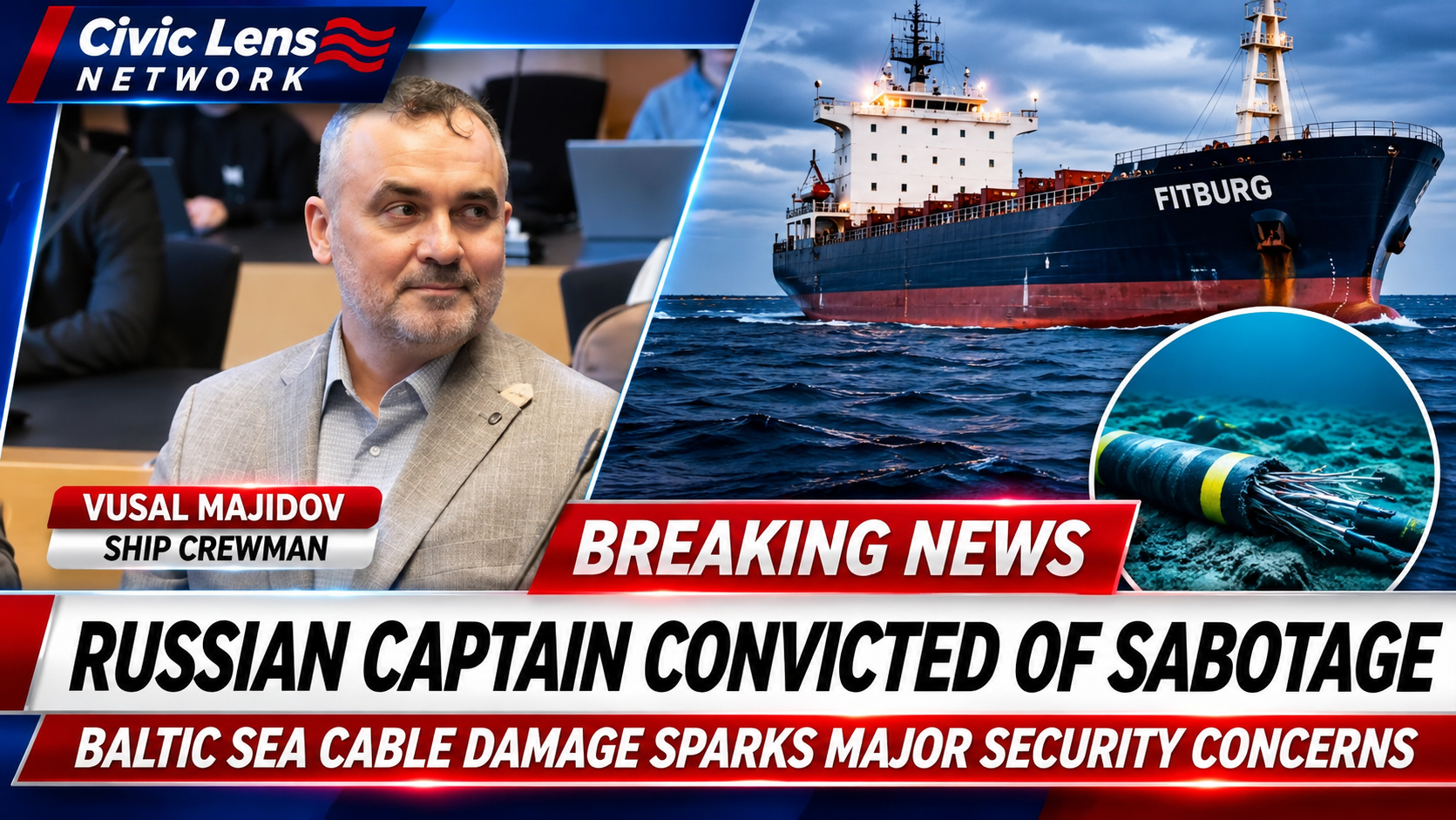
A Finnish court has convicted a Russian ship captain and an Azerbaijani crew member of aggravated sabotage after investigators determined that their cargo vessel dragged an anchor across approximately 80 miles of the Baltic Sea floor, damaging critical underwater communications cables and threatening additional infrastructure connecting European countries.
The ruling marks a significant development in Europe’s growing battle to protect vulnerable undersea infrastructure amid mounting concerns about maritime sabotage, foreign intelligence operations, and threats to NATO member nations.
The Helsinki District Court sentenced Russian captain Andrei Maksimenko to three years and six months in prison. Azerbaijani boatswain Vusal Majidov received a sentence of two years and ten months.
Both men denied committing a crime.
The court concluded that the defendants knowingly allowed the cargo vessel Fitburg to continue traveling while dragging its anchor chain and associated equipment along the seabed.
The incident damaged two underwater telecommunications cables and endangered seven additional communications and electrical cables, along with a natural gas pipeline.
The judgment represents a significant legal finding in a region where repeated damage to underwater infrastructure has raised concerns about deliberate attacks against European communications and energy systems.
An 80-Mile Trail of Destruction Beneath the Baltic Sea
The incident occurred on December 31, 2025, while the cargo vessel Fitburg was traveling from St. Petersburg, Russia, toward Israel.
The ship was registered in St. Vincent and the Grenadines, although its captain was Russian.
According to findings released by the Helsinki District Court, the vessel traveled approximately 130 kilometers, or 80 miles, while dragging its anchor chain and anchor components across the seabed.
The dragging continued for several hours in the Gulf of Finland, an important maritime corridor connecting Finland, Estonia, Russia, and other Baltic Sea nations.
During that journey, the anchor equipment crossed nine underwater telecommunications and electrical cables and one natural gas pipeline.
Two telecommunications cables sustained physical damage.
The remaining seven cables and the pipeline were exposed to the possibility of damage, although investigators did not establish that those structures were destroyed.
Finnish authorities eventually detected the vessel’s unusual activity and contacted its crew.
The anchor was raised only after authorities intervened.
The court determined that the circumstances presented an exceptionally serious danger to essential societal functions.
Investigators Discover Critical Evidence
One of the most important findings involved the ship’s anchor mechanism.
Investigators established that the anchor’s locking equipment was functioning properly when the vessel departed St. Petersburg on December 30, 2025.
The anchor was also confirmed to have been raised when the ship left port.
Evidence showed that the anchor-dragging marks on the seabed extended toward the boundary of Russian territorial waters.
Based on those findings, the court concluded that the anchor had been lowered sometime after the ship departed St. Petersburg but before it left Russian territorial waters.
That conclusion raised a critical question.
How could a commercial cargo vessel travel such an extraordinary distance while dragging heavy anchor equipment without its senior crew recognizing what was happening?
The prosecution did not establish that the captain personally ordered the anchor to be lowered.
Nor did prosecutors claim that the boatswain personally lowered it.
Instead, the court determined that both men must have known the anchor was down while the vessel continued its journey.
The captain was found to have accepted the vessel’s continued movement despite the dragging equipment.
The boatswain was found to have actively contributed to the ship continuing its journey for approximately two hours after Finnish authorities first contacted the crew.
The court also determined that the boatswain failed to fulfill his responsibility to ensure that the anchor was properly secured while the vessel was underway.
These findings formed a central part of the aggravated sabotage convictions.
Finnish Court Rejects Accidental Damage Explanation
The court’s judgment went beyond determining that the vessel had damaged underwater infrastructure.
Judges concluded that the defendants’ actions constituted intentional aggravated sabotage under Finnish criminal law.
The court found that the conduct was intended to cause extensive harm to society and its essential functions.
It also determined that the relatively limited physical damage was attributable to chance rather than an effort by the defendants to prevent further destruction.
The court considered the potential consequences especially serious because the anchor crossed multiple pieces of critical infrastructure.
Underwater telecommunications cables carry information between countries, supporting internet connectivity, business communications, financial services, and other essential activities.
Damage to such systems can create expensive repair requirements and threaten the reliability of international communications networks.
The court’s findings establish criminal responsibility at the district court level.
However, the ruling is not yet final, and the defendants retain the right to appeal.
Russian Captain Receives Longer Prison Sentence
The Helsinki District Court determined that Captain Maksimenko carried greater responsibility because he had overall authority for the ship’s operation, navigation, and safe passage.
He received a sentence of three years and six months.
Boatswain Majidov received two years and ten months.
The court ordered both men taken into custody following the verdict.
Before the ruling, they had been subject to travel restrictions while remaining in Finland.
In addition to the prison sentences, the defendants were ordered to pay compensation for the investigation and repair of the damaged infrastructure.
According to Reuters, the court ordered approximately €1.9 million in joint damages, with the captain responsible for an additional €85,000.
The financial penalties reflect the substantial costs associated with investigating and repairing underwater infrastructure.
The captain intends to appeal the conviction, while the boatswain had not yet decided whether to challenge the judgment.
Why Underwater Cables Are a National Security Concern
The Baltic Sea has become an increasingly important security concern for European governments.
Underwater telecommunications cables and energy pipelines form part of the infrastructure that supports modern economies.
Although these systems are largely invisible to the public, they play an essential role in connecting countries and maintaining international communications.
Commercial shipping routes frequently pass near these cables.
That proximity creates a potential vulnerability because anchors, fishing equipment, and other maritime objects can damage infrastructure resting on or beneath the seabed.
Some cable damage results from accidents.
Other incidents have raised concerns about deliberate interference.
The difficulty for investigators is distinguishing ordinary maritime accidents from intentional sabotage.
Evidence must establish not only how infrastructure was damaged but also whether the people involved acted knowingly or deliberately.
The Fitburg ruling is significant because Finnish judges concluded that the defendants committed aggravated sabotage rather than merely causing accidental damage.
A Growing Pattern of Baltic Sea Incidents
The December 2025 incident was not the first time underwater infrastructure in the Baltic region had suffered suspicious damage.
Since Russia’s full-scale invasion of Ukraine in February 2022, European authorities have investigated several incidents involving damaged telecommunications cables, energy connections, and pipelines.
One prominent case involved the tanker Eagle S, which was suspected of damaging underwater cables in the Gulf of Finland around Christmas 2024.
That case generated major attention because of concerns about vessels operating in waters close to NATO territory.
In October 2025, a Finnish district court initially dismissed the Eagle S case on jurisdictional grounds.
An appeals court later overturned that decision and returned the case for further proceedings.
The differing legal outcomes demonstrate how complicated these investigations can become, particularly when incidents occur outside territorial waters.
Authorities must establish both criminal responsibility and the legal basis for prosecuting conduct occurring at sea.
The Fitburg judgment represents another important development in those efforts.
Was Russia Behind the Sabotage?
The nationality of the ship’s captain and the vessel’s departure from a Russian port have attracted attention because of the wider security situation in Europe.
Western governments have repeatedly warned about suspected Russian-linked sabotage and intelligence activity targeting European infrastructure.
However, an important distinction remains.
The Finnish court convicted two individual crew members of aggravated sabotage.
The judgment did not establish that the Russian government ordered, financed, or coordinated the operation.
No publicly verified evidence presented in the reporting establishes a direct command relationship between Russian intelligence agencies and the defendants.
The distinction does not diminish the seriousness of the crime.
It separates what the court established from broader questions about possible state involvement.
Determining whether the incident formed part of a coordinated foreign operation would require additional evidence connecting the defendants’ actions to government officials, intelligence services, or other organizers.
Such evidence has not been publicly established in this case.
Finland Establishes Its Right to Prosecute
Another significant part of the ruling concerned jurisdiction.
The incident occurred outside Finland’s territorial waters, raising questions about whether Finnish courts had the authority to prosecute the defendants.
The Helsinki District Court concluded that it did.
Judges determined that the offenses were intentional and that their consequences occurred in Finland.
The court also rejected the argument that the matter belonged exclusively within maritime law proceedings.
This decision could have implications for future cases involving damage to infrastructure that crosses national boundaries.
Underwater cables frequently connect multiple countries, and incidents may occur in waters where legal jurisdiction is complicated.
Establishing a legal basis for prosecution is therefore essential if authorities intend to hold individuals accountable for deliberate interference with international infrastructure.
The ruling could become an important reference point in future legal disputes, although its significance will depend partly on the outcome of any appeal.
Europe Faces a Difficult Security Challenge
Protecting underwater infrastructure presents challenges that differ substantially from defending airports, military bases, or government buildings.
Telecommunications cables can extend hundreds or thousands of miles beneath the ocean.
Monitoring every section continuously is difficult.
Commercial vessels routinely cross these routes, making it challenging to identify suspicious behavior among legitimate maritime activity.
Repair operations can also be expensive and technically demanding.
When infrastructure is damaged, specialized vessels and equipment may be required to locate and restore the affected systems.
European authorities have increasingly focused on maritime monitoring, cooperation between neighboring countries, and the rapid investigation of suspicious incidents.
The Fitburg case demonstrates the importance of detecting unusual vessel behavior before extensive damage occurs.
Finnish authorities identified the dragging anchor and intervened while the ship was still moving.
According to the court’s findings, the incident could have caused significantly greater damage than it ultimately did.
A Conviction With International Implications
The November 5 ruling represents a consequential moment in Europe’s efforts to defend critical infrastructure.
Two crew members have been convicted of aggravated sabotage.
Two telecommunications cables were damaged.
Seven additional cables and a natural gas pipeline were placed at risk.
The vessel dragged anchor equipment across approximately 80 miles of seabed before Finnish authorities intervened.
The defendants now face prison sentences and substantial financial penalties, although their convictions remain subject to appeal.
The broader security questions remain unresolved.
European governments must continue determining how best to protect underwater infrastructure from both accidental damage and deliberate interference.
Investigators must also establish whether individual incidents are isolated crimes or part of larger coordinated operations.
For now, the Finnish court’s decision sends a clear message about the legal consequences of knowingly endangering essential communications infrastructure.
The Baltic Sea is no longer simply a commercial shipping corridor.
It has become an increasingly important arena for European infrastructure security, where actions occurring far beneath the water can carry consequences for entire nations.
And as this case demonstrates, the evidence left behind on the seabed can become central to determining criminal responsibility.