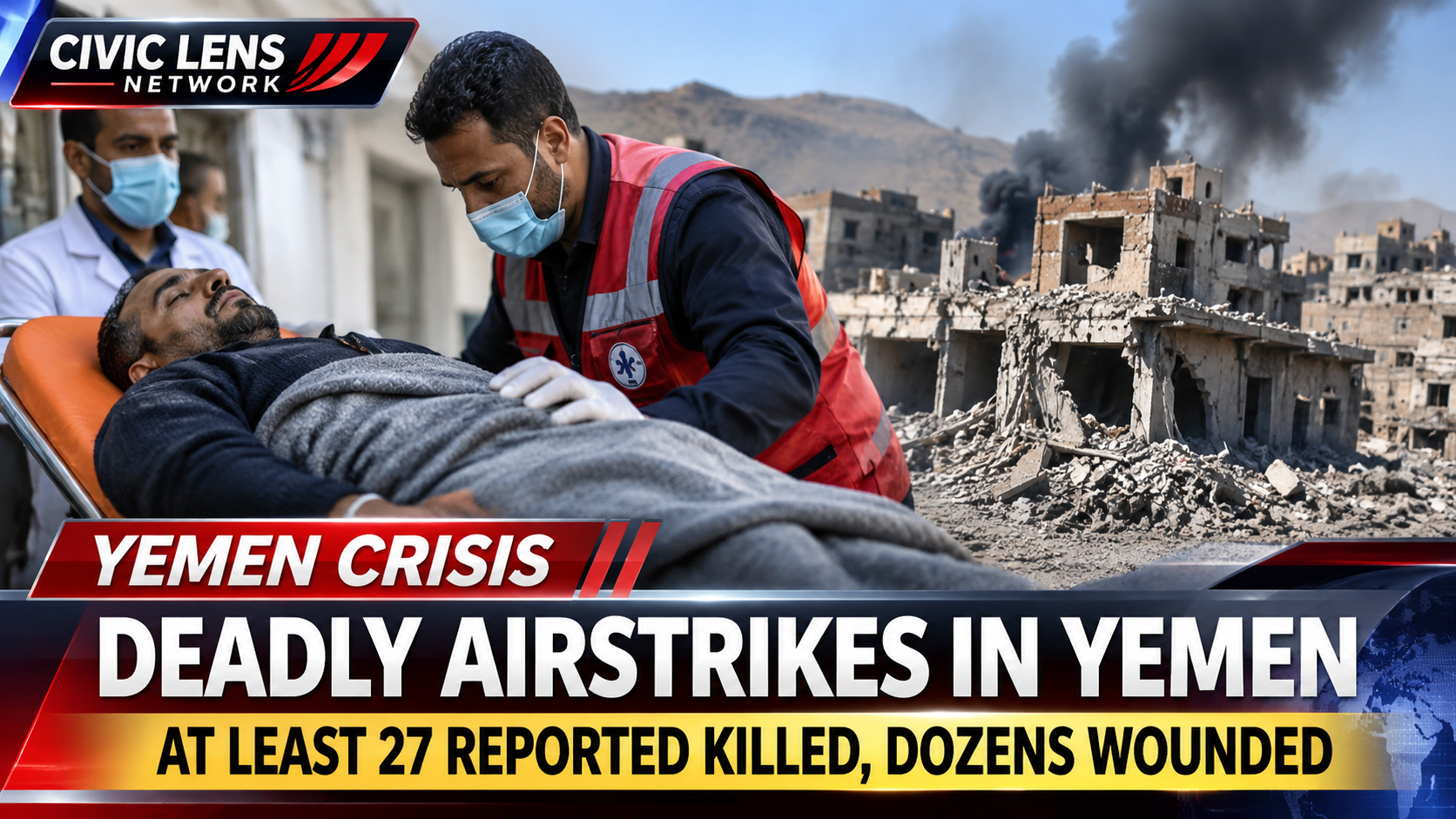
A devastating series of airstrikes has struck a residential village near Yemen’s capital, leaving at least 27 people reportedly dead and 36 others wounded as renewed fighting threatens to plunge the war-torn country into another humanitarian catastrophe.
The strikes hit homes in al-Shariya, a farming village approximately 10 miles northeast of Sanaa, sending buildings crashing into rubble and forcing terrified residents to flee for safety.
According to Yemen’s Houthi-run Health Ministry, many of those killed and wounded were women and children.
Rescue crews continued searching destroyed homes for survivors as emergency workers transported injured residents to hospitals in the capital.
Houthi authorities accused Saudi Arabia of carrying out the strikes, but independent confirmation of responsibility has not been established.
The attack comes amid a dangerous escalation in Yemen’s civil war, with competing military forces exchanging accusations over deadly strikes that have reportedly killed dozens of civilians in just two days.
Residential Homes Reduced to Rubble
The destruction in al-Shariya has left families searching for loved ones beneath collapsed buildings.
Footage from the village showed shattered homes, dust-filled streets and residents gathering near damaged structures as rescue operations continued.
Anees al-Asbahi, a spokesperson for the Houthi-run Health Ministry, reported that at least 27 people had been killed and 36 wounded.
Authorities warned that the death toll could increase as additional victims were recovered.
Medical personnel in Sanaa received wounded residents, including children requiring emergency treatment.
Hospital images showed the devastating consequences of the strikes, with medical workers attempting to stabilize victims before transferring some to other facilities.
Houthi officials also alleged that additional strikes targeted emergency responders as they attempted to rescue people trapped beneath the wreckage.
That allegation has not been independently confirmed.
The destruction raises urgent questions about the targeting of residential areas and the precautions taken to protect civilians during military operations.
Saudi Arabia Accused of Carrying Out the Attack
Houthi officials blamed Saudi Arabia for the airstrikes, accusing the kingdom of conducting military operations against civilian homes.
Saudi officials had not immediately responded to requests for comment concerning the reported attack.
The absence of independent confirmation means responsibility for the specific strikes remains unresolved.
Saudi Arabia has supported forces opposing the Iranian-backed Houthi movement during Yemen’s long-running civil war.
The renewed conflict has brought another wave of airstrikes, missile attacks and ground fighting as both sides attempt to strengthen their military positions.
The Houthis control Sanaa and large portions of northern and western Yemen, while the internationally recognized government and Saudi-backed forces retain positions elsewhere in the country.
The latest violence demonstrates how quickly civilians can become trapped between opposing forces when fighting spreads into populated areas.
Another Deadly Attack Reported Just One Day Earlier
The reported destruction near Sanaa followed another deadly incident in southwestern Yemen.
On Friday, strikes hit a market in the al-Waziyah district of Taiz province, reportedly killing at least 30 people and wounding eight others.
The market was a gathering place for civilians conducting ordinary daily business when the attack occurred.
Houthi officials accused Saudi Arabia of responsibility.
However, authorities aligned with Yemen’s Saudi-backed government disputed that account and blamed Houthi forces.
Neither side’s version has been independently verified.
Taken together, the two incidents have produced reports of at least 57 deaths within approximately 48 hours.
The figures remain provisional and depend on information supplied by authorities connected to the conflict.
Nevertheless, the reports point to a sharp deterioration in security for civilians already living under extraordinarily difficult conditions.
Houthis Announce Retaliatory Attacks
Following the reported strikes, Houthi military spokesperson Brigadier General Yahya Saree announced that the movement had launched retaliatory attacks against Saudi Arabia.
The group said its operations were a response to the violence near Sanaa and the previous day’s deadly market incident.
The precise results of those claimed retaliatory attacks were not independently established in the initial reports.
The Houthis have previously used missiles and drones to target Saudi military installations, airports, energy infrastructure and other strategic facilities.
The movement has also carried out attacks affecting shipping routes around the Red Sea and the Bab el-Mandeb Strait.
Those operations have raised international concerns because the region is a major passageway for global maritime commerce.
Additional exchanges between the Houthis and Saudi-backed forces threaten to widen the fighting and complicate efforts to restore stability.
Yemen’s Fragile Truce Has Collapsed
Yemen has endured more than a decade of devastating conflict.
The Houthis seized control of Sanaa in 2014, setting off a prolonged struggle involving the internationally recognized government, regional military powers and competing armed factions.
Saudi Arabia subsequently organized a military coalition supporting the Yemeni government.
Years of fighting devastated infrastructure, displaced millions of people and contributed to widespread shortages of food, clean water and medical supplies.
A United Nations-brokered truce in 2022 significantly reduced large-scale fighting, offering hope that the country might eventually move toward a lasting political settlement.
However, that relative calm collapsed during the summer of 2026.
Renewed offensives, airstrikes and retaliatory attacks have once again placed communities across Yemen in danger.
The latest escalation has intensified fears that the country could return to the levels of destruction witnessed during earlier phases of the war.
Hundreds of Thousands Displaced as Humanitarian Conditions Deteriorate
The renewed fighting is worsening an already severe humanitarian emergency.
According to figures reported by international humanitarian organizations, more than 200,000 people have been displaced since the latest round of fighting began.
Many families have fled their homes with few possessions, seeking shelter in communities already struggling with limited resources.
The situation around Taiz has become especially concerning.
Fighting and restrictions on movement have complicated access to food, drinking water and essential supplies.
Hospitals face additional pressure as medical workers attempt to treat victims of airstrikes and ground combat while coping with shortages of equipment and medicine.
For civilians living in contested areas, the dangers extend beyond direct military attacks.
Damaged roads, disrupted markets, rising food insecurity and the collapse of essential services can place entire communities at risk.
Children, older residents and people requiring medical treatment are particularly vulnerable when supply routes are interrupted.
Questions Mount Over Civilian Protection
The reported strikes on residential homes and a crowded market raise serious questions about the conduct of military operations in Yemen.
International humanitarian law requires parties involved in armed conflict to distinguish between civilians and combatants and to take precautions to minimize civilian harm.
Military objectives do not eliminate those obligations.
Determining whether a particular strike violated international law requires reliable evidence about the intended target, the information available to those conducting the operation and the circumstances surrounding the attack.
The competing accusations following the latest incidents make independent investigation especially important.
Authorities must establish who carried out the strikes, what was targeted and whether civilians were unlawfully placed in danger.
The allegations that rescue workers were targeted also warrant careful examination.
Emergency personnel attempting to save victims must be protected under the applicable rules of armed conflict.
A Country Facing Another Deadly Chapter
For the families of those reportedly killed in al-Shariya, the consequences of the renewed fighting are immediate and devastating.
Homes have been destroyed, relatives are missing and hospitals are treating victims of a conflict that has already inflicted enormous suffering on Yemen.
The reported death toll from Saturday’s strikes could rise as rescuers continue searching collapsed buildings.
Meanwhile, retaliatory attacks and renewed military operations threaten to bring additional violence to communities across the country.
The central questions now extend beyond who launched the latest airstrikes.
Can Yemen’s opposing forces prevent further civilian casualties?
Will international pressure produce a renewed ceasefire?
And how many more families will be forced to endure the consequences of a war that has already lasted more than a decade?
As the fighting continues, Yemen faces the possibility of another prolonged period of destruction, displacement and civilian suffering.
For those trapped in the conflict, the need for accountability, humanitarian assistance and an end to the violence has become increasingly urgent.