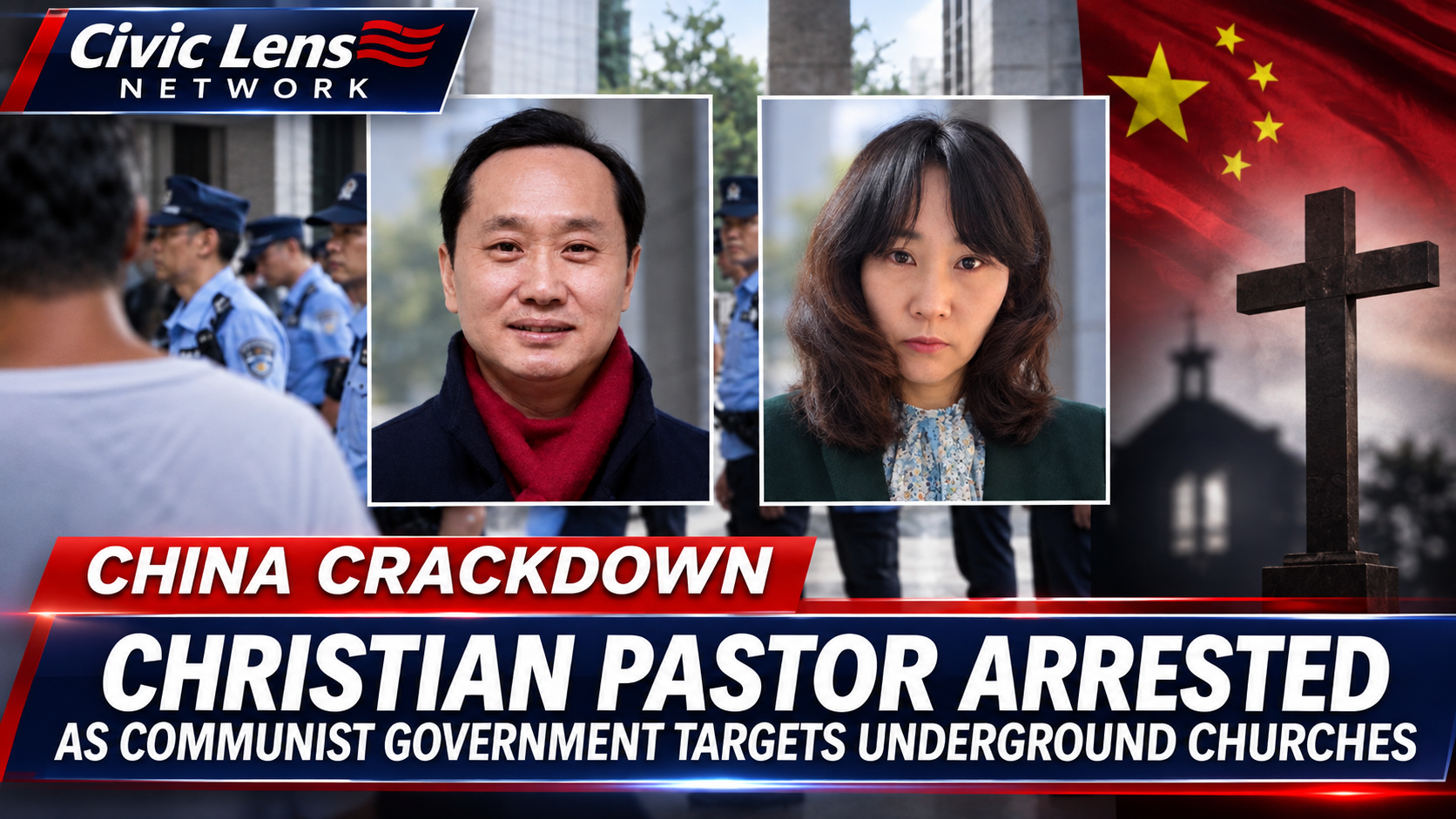
China’s Communist government is facing renewed scrutiny over religious freedom following the arrest of a prominent Christian pastor whose congregation has spent years resisting government control.
Pastor Xianfeng Edward Cui, founder of Beijing Jiaquan Church, was formally arrested on October 23 on suspicion of fraud after authorities detained him during a massive police operation involving approximately 100 officers.
The arrest has raised serious questions about whether Chinese authorities are using financial crime allegations to punish Christian congregations that refuse to place themselves under the supervision of the Communist Party.
Cui’s wife, Jin Young Gu, says the accusations involve financial offerings collected from church members. Religious freedom advocates believe the allegations may be connected to the congregation’s refusal to register with China’s government-controlled religious system.
Chinese authorities have not publicly presented detailed evidence establishing that the pastor committed fraud.
A Massive Police Operation Against Christians
The confrontation began September 4, when members of Jiaquan Church were preparing to celebrate the congregation’s twentieth anniversary.
Approximately 50 church members were preparing a hotel conference room when more than 100 police officers, including plainclothes personnel, reportedly surrounded the gathering.
Officers collected identifying information from attendees and detained several church workers.
Cui was arrested elsewhere during the same operation.
According to religious freedom organization ChinaAid, eight Christians were ultimately placed in criminal detention as authorities investigated alleged financial wrongdoing.
Seven of the detained church workers were later released on bail, while Cui remained in custody at Beijing’s Shijingshan District Detention Center.
The extraordinary police presence at a religious anniversary celebration has prompted questions about the government’s priorities.
Why would authorities deploy such a large force against a congregation preparing for a Christian gathering?
And if investigators possess legitimate evidence of financial crimes, why have the details not been publicly disclosed?
These questions remain unanswered.
A Church That Refused Government Control
Jiaquan Church was established in 2006 after Cui and his wife returned to China following religious studies in the United States.
The congregation grew into an independent Christian network reportedly serving more than 1,000 believers across multiple locations.
Unlike state-approved Protestant congregations, Jiaquan Church maintained its independence from the government-controlled religious establishment.
That independence repeatedly brought the church into conflict with Chinese authorities.
In 2019, officials sealed the congregation’s worship facility in Beijing, forcing members to gather in smaller groups at different locations.
In 2023, authorities interrupted a Sunday church class and warned the pastor that his congregation had become too large.
According to his wife, officials instructed him to limit the size and organization of his ministry.
The warning suggested that government officials were concerned not simply with where Christians worshipped, but with how many people were participating and how independently their congregations operated.
Christianity Under Communist Party Supervision
China officially recognizes Christianity, but religious organizations face extensive government regulation.
Protestant congregations are expected to operate within the state-approved religious system, while Catholic communities face their own government oversight requirements.
Independent house churches often reject those arrangements because they believe religious doctrine, church leadership and worship practices should not be controlled by political authorities.
Under President Xi Jinping, the government has intensified efforts to bring religious activity into conformity with Communist Party priorities.
These policies have included tighter oversight of religious organizations, restrictions on unauthorized gatherings and increased regulation of religious activities online.
The government’s broader policy of adapting religious practice to Chinese political and cultural requirements has generated international concern about the independence of religious institutions.
For Christians who believe their ultimate religious authority comes from Scripture rather than the state, the conflict raises fundamental questions about freedom of conscience.
The issue extends beyond registration paperwork.
It concerns whether a government should possess the power to determine how independently religious communities can organize, teach and worship.
Fraud Allegations Raise Troubling Questions
The financial allegations against Cui are particularly controversial because they reportedly concern church offerings.
Christian congregations commonly collect voluntary contributions to support ministry operations, religious education, charitable activities and their places of worship.
Collecting donations does not, by itself, establish criminal fraud.
However, legitimate financial crimes can occur within religious organizations, and any specific accusation must be evaluated according to evidence.
In Cui’s case, authorities have not publicly disclosed sufficient information to independently determine whether the allegations involve actual deception or ordinary church financial activities that the government considers unauthorized.
Religious freedom advocates argue that the lack of transparency makes independent scrutiny essential.
ChinaAid has warned that economic crime allegations are increasingly being used against leaders of independent Christian congregations.
The organization has called for transparency, access to legal representation and the release of detainees unless authorities can demonstrate legitimate criminal wrongdoing.
The central question is straightforward.
Is the Chinese government investigating an actual financial crime, or is it using the criminal justice system to bring an independent Christian church under political control?
Without publicly available evidence, that question cannot be conclusively answered.
Part of a Larger Crackdown
Cui’s arrest is not an isolated incident.
In October 2025, Chinese authorities detained approximately 30 leaders associated with Zion Church, one of the country’s largest independent Christian networks.
Its founder, Pastor Jin Mingri, was among those arrested.
He was subsequently released in July 2026 following a personal request from President Donald Trump to Chinese President Xi Jinping during a visit to Beijing, according to reporting on the case.
Other independent Christian congregations have also faced raids, detentions and restrictions.
In January 2026, authorities detained six members of the Early Rain Covenant Church in Chengdu.
The congregation has experienced years of government pressure, including the imprisonment of its founder, Pastor Wang Yi, who received a nine-year prison sentence in 2019.
Together, these cases illustrate a continuing confrontation between China’s Communist government and Christian organizations unwilling to surrender their institutional independence.
A Family Separated by Government Restrictions
The consequences of the crackdown extend beyond the detained pastor.
Cui’s wife, a South Korean national, says she has been unable to return to China since authorities began denying her visa applications in 2023.
The restrictions have separated the couple while her husband’s legal situation has become increasingly serious.
She has appealed for prayers and international attention to the case.
In a statement reported by ChinaAid, the family emphasized that Jiaquan Church has no political ambitions and does not seek confrontation with secular authorities.
Its stated mission remains religious worship and Christian ministry.
That distinction raises another important question.
If an independent congregation does not advocate political violence or overthrowing the government, why should its refusal to join a state-controlled religious organization make it a target of intense police scrutiny?
The International Community Faces a Test
The arrest places renewed attention on how the United States and other governments respond to restrictions on religious freedom in China.
Washington has repeatedly criticized the Chinese government’s treatment of independent religious organizations.
The release of Zion Church founder Jin Mingri following Trump’s intervention demonstrates that high-level diplomatic pressure can sometimes produce results.
However, individual releases do not necessarily resolve the broader problem.
Religious freedom advocates argue that lasting improvements require meaningful protections for independent congregations, transparent judicial proceedings and an end to punishment based solely on peaceful religious activity.
For China, the issue is also one of international credibility.
A government that claims to respect religious belief must confront questions about why independent churches repeatedly face police raids, detention and restrictions on worship.
Faith Beyond Government Permission
For Christians around the world, the arrest of Pastor Cui is another reminder that the freedom to worship is not universally protected.
The New Testament records numerous occasions when early Christians faced imprisonment, intimidation and demands to abandon their religious mission.
Acts 5:29 records the apostles’ declaration:
“We ought to obey God rather than men.”
That passage continues to carry significance for Christians who believe religious convictions cannot be dictated by political authorities.
The situation in Beijing is ultimately about more than one pastor or one congregation.
It concerns the boundaries of government power over religious belief.
Pastor Cui remains in detention, and the allegations against him have not been proven in a publicly documented judicial proceeding.
Until Chinese authorities provide transparent evidence and a fair legal process, serious questions will remain about whether the pastor is being prosecuted for genuine criminal conduct or punished for leading a Christian congregation outside Communist Party control.
For the members of Jiaquan Church, the immediate concern is the fate of their pastor.
For the wider Christian community, the case represents a much larger struggle over whether freedom of faith can survive when the government demands authority over the church itself.