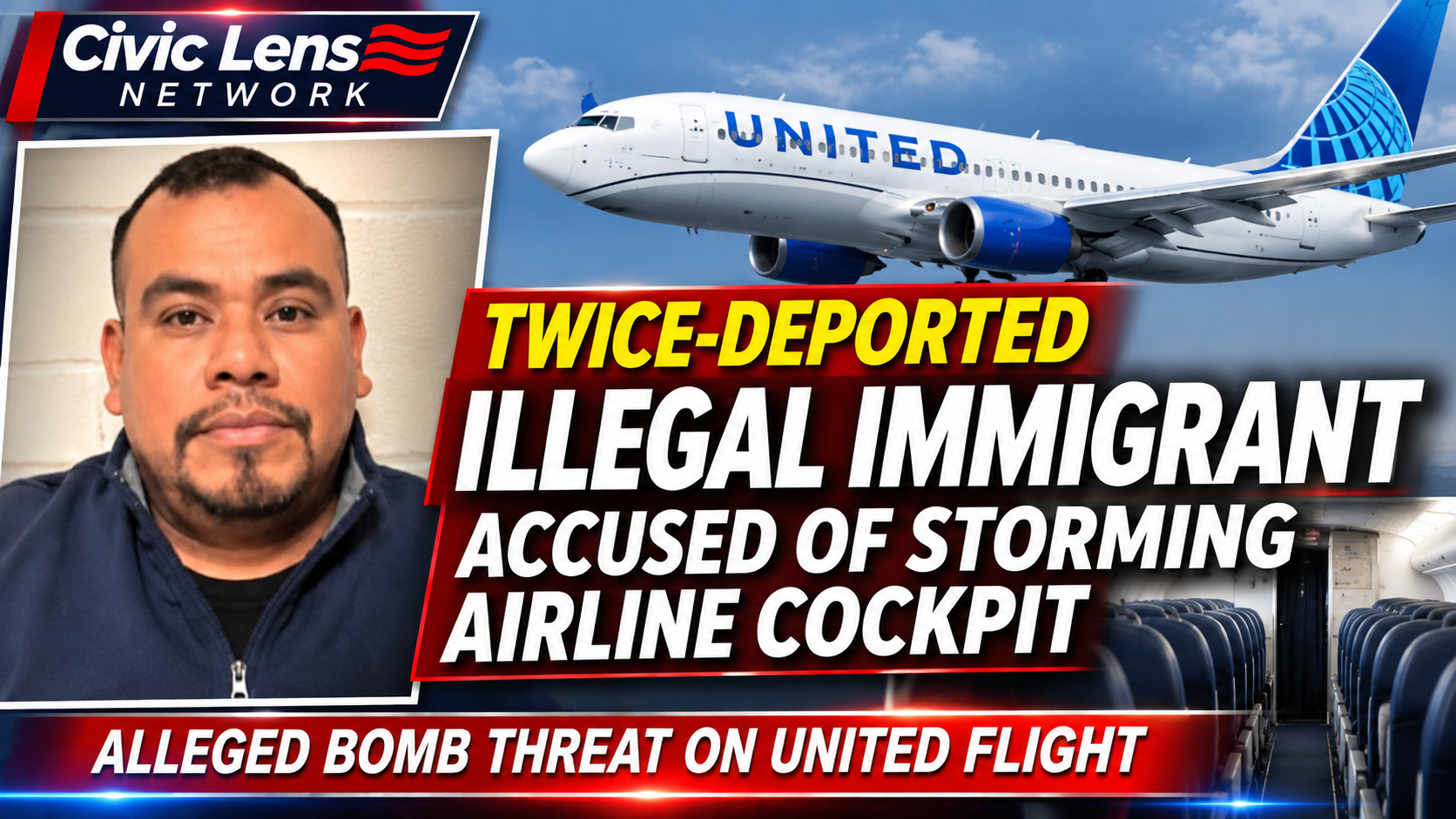
A Honduran illegal immigrant who had already been deported from the United States twice is accused of attempting to storm the cockpit of a United Airlines passenger jet after allegedly claiming he was carrying a bomb, triggering a hijacking alert and a frightening midair security emergency.
The suspect, identified as 34-year-old Rony Alexander Gomez-Alberto, was arrested Monday night, November 9, after United Airlines Flight 2174 landed at Louis Armstrong New Orleans International Airport.
According to the Department of Homeland Security, Gomez-Alberto had been removed from the United States twice before being apprehended during a third attempted illegal entry. He was subsequently released from immigration custody in 2020 following an immigration judge’s order.
The incident has raised serious questions about immigration enforcement and how someone with multiple deportations was able to remain in the country and board a commercial passenger aircraft.
Bomb Threat Triggers Hijacking Alert
United Airlines Flight 2174 was traveling from Newark, New Jersey, to New Orleans, Louisiana, carrying 46 passengers and six crew members aboard a Boeing 737 MAX 9.
During the flight, Gomez-Alberto allegedly told flight attendants he had a bomb and attempted to reach the cockpit.
Crew members intervened, preventing the alleged intrusion and moving the suspect toward the rear of the aircraft.
The pilots reportedly issued a hijacking alert as the situation unfolded.
Despite the alarming incident, the aircraft landed safely in New Orleans, where law enforcement officers were waiting.
No injuries were reported.
Authorities have not established that the suspect possessed an actual explosive device.
Deported Twice, Arrested a Third Time
The suspect’s immigration history has become one of the most troubling aspects of the case.
According to DHS records, Gomez-Alberto was first apprehended by Border Patrol agents in September 2011 after illegally entering the United States near El Indio, Texas.
He was deported.
In October 2014, authorities caught him again after another illegal entry near Columbus, New Mexico.
He was deported a second time.
However, those removals did not prevent another attempted entry.
In 2019, Border Patrol agents arrested Gomez-Alberto near San Ysidro, California, following a third attempted illegal crossing.
Instead of being immediately removed again, he remained in immigration custody until January 2020, when an immigration judge ordered his release pending removal proceedings.
DHS confirmed that ICE complied with the order.
The eventual outcome of those immigration proceedings has not been established in the available reporting.
Criminal History Raises Additional Concerns
Federal immigration authorities also reported that Gomez-Alberto had a criminal history involving felony bomb-threat offenses, terroristic-threat offenses and disorderly conduct.
The precise disposition of those earlier offenses was not immediately established.
Following Monday’s airline incident, Jefferson Parish sheriff’s deputies arrested Gomez-Alberto.
He was booked on Louisiana charges including communicating false information about planned arson and terrorizing.
He was subsequently held without bond.
On November 10, Immigration and Customs Enforcement lodged a detainer requesting notification before his release so federal immigration authorities could assume custody.
The FBI has also been involved in reviewing the incident, while federal prosecutors will determine whether additional charges are appropriate.
Gomez-Alberto remains accused of the aircraft-related offenses and has not been convicted in connection with the incident.
A Border Security Failure That Demands Answers
The case presents an uncomfortable question for federal immigration authorities: How did a foreign national with two previous deportations and another border apprehension remain in the United States long enough to become the subject of an alleged hijacking emergency?
The documented sequence of deportations, reentry attempts and eventual release exposes the challenges of enforcing immigration orders against individuals who repeatedly cross the border illegally.
It also raises questions about what information was available to immigration authorities when Gomez-Alberto was released in 2020.
The fact that an immigration judge ordered his release does not establish that the judge knew about or disregarded every element of his reported criminal history.
Nevertheless, the incident demonstrates why repeat immigration violations and previous threats involving explosives deserve close scrutiny.
For the 52 passengers and crew members aboard Flight 2174, the immediate danger ended when the aircraft landed safely.
For federal authorities, the investigation is far from over.
The central question now extends beyond what allegedly happened aboard the aircraft to whether existing immigration enforcement procedures failed to prevent a potentially catastrophic aviation security incident.