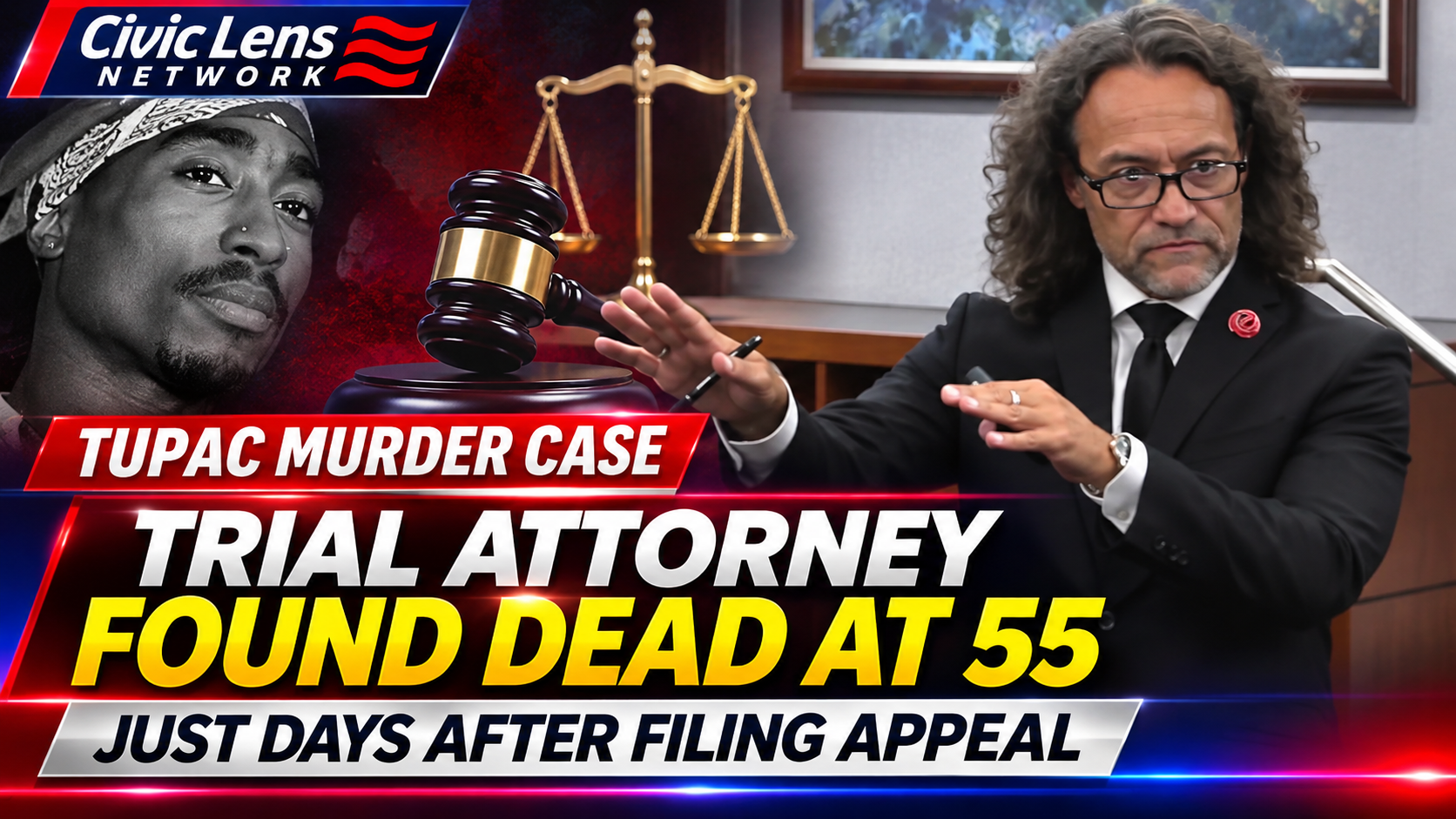
The mysterious circumstances surrounding one of the most infamous murders in American music history have taken another unexpected turn after the defense attorney representing the man convicted of killing legendary rapper Tupac Shakur was found dead inside his Las Vegas home.
Michael Sanft, 55, was discovered dead on November 6, just one week after filing a notice of appeal challenging the murder conviction of Duane “Keffe D” Davis.
The timing has drawn renewed attention to a case that has captivated the public for nearly three decades.
Authorities have not announced an official cause or manner of death. Las Vegas police have stated that Sanft’s death does not appear suspicious, and there is currently no verified evidence connecting his death to the Tupac murder case.
Nevertheless, the sudden loss of the attorney responsible for one of the country’s most closely watched criminal appeals raises significant questions about what happens next in a legal battle that many believed had finally reached its conclusion.
A Sudden Death After a Historic Conviction
Sanft had become nationally recognized for defending Davis, the former gang figure accused of orchestrating the 1996 drive-by shooting that killed Tupac Shakur.
Following a highly publicized trial, a Nevada jury convicted Davis of first-degree murder in August 2026.
On October 13, Davis received a sentence of 40 years to life in prison.
The verdict represented a historic moment in a criminal investigation that had remained unresolved for approximately 30 years.
For prosecutors, the conviction represented long-awaited accountability for the killing of one of hip-hop’s most influential artists.
For the defense, however, the legal battle was far from finished.
Sanft maintained that prosecutors had failed to establish their case beyond a reasonable doubt and questioned the reliability of evidence presented against his client.
On October 30, he filed a notice of appeal, formally beginning the process of challenging the conviction.
Seven days later, he was dead.
What Authorities Have Confirmed
According to information released through local reporting, Sanft’s body was discovered at his home on Friday morning.
The Clark County Coroner’s Office confirmed his death, but the official cause and manner remained pending.
The Las Vegas Metropolitan Police Department indicated that the circumstances did not appear suspicious.
That distinction is important.
A death occurring during a high-profile criminal case can generate public speculation, particularly when the underlying prosecution involves decades of controversy, gang rivalries, and competing accounts of a famous murder.
However, the timing of Sanft’s death does not establish that foul play occurred.
There has been no confirmed evidence of homicide, retaliation, threats connected to the appeal, or any conspiracy involving the Tupac investigation.
Until medical examiners complete their work and authorities release additional findings, the circumstances surrounding Sanft’s death remain incomplete.
The Attorney Who Challenged the Tupac Murder Case
Michael Sanft was an experienced Nevada trial lawyer with a career extending well beyond the Tupac prosecution.
According to his professional biography, he had handled approximately 150 jury trials.
He earned his law degree from Brigham Young University and became a member of the Nevada State Bar in 2002.
His background was far removed from the celebrity-driven legal battles that eventually brought him national attention.
Sanft grew up in Tonga before moving to San Diego during childhood.
He later established himself in the Nevada legal community, where he developed a reputation as an aggressive but personable courtroom advocate.
Colleagues described him as an attorney who could connect with jurors and challenge opposing witnesses without relying on unnecessarily complicated legal language.
He also represented former Nevada politician Michele Fiore in a separate federal criminal case.
But it was his defense of Duane Davis that placed him at the center of a case followed by millions of music fans around the world.
Why the Tupac Case Remains So Controversial
Tupac Shakur was just 25 years old when he was fatally shot in Las Vegas on September 7, 1996.
The rapper was riding in a BMW driven by Death Row Records executive Marion “Suge” Knight when a white Cadillac pulled alongside the vehicle near the Las Vegas Strip.
Gunfire erupted, striking Shakur multiple times.
Knight survived.
Shakur died six days later.
His death sent shock waves through the music industry and intensified scrutiny of the violent rivalries surrounding rap music during the 1990s.
Despite numerous investigations, interviews, and public allegations, the murder remained unsolved for decades.
The case became the subject of documentaries, books, television programs, and countless theories about who ordered the killing and why.
Davis eventually emerged as a central figure after publicly discussing his alleged involvement in interviews and a memoir.
Authorities arrested him in September 2023.
He became the only person criminally charged in connection with Shakur’s murder.
Prosecutors argued that Davis organized the attack in retaliation for an earlier confrontation involving his nephew and members of Shakur’s entourage.
The defense challenged that account, arguing that investigators relied too heavily on statements Davis had made publicly.
Sanft Questioned the Evidence
Throughout the trial, Sanft attempted to undermine the prosecution’s interpretation of the evidence.
A central issue was whether Davis’s own statements were reliable enough to support a murder conviction.
Davis had discussed the killing publicly on multiple occasions, but the defense argued that those accounts did not establish his guilt beyond a reasonable doubt.
Sanft questioned the quality of the original investigation and challenged the strength of the evidence connecting Davis to the shooting.
The defense also raised concerns about the passage of time.
Nearly three decades had elapsed between Shakur’s murder and the trial, creating obvious difficulties involving witness memories, missing evidence, and the reliability of historical accounts.
Prosecutors maintained that the evidence, including Davis’s statements and witness testimony, established his role in organizing the killing.
The jury ultimately agreed with the prosecution.
Following the verdict, Sanft expressed disappointment but defended the work of his legal team.
He believed the defense had presented its case effectively and intended to continue challenging the outcome.
An Appeal That Had Just Begun
On October 30, Sanft filed a notice of appeal on behalf of Davis.
That filing was significant because it preserved the defendant’s opportunity to seek review of his conviction by a higher court.
An appeal is not a second trial.
Instead, appellate judges generally examine whether legal errors occurred during the original proceedings that could justify reversing a conviction or ordering additional proceedings.
Potential appellate issues can include disputed evidence, jury instructions, procedural rulings, and questions concerning the defendant’s constitutional rights.
The precise arguments Davis’s legal team intended to present have not all been publicly established.
Sanft’s death now creates an immediate practical challenge for the defense.
A new attorney will likely need to become familiar with the extensive trial record, review previous legal motions, examine possible grounds for appeal, and determine how best to proceed.
The change could complicate preparation, although it does not automatically invalidate the appeal or overturn the conviction.
Davis retains the right to pursue available appellate remedies.
The courts will determine the appropriate procedural steps as the case moves forward.
A Career Remembered by Colleagues
Beyond the headlines surrounding the Tupac trial, Sanft’s death has prompted tributes from members of the Nevada legal community.
Michael Sloan, a Clark County District Court marshal and longtime friend, remembered Sanft as an exceptionally kind person and close companion.
The two shared a passion for motorcycles and traveled together on riding trips.
Prosecutor Marc DiGiacomo, who worked on the Davis case, also praised Sanft’s professional abilities and expressed sadness over his death.
Those reactions illustrate that Sanft was more than the attorney associated with a celebrity murder trial.
He was a father, friend, colleague, and established member of the legal profession.
Friends described his charisma, generosity, and ability to make people feel comfortable.
His death leaves behind a grieving family and a legal community mourning an experienced courtroom advocate.
Why the Timing Is Attracting Attention
The fact that Sanft died just days after filing the appeal has become one of the most widely discussed aspects of the story.
The sequence is undeniably striking.
A major murder conviction was handed down in October.
The defense initiated an appeal at the end of that month.
One week later, the lead attorney was found dead.
But there is an important difference between an unusual sequence of events and evidence that those events are connected.
At present, authorities have not identified any suspicious circumstances surrounding his death.
There is no publicly verified evidence suggesting Sanft was targeted because of his representation of Davis.
Speculation about a possible connection would therefore go beyond the established facts.
The legitimate unanswered questions concern the medical determination of his death, the transition to new legal representation, and the future schedule of the appeal.
Those questions deserve careful attention without treating unproven theories as established reality.
What Happens to Duane Davis Now?
Davis remains convicted of first-degree murder and is serving his sentence.
The death of his attorney does not erase the jury’s verdict or change the punishment imposed by the court.
However, the appeal remains an important part of the legal process.
A replacement attorney may need time to review the evidence and understand the legal strategy developed during the trial.
The new defense team could also evaluate whether additional arguments should be raised within the applicable appellate rules.
The prosecution, meanwhile, will have the opportunity to defend the conviction against whatever claims are presented.
For Shakur’s family, the case has already involved decades of uncertainty and an extraordinarily long wait for a criminal verdict.
Any further proceedings could extend the legal process.
For Davis, the appeal represents a remaining opportunity to challenge the judgment against him.
For the public, the case remains a reminder that even a historic conviction does not necessarily mark the end of a major criminal prosecution.
A Case That Continues to Make Headlines
Nearly 30 years after Tupac Shakur was killed, the case continues to produce unexpected developments.
The rapper’s death became one of the defining tragedies of modern American music.
His influence has endured through generations of performers, while the circumstances surrounding his murder have remained a subject of intense public interest.
The conviction of Duane Davis appeared to provide a major measure of legal closure.
But the sudden death of Michael Sanft has introduced a new complication into the case’s next chapter.
Authorities have not determined or publicly disclosed what caused the attorney’s death, and police have indicated that it does not appear suspicious.
The appeal process, meanwhile, must continue without the lawyer who defended Davis through the trial and initiated the challenge to his conviction.
For now, the facts establish a sudden death, an unfinished appeal, and a murder case that remains legally active decades after the world lost one of its most recognizable musical voices.
Whether the appeal changes the outcome remains to be seen.
What is certain is that the Tupac Shakur case is once again making headlines, this time following the unexpected death of the attorney who had been preparing to fight its historic verdict.