Foreign money has become a major part of Washington’s influence industry, and newly examined spending figures reveal just how much some Middle Eastern countries have invested in building relationships and promoting their interests in the United States.
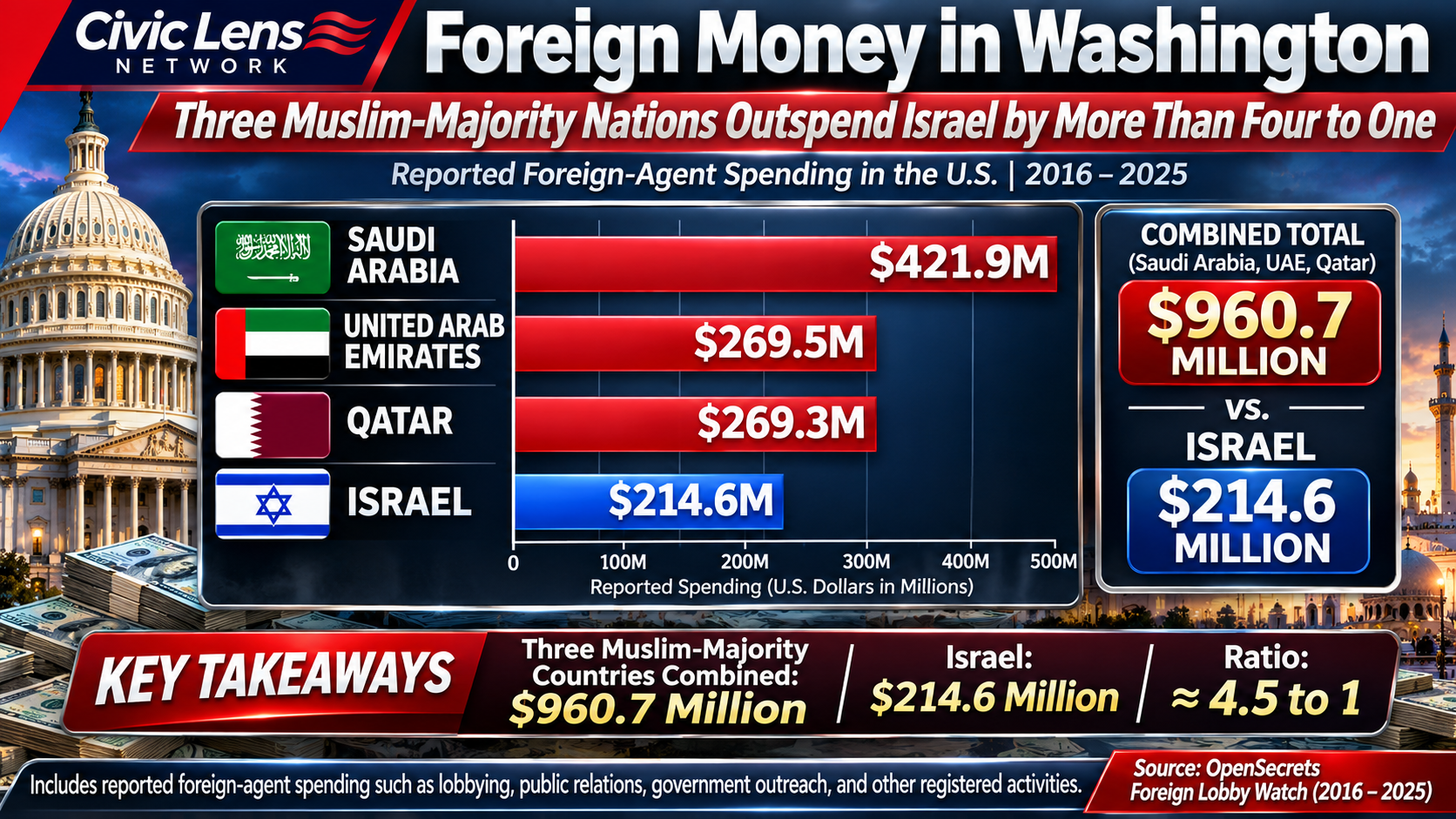
According to OpenSecrets Foreign Lobby Watch, Saudi Arabia, Qatar and the United Arab Emirates accounted for approximately $960.7 million in reported foreign-agent spending between 2016 and 2025.
During that same period, Israel accounted for approximately $214.6 million.
The combined spending associated with those three Muslim-majority countries was roughly 4.5 times the amount associated with Israel.
Nearly One Billion Dollars From Three Countries
The figures reveal the scale of foreign spending connected to some of America’s most important Middle Eastern partners.
Saudi Arabia accounted for approximately $421.9 million, making it one of the largest sources of foreign-agent spending recorded in the United States.
The United Arab Emirates followed with approximately $269.5 million, while Qatar accounted for another $269.3 million.
Israel’s reported total was approximately $214.6 million.
These figures represent payments associated with foreign principals, including governments, businesses and other organizations. They do not mean that the entire amount went directly toward lobbying members of Congress.
Nevertheless, the totals demonstrate the substantial financial resources that foreign interests are willing to commit to maintaining a presence in Washington.
How Foreign Governments Gain Access
Foreign governments are generally prohibited from contributing directly to American federal election campaigns. However, they can hire American lobbying firms, attorneys, consultants and public relations companies to represent their interests.
Under the Foreign Agents Registration Act, individuals and organizations conducting certain activities on behalf of foreign principals must register with the Department of Justice and disclose their relationships and financial arrangements.
These activities can include contacting government officials, promoting policy positions, influencing public opinion and conducting public relations campaigns.
The reporting system also covers activities such as tourism and trade promotion, meaning not every dollar represents an attempt to influence legislation.
The distinction matters, but so does the larger question: How much influence can foreign interests gain when they have hundreds of millions of dollars available to spend?
What About Pro-Israel Political Contributions?
Israel’s foreign-agent spending is separate from political contributions made by American organizations supporting Israel.
Groups such as the American Israel Public Affairs Committee, commonly known as AIPAC, operate within the American political system and participate in campaign financing and lobbying under domestic laws.
OpenSecrets records approximately $43.5 million in contributions associated with AIPAC during the 2023–2024 election cycle, including money directed toward Democratic and Republican interests.
Other pro-Israel organizations, including J Street and the Republican Jewish Coalition, also reported millions of dollars in political contributions.
Those domestic political contributions are not included in Israel’s foreign-agent spending total.
Likewise, political contributions made by Muslim Americans are not included in the foreign-agent totals for Saudi Arabia, Qatar or the United Arab Emirates.
The figures therefore measure different financial activities and should not be treated as a complete accounting of Jewish or Muslim political influence.
Washington’s Foreign Influence Question
The spending figures raise a broader issue that crosses party lines.
American politicians regularly debate the influence of campaign donors, corporations and special-interest organizations. Foreign governments and foreign-connected organizations represent another substantial source of spending directed toward American institutions and public opinion.
Saudi Arabia, Qatar, the United Arab Emirates and Israel all maintain important relationships with the United States, involving defense cooperation, regional security, economic interests and diplomatic negotiations.
Their priorities do not always align with one another, and their relationships with Washington involve competing interests.
The central issue is not the religion of a country’s population. It is whether American citizens can clearly identify who is paying to influence their government and what those interests are seeking in return.
Following the Money
The nearly $961 million associated with Saudi Arabia, Qatar and the United Arab Emirates illustrates the scale of foreign-connected spending in Washington over a decade.
But spending alone does not establish corruption, illegal conduct or control over American politicians.
Determining whether financial relationships have improperly influenced government decisions requires examining lobbying contracts, disclosed contacts, legislative activity and any evidence connecting payments to official actions.
For Americans concerned about foreign influence, the most important demand may be straightforward: Full transparency about who is paying, who is receiving the money and what policies they are attempting to shape.
Washington should be accountable to the American public, regardless of whether the outside interests involved come from the Middle East, Europe, Asia or anywhere else.