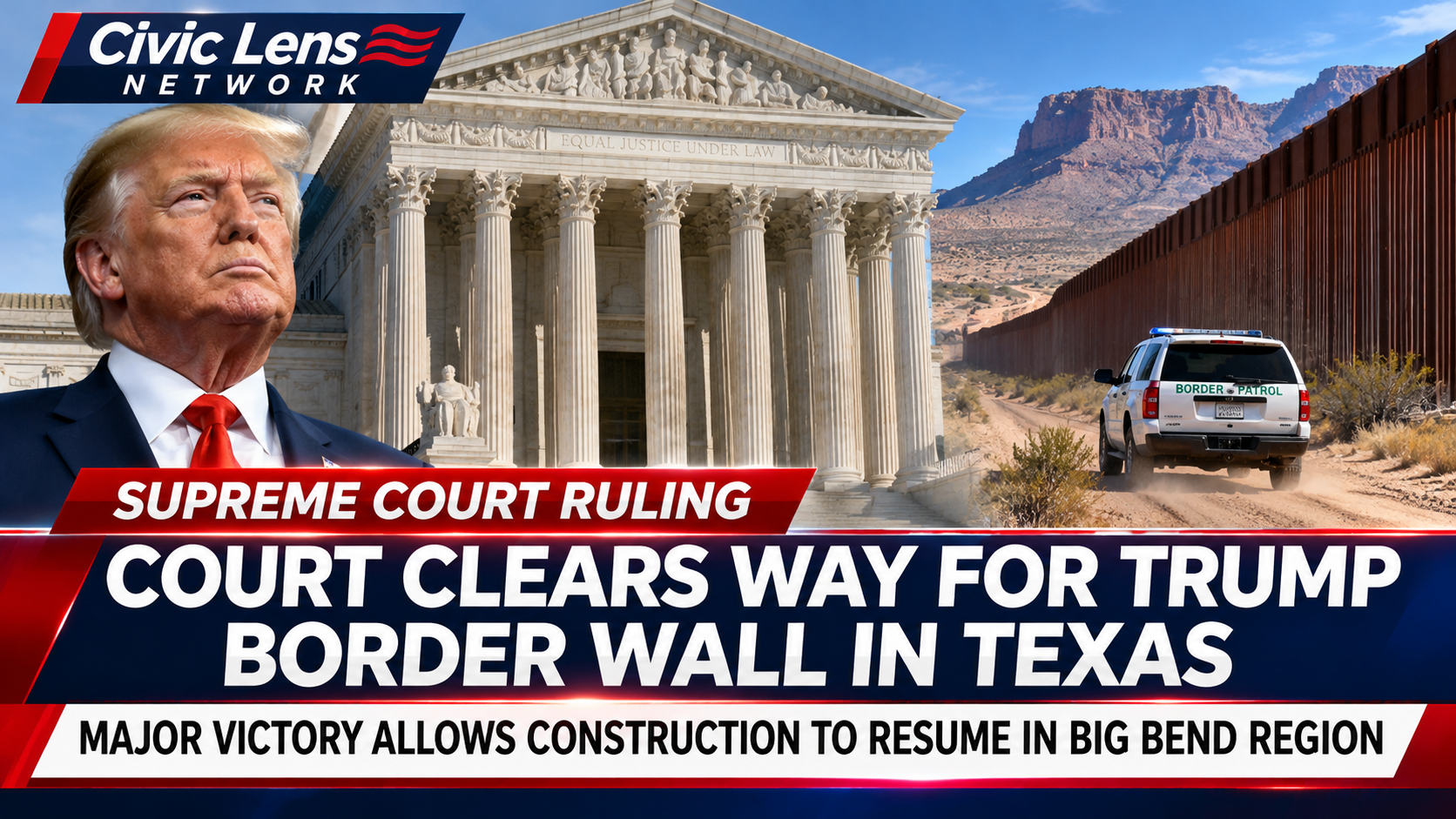
President Donald Trump has secured a significant legal victory after the United States Supreme Court cleared the way for his administration to resume construction of border security barriers in West Texas, overturning a lower court order that had temporarily halted the project.
The November 9 ruling allows federal contractors to move forward with construction in the Big Bend region, including infrastructure planned for areas within Big Bend National Park, while a legal challenge continues.
The decision represents an important victory for the administration’s effort to strengthen security along the southern border and reinforces the federal government’s authority to pursue border enforcement projects under existing immigration laws.
For Trump, who has made securing the border a defining political priority, the ruling removes a major legal obstacle from an ambitious construction program.
However, the Supreme Court has not issued a final ruling on the legality of the entire project. The underlying lawsuit remains unresolved.
Supreme Court Overturns Construction Freeze
The dispute reached the nation’s highest court after U.S. District Judge Kathleen Cardone ordered construction activities in the Big Bend region to stop.
The injunction prevented the administration from proceeding with border barriers, access roads and other related infrastructure while litigation continued.
The Trump administration challenged that decision, arguing that the suspension interfered with its responsibility to secure the international border.
Federal attorneys maintained that delaying construction could create vulnerabilities that criminal organizations, human traffickers and illegal border crossers might exploit.
The Supreme Court agreed to grant the administration emergency relief.
In its unsigned ruling, the court determined that the federal government’s border security interests outweighed the environmental and recreational harms alleged by the plaintiffs at this preliminary stage.
Justice Ketanji Brown Jackson was the only justice to publicly oppose granting the administration’s request.
The ruling permits construction to resume while the courts continue considering the broader legal dispute.
A Major Victory for Trump’s Border Security Agenda
Border security has remained one of Trump’s most recognizable political commitments.
Throughout his political career, he has argued that the United States must maintain effective control over who enters the country.
His administration has consistently emphasized physical barriers as one component of a broader strategy involving Border Patrol agents, surveillance technology, immigration enforcement and efforts to combat international criminal organizations.
The latest Supreme Court decision strengthens the administration’s ability to implement that strategy.
Supporters of stronger border enforcement argue that federal authorities should not be forced to wait through lengthy litigation before addressing vulnerabilities along the southern border.
They contend that maintaining secure borders is a fundamental responsibility of the national government.
The administration has warned that leaving portions of the border without adequate security infrastructure could encourage illegal crossings to shift into those areas.
Federal officials also argue that border barriers and patrol roads can improve agents’ ability to respond to suspected smuggling operations and unauthorized entries.
The court’s decision does not establish that every proposed barrier is necessary or effective. It does, however, allow the administration to proceed with construction while those broader questions remain contested.
Why Big Bend Matters
The Big Bend region stretches across a remote portion of West Texas along the Rio Grande, which forms the international boundary between the United States and Mexico.
Its rugged landscape includes mountains, deserts, steep canyons and long stretches of isolated territory.
Big Bend National Park is one of the region’s most recognizable landmarks, attracting visitors from across the country.
The terrain presents unusual challenges for border enforcement.
Unlike heavily populated border areas, portions of Big Bend are difficult to access by vehicle and can be far from established roads or law enforcement facilities.
The Trump administration argues that these conditions make security infrastructure important.
Federal officials have warned that gaps in border defenses could become attractive routes for illegal crossings and criminal activity.
The administration has cited more than 89,000 apprehensions in the Big Bend Border Patrol sector between 2021 and 2025.
Opponents dispute the need for extensive construction, pointing out that the sector has historically accounted for a relatively small percentage of apprehensions along the entire southern border.
Both arguments are central to the ongoing dispute.
The government views the region as a potential security vulnerability, while critics question whether the proposed infrastructure is proportionate to the level of activity recorded there.
What Will Actually Be Built?
The administration’s construction plans involve several types of border security infrastructure.
These include steel pedestrian barriers in certain locations, vehicle barriers, patrol roads and surveillance systems.
The Big Bend sector extends for more than 500 miles along the southern border.
According to federal descriptions of the project, most construction is expected to occur outside Big Bend National Park, including on privately owned land.
Inside the national park, the administration has described plans for approximately 17 miles of noncontiguous vehicle barriers rather than the 30-foot pedestrian walls planned for other sections of the border.
Additional roads and security infrastructure are also contemplated.
That distinction is important because some descriptions of the project have suggested that a continuous 30-foot wall would run through the national park itself.
The administration’s stated plans do not call for that type of continuous pedestrian wall inside the park.
Nevertheless, opponents maintain that roads, vehicle barriers and other construction could permanently alter sensitive areas.
The final scope and timing of construction remain subject to administrative decisions and continuing litigation.
Environmental Laws at the Center of the Fight
The legal controversy centers on the federal government’s authority to waive certain legal requirements to accelerate border construction.
Under a 1996 immigration law, the secretary of homeland security has authority to waive legal requirements considered necessary to ensure the rapid construction of border barriers and roads.
The Trump administration relied on that authority to bypass multiple environmental and conservation requirements.
The challengers argued that the government exceeded the authority Congress provided.
Their lawsuit was brought by the Center for Biological Diversity, a local river guide and an organization concerned about preserving a historic church in the region.
The plaintiffs argued that construction could damage protected landscapes, wildlife habitats, recreational areas and culturally significant locations.
Judge Cardone initially sided with the challengers and halted construction.
The Supreme Court subsequently concluded that the federal law at issue likely limits judicial review of the plaintiffs’ claims.
That determination was sufficient for the justices to suspend the lower court’s injunction.
The decision is not a final judgment that every waiver or construction activity is lawful.
It is an emergency ruling allowing the government to proceed while the legal process continues.
Opposition Extends Beyond Democrats
Although border security is often portrayed as a partisan issue, opposition to the Big Bend construction project has included Republicans as well as Democrats.
Some local officials, landowners and conservation advocates have questioned whether extensive barriers are necessary in a region with relatively low recorded illegal crossing activity.
Republican Senator John Cornyn has also expressed concerns about construction through the Big Bend landscape.
Critics argue that the project could harm tourism, interfere with private property and damage areas that are difficult or impossible to restore.
Some have suggested that surveillance technology and targeted enforcement could provide security without requiring extensive physical construction.
The Center for Biological Diversity strongly criticized the Supreme Court’s decision, warning that construction could permanently alter parts of the national park and surrounding wilderness.
These concerns have not persuaded the Supreme Court to maintain the construction freeze.
The justices instead determined that the federal government’s interest in advancing border security justified allowing work to resume while litigation proceeds.
The Larger Question of Federal Authority
Beyond the immediate construction dispute, the ruling raises important questions about the balance between federal authority and judicial oversight.
Congress has granted the executive branch substantial powers to construct barriers along the southern border.
Those powers include mechanisms intended to prevent certain regulatory requirements from delaying construction.
The Trump administration argues that Congress deliberately provided this authority because border security is a national priority.
Opponents maintain that broad waivers can undermine protections established by other federal laws.
The Supreme Court’s decision indicates that the government’s statutory authority carries significant weight when courts consider emergency requests involving border construction.
However, the ruling should not be interpreted as eliminating all possible judicial challenges or granting unlimited authority over federal land.
The underlying litigation will determine what legal issues remain open for further consideration.
What Happens Next?
With the lower court’s injunction suspended, the Trump administration can resume construction activities that had been halted.
Customs and Border Protection has not established a publicly confirmed timetable for restarting every affected portion of the project.
Contractors may proceed with authorized work, but the administration must still navigate practical construction requirements and the continuing legal challenge.
Environmental groups and other plaintiffs are expected to continue opposing the project through available legal channels.
The Supreme Court could also face additional questions concerning the scope of federal waiver authority and the legal limits of border construction.
For now, the immediate result is clear.
President Trump has won a significant Supreme Court decision allowing a major component of his border security agenda to advance.
The ruling underscores the administration’s ability to rely on federal immigration law when pursuing border infrastructure, even when environmental organizations and local opponents challenge those plans.
It also highlights a continuing national debate over how the United States should balance border security, federal authority, property rights and environmental protection.
For supporters of Trump’s border policies, the decision marks another step toward expanding physical security infrastructure along the southern border.
For opponents, it represents a setback in their efforts to protect the Big Bend landscape from additional construction.
The final legal outcome remains undecided, but the administration has secured the immediate authority it sought.
After weeks of legal uncertainty, border construction in the Big Bend region can move forward once again.