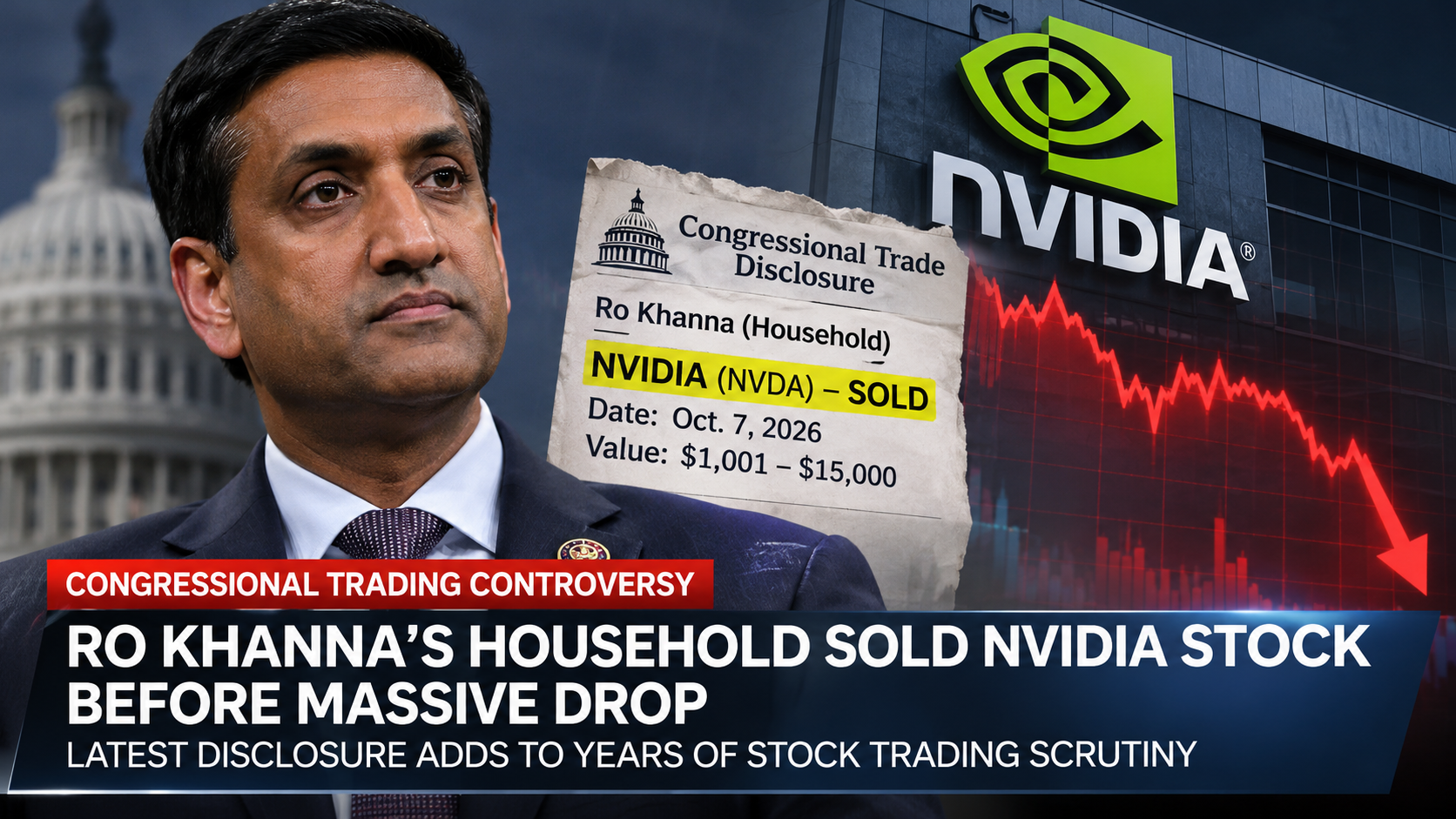
Democratic Congressman Ro Khanna of California is facing renewed scrutiny after financial disclosures revealed that his household sold Nvidia stock weeks before the technology giant suffered a major market decline. But the transaction is only the latest in a long history of stock trading associated with the congressman’s household.
According to congressional financial disclosures, Khanna’s spouse sold Nvidia shares valued between $1,001 and $15,000 on October 7, 2026. The transaction was disclosed on November 9, shortly before Nvidia experienced significant market turbulence.
The timing has raised questions about congressional stock trading, particularly because Khanna has publicly supported legislation restricting lawmakers and their families from trading individual stocks.
Nvidia’s decline followed reports concerning CEO Jensen Huang and allegations involving a personal relationship with a woman suspected of connections to Chinese intelligence. Those suspicions have not been established as fact. The controversy, combined with broader market pressures, contributed to concerns about the company’s leadership and future.
For ordinary investors, the decline meant substantial financial losses. Khanna’s household, meanwhile, had already sold at least some Nvidia shares before the turmoil.
The disclosure does not establish that Khanna personally directed the transaction or that his household sold its entire Nvidia position. Nevertheless, the timing adds to a much larger debate about the financial activities of elected officials.
A History of Thousands of Stock Transactions
The Nvidia sale was far from an isolated investment decision.
Congressional trading analyses indicate that Khanna’s household reported more than 4,000 stock transactions during 2025 alone, involving hundreds of publicly traded companies.
Those investments have included major corporations such as Amazon, Apple, Netflix, Alphabet, and numerous financial institutions and technology companies.
Additional disclosures during 2026 documented transactions involving Intel, Oracle, Netflix, Bank of America and other prominent businesses.
The sheer volume of trading has made Khanna’s household one of the most active among members of Congress, despite his public support for restricting congressional stock ownership and trading.
That contradiction deserves attention.
Khanna represents a district in the heart of Silicon Valley, placing him at the center of debates involving artificial intelligence, technology regulation, federal spending and national security.
His congressional position gives him influence over policies affecting some of the same industries represented in his household’s investment portfolio.
There is no established evidence that those investments were made using confidential government information. But the potential appearance of a conflict of interest is precisely why congressional stock trading has become such a controversial issue.
Questions About Investment Performance
Khanna’s household has previously attracted attention over reports suggesting that its investments substantially outperformed broader market benchmarks.
A June 2026 report cited an analysis claiming unusually strong investment returns associated with the household’s trading activity.
Such estimates depend on the methodology used and do not independently establish wrongdoing.
Nevertheless, the combination of extensive trading, reported investment performance and transactions involving companies affected by federal policy has generated legitimate questions about whether congressional households should participate in individual stock markets.
Khanna has maintained that investment decisions are handled independently and that he does not personally direct the trades.
That distinction matters legally, but it does not eliminate the broader public concern.
Americans who work ordinary jobs rarely have the political connections, industry access or proximity to federal policymaking enjoyed by members of Congress.
Even when investments are managed by spouses or financial professionals, the appearance of privileged access can damage public confidence.
The Nvidia Sale Raises New Questions
The October Nvidia transaction is particularly noteworthy because of its timing.
The shares were sold weeks before the company’s sharp decline, allowing the household to avoid subsequent losses on the shares that had been sold.
However, the public records do not establish why the sale occurred, whether it was part of a broader investment strategy or whether anyone anticipated the events that followed.
They also do not establish that Khanna’s household liquidated its entire Nvidia position.
Those unanswered questions make transparency essential.
Khanna should explain whether he knew about the transaction beforehand, who authorized it and whether the investment decisions were made through an independently managed account.
The public should also be able to determine whether similar transactions occurred before other significant market movements.
A pattern of trading activity is documented. A pattern of knowingly avoiding stock crashes has not been established.
Congress Continues to Police Itself
The controversy exposes a problem that extends far beyond one congressman.
Members of Congress help write laws governing corporations, financial markets, international trade, government contracts and emerging technologies.
Those decisions can influence the value of publicly traded companies.
Yet lawmakers and their households have continued reporting transactions involving businesses affected by federal policy.
Under the STOCK Act, qualifying securities transactions generally must be disclosed within 45 days. The October 7 Nvidia sale was reported on November 9, within that legal deadline.
But complying with disclosure requirements is not the same as eliminating potential conflicts of interest.
Khanna’s public support for congressional trading restrictions makes the continued activity within his own household especially worthy of scrutiny.
If lawmakers believe congressional stock trading creates unacceptable conflicts, Americans have every reason to question why those transactions continue while reforms remain unfinished.
Americans Deserve Answers
The issue is not whether every profitable stock transaction involving a politician is evidence of corruption. It is whether the existing system provides enough protection against conflicts of interest and the possibility of privileged information being exploited.
Khanna’s household has reported thousands of transactions involving major American corporations. Its Nvidia sale before a substantial decline adds another reason for the public to demand greater transparency.
No evidence presented in the public disclosures establishes insider trading or illegal conduct by Khanna or his spouse.
But the volume of trading and the congressman’s influence over technology policy make these transactions a legitimate matter of public interest.
Congress has spent years debating restrictions on lawmakers and their families trading individual stocks. Meanwhile, the transactions continue.
Americans deserve a system in which elected officials are held to clear standards, potential conflicts are addressed and financial transparency is more than a paperwork requirement.
Until those reforms become reality, every unusually timed congressional stock transaction will continue raising the same question: Are the people writing the rules playing by the same standards as everyone else?