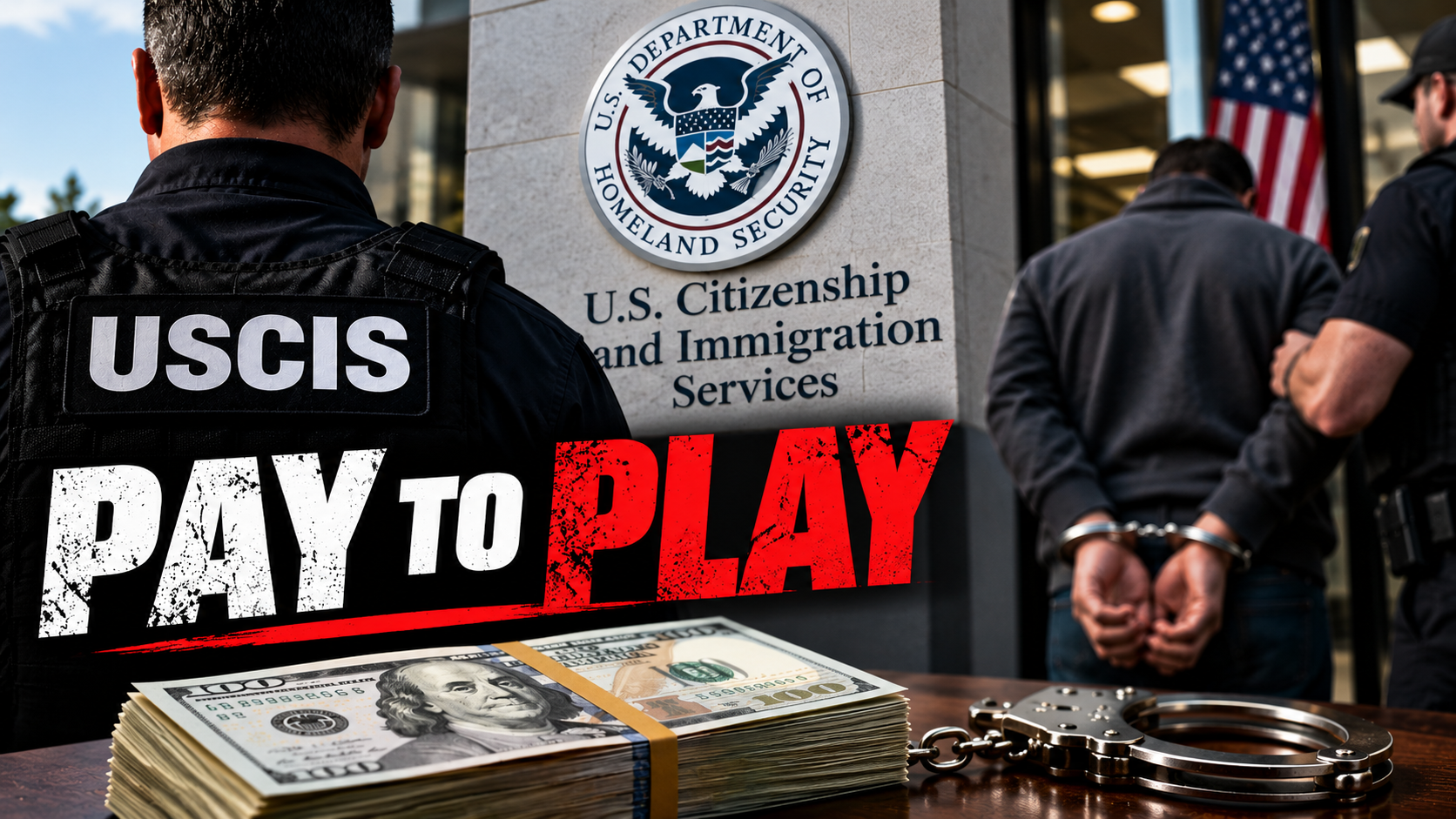
Federal prosecutors in Dallas have charged a former senior officer of U.S. Citizenship and Immigration Services and an associate with conspiracy after investigators say the pair spent more than six years taking money to push green cards, family petitions and citizenship cases through the system. The accusations remain unproven. Both men are presumed innocent.
A criminal complaint is an allegation, not a finding of guilt. Lukman Owolabi Ganiyu, identified as a former Senior Immigration Services Officer with USCIS, and Adeniyi Akeem Somoye were arrested on September 2 after a sealed complaint was filed August 31 in the Northern District of Texas. U.S. Attorney Ryan Raybould announced the case two days later.
Each faces a single count of conspiracy to receive illegal gratuities by a public official. The charge carries a maximum of five years in prison and a $250,000 fine. Prosecutors say the scheme ran from December 2019 through March 2026, the same month Ganiyu left the agency. Court documents described in later reporting say he resigned citing personal reasons rather than being immediately removed as the investigation closed in.
According to the Justice Department, Ganiyu used his official position to approve four core benefit forms in exchange for money: Form I-130, the petition for an alien relative; Form I-485, the application to register permanent residence or adjust status, commonly known as the green card filing; Form I-751, the petition to remove conditions on residence; and Form N-400, the application for naturalization. Investigators allege he did more than hurry paperwork. The complaint, as summarized by the U.S.
Attorney’s Office, says Ganiyu bypassed required interviews, supervisory review, jurisdictional limits, background checks and ordinary USCIS processing rules. Prosecutors further allege that many of the applicants were not eligible under federal law. That last claim is central and still untested in court. The government has not publicly released a complete list of cases, a count of approvals or the identities of the applicants.
What it has said is that payments lined up with approvals Ganiyu issued and that communications tied the two men to the people whose files they handled. Reporting based on the complaint fills in how the alleged rerouting worked. Ganiyu is accused of pulling files out of field offices in Minneapolis, Charlotte and Houston so he could control and approve them himself, away from the supervisors who would normally have reviewed those cases. That is the jurisdictional allegation in concrete terms.
Immigration interviews, background checks and local supervisory sign off exist precisely so one officer cannot quietly take over a file from another city and stamp it. Somoye is not described as a government employee. Prosecutors cast him as the financial partner. The official press release says the two men together collected hundreds of thousands of dollars from applicants and that several payments correspond directly with Ganiyu’s approvals.
Court records obtained by the New York Post go further and should be treated as allegations drawn from the complaint, not as established totals. Those records, as reported, attribute to Ganiyu about $671,438 received through Zelle and Cash App plus about $287,830 in cash deposits, a combined figure near $960,000.
Somoye is described as moving roughly $1.7 million in transfer volume through banks, Zelle and Cash App, a number prosecutors themselves treat with caution because money allegedly moved back and forth among the men and applicants, inflating the gross flow. The same reporting cites about $449,010 in cash deposits tied to Somoye. The distinction matters. Transfer volume is not the same as net profit.
The Justice Department’s own public statement stayed with “hundreds of thousands of dollars.” The larger figures come from the underlying affidavit as described by a newspaper that obtained it. Until those exhibits are tested, both descriptions should sit side by side. Investigators also compared the money to reported income.
Ganiyu’s government salary was described as about $67,732 a year. Somoye’s claimed legitimate wages were described as about $7,506 a year. Those figures, if accurate, explain why the cash and app transfers drew attention. They do not, by themselves, prove every dollar was an illegal gratuity.
The communications trail is unusually detailed for an opening charging document. Agents say they recovered thousands of WhatsApp messages and hundreds of calls among Ganiyu, Somoye and numerous applicants during the charged period. Most of the citizenship applications at issue, prosecutors told reporters, came from African countries. The government has not said how many files were involved.
One allegation reaches the alleged middleman himself. Prosecutors say Ganiyu fast tracked citizenship for Somoye, then approved residency for Somoye’s wife and child. If proven, that would mean the officer did not only sell access to strangers. He is accused of using the same machinery for his partner’s household.
No attorneys, additional USCIS officers or named intermediaries have been charged in the public materials released so far. That absence is not proof the circle stopped at two men. It is simply where the case stands. The investigation was conducted by the USCIS Office of Investigations, the Department of Homeland Security Office of Inspector General and the FBI’s Dallas Field Office.
Assistant U.S. Attorney Chad Meacham is prosecuting. Ganiyu also appeared in a related magistrate matter in the Western District of Texas after his arrest, where a judge ordered him detained without bond, a sign prosecutors viewed him as a flight or safety risk at the first appearance stage. Detention pending further proceedings is not a conviction.
The case lands on a sore point inside the immigration system. Interviews, background checks and supervisory review are the ordinary brakes on a single officer’s power. If the government’s account is true, those brakes failed for years across multiple cities while digital payments and encrypted chats ran in the open. If the government’s account is overstated, two men have been publicly tied to nearly a decade of corruption on a complaint that has not yet faced a grand jury indictment or a trial.
For now the record is this. Two defendants. One conspiracy count. Alleged payments tied to family petitions, green cards, lifting of conditions and citizenship.
Alleged shortcuts around interviews, background checks, jurisdiction and supervisors. A money trail of apps and cash. A resignation in March. Arrests in September.
No verdict. What happens to the people who received those approvals is a separate question the charging papers do not answer. Benefits obtained through fraud can be revisited. Whether USCIS will reopen a defined set of files, and how many files that set contains, has not been announced.