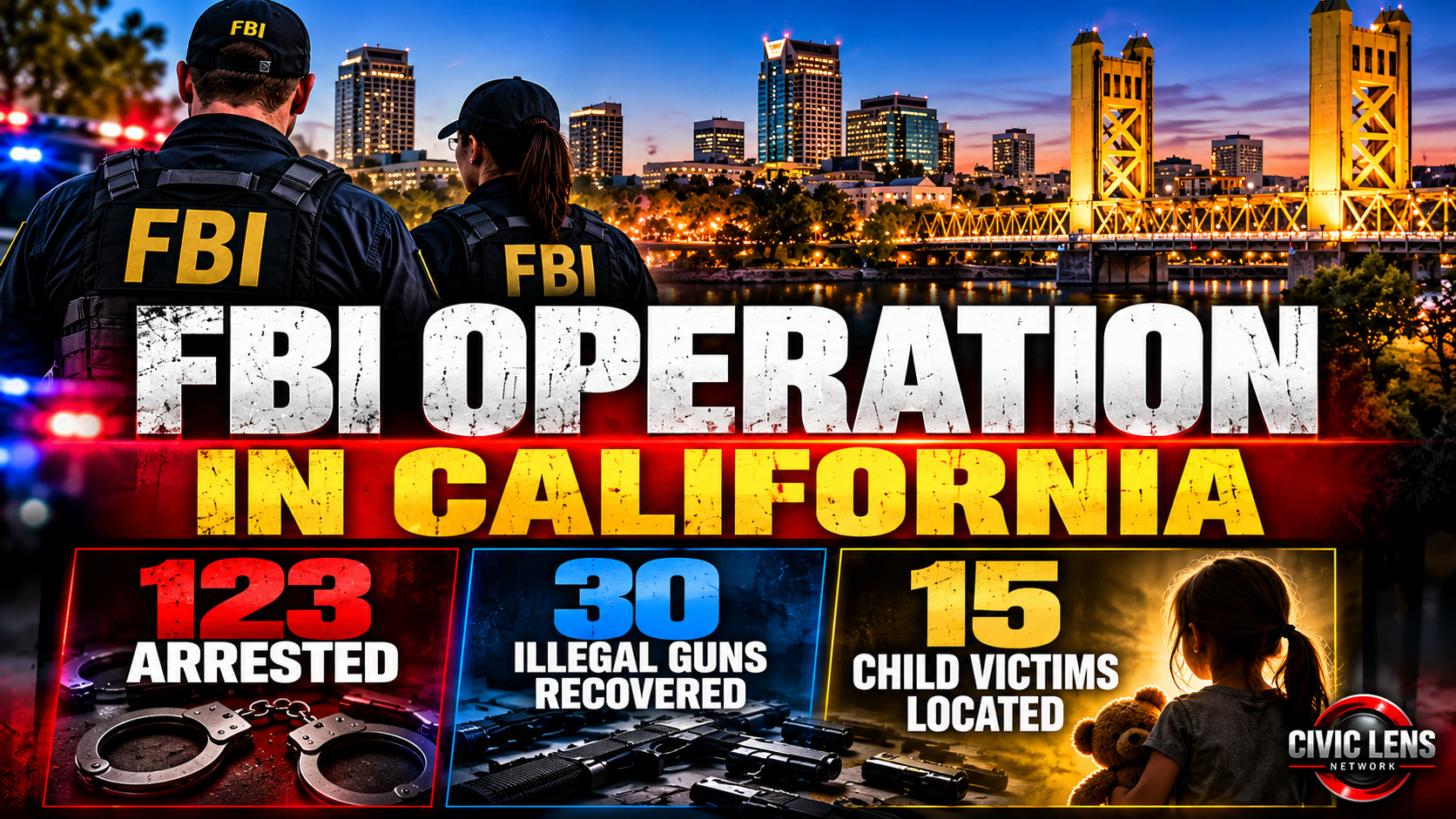
Federal authorities working under the FBI Sacramento Field Office arrested 123 people across a 34-county stretch of Northern and Central California during a four-month surge against violent crime, recovering 30 illegal firearms and identifying or locating 15 children who were victims of violent crime. The effort, known as Operation Summer Heat 2.0, ran from June 1 through September 30, 2026. It formed part of a nationwide FBI initiative involving all field offices and partners at every level of government.
In the Sacramento division’s territory, which covers the Eastern District of California, agents and task force officers also conducted 69 drug seizures that removed 7.5 kilograms of fentanyl, 562.03 kilograms of methamphetamine, 56.63 kilograms of cocaine, and nearly one kilogram of MDMA from circulation. Acting Special Agent in Charge Brian Tosh described the results as evidence of a sustained focus on violent offenders.
“This second year of Operation Summer Heat clearly demonstrates the FBI’s focus on crushing violent crime and the whole-of-government approach necessary to ensure safer communities,” he said. “We are surging resources and working shoulder-to-shoulder with our law enforcement partners at all levels to remove violent crime and dangerous drugs from the communities we serve.”
Nationwide, the same operation produced 8,927 arrests, the recovery of 5,013 illegal weapons, the seizure of 687 kilograms of fentanyl and 27,512 kilograms of cocaine, and the identification or location of 1,410 child victims of violent crime. Those figures, released by the FBI, followed reported national declines in violent crime in 2025. The Sacramento Field Office’s jurisdiction spans 34 of California’s 58 counties, from the Oregon border south through the Central Valley and east to the Sierra Nevada.
Headquarters is in Roseville, with resident agencies in Bakersfield, Chico, Fresno, Redding, South Lake Tahoe, Stockton, and Vacaville. The operation targeted violent criminals and fugitives, efforts to dismantle violent gangs, the identification and recovery of child victims, and violent crime cases in Indian Country. Local, state, and other federal partners participated, though officials have not released a comprehensive list of specific agencies involved in the 123 arrests. Public announcements describe the 123 arrests as involving violent offenders.
They do not provide a breakdown by category, such as how many involved homicide, assault, robbery, drug trafficking, firearms offenses, human trafficking, or outstanding warrants. No names of the arrested individuals have been released in connection with the operation’s aggregate results, nor have officials disclosed prior convictions, parole status, or the number of cases that involved previously released individuals. Court filings and local records may contain additional details in individual cases, but those have not been aggregated or publicly linked to the Summer Heat totals.
The 15 children were described by the FBI Sacramento office as having been “identified/recovered” and by local reporting as “child victims of violent crime” who were “found or identified.” Official language does not specify that all, or even most, were rescued from trafficking. In FBI Violent Crimes Against Children investigations, “identified or located” can encompass missing children who were found, children identified as victims through forensic or investigative work (including in cases involving sexual abuse or exploitation), and children recovered from environments involving violence.
The precise circumstances of these 15 cases have not been detailed publicly, consistent with practices that protect victim privacy and ongoing investigations. Nationally, the 1,410 figure similarly refers to children identified or located in violent crimes against children investigations. The 30 illegal firearms recovered in the Sacramento region are described only as illegal weapons.
No public information has been released on specific types (handguns, rifles, ghost guns, or converted weapons), the circumstances of each recovery, or whether particular firearms were linked to other open investigations or shootings. Across the country, the operation recovered more than 5,000 illegal weapons. Authorities have stated that the operation sought to disrupt violent gangs and remove repeat violent offenders, but they have not identified specific organized networks, named gangs, or trafficking organizations dismantled solely through the Sacramento portion of Summer Heat 2.0.
Earlier related efforts in the region have targeted groups involved in drug and firearms trafficking, including cases involving Sureño-linked activity. Whether any of the 123 arrests involved individuals with documented histories of prior violent crime, warrant failures, or repeated releases remains outside the publicly released totals. The concentration of effort across the 34-county region reflects the FBI’s assessment of violent crime, gang activity, drug distribution corridors, and crimes against children in both urban centers such as Sacramento, Fresno, Stockton, and Bakersfield and surrounding communities.
Officials have not published a list of specific neighborhoods prioritized within that territory. No statements from local prosecutors or additional Sacramento-area law enforcement agencies detailing the 123 arrests have accompanied the FBI’s release. Federal prosecutors in the Eastern District of California have handled related drug and firearms cases in the region, but none have been publicly tied by name to these aggregate figures. Officials have not indicated whether further federal indictments stemming from the operation are imminent, though individual cases continue through the courts.
The results arrive against a backdrop of reported national declines in violent crime. In Northern California, persistent challenges include the flow of fentanyl and methamphetamine, illegal firearms in the hands of prohibited persons, and the exploitation of children. The FBI has framed the operation as an ongoing demonstration that coordinated enforcement can remove offenders and seize contraband even as overall reported crime rates fall.
Whether the 123 arrests and related recoveries produce measurable, sustained reductions in specific communities will depend on continued prosecutions, local enforcement, and data that have not yet been released.