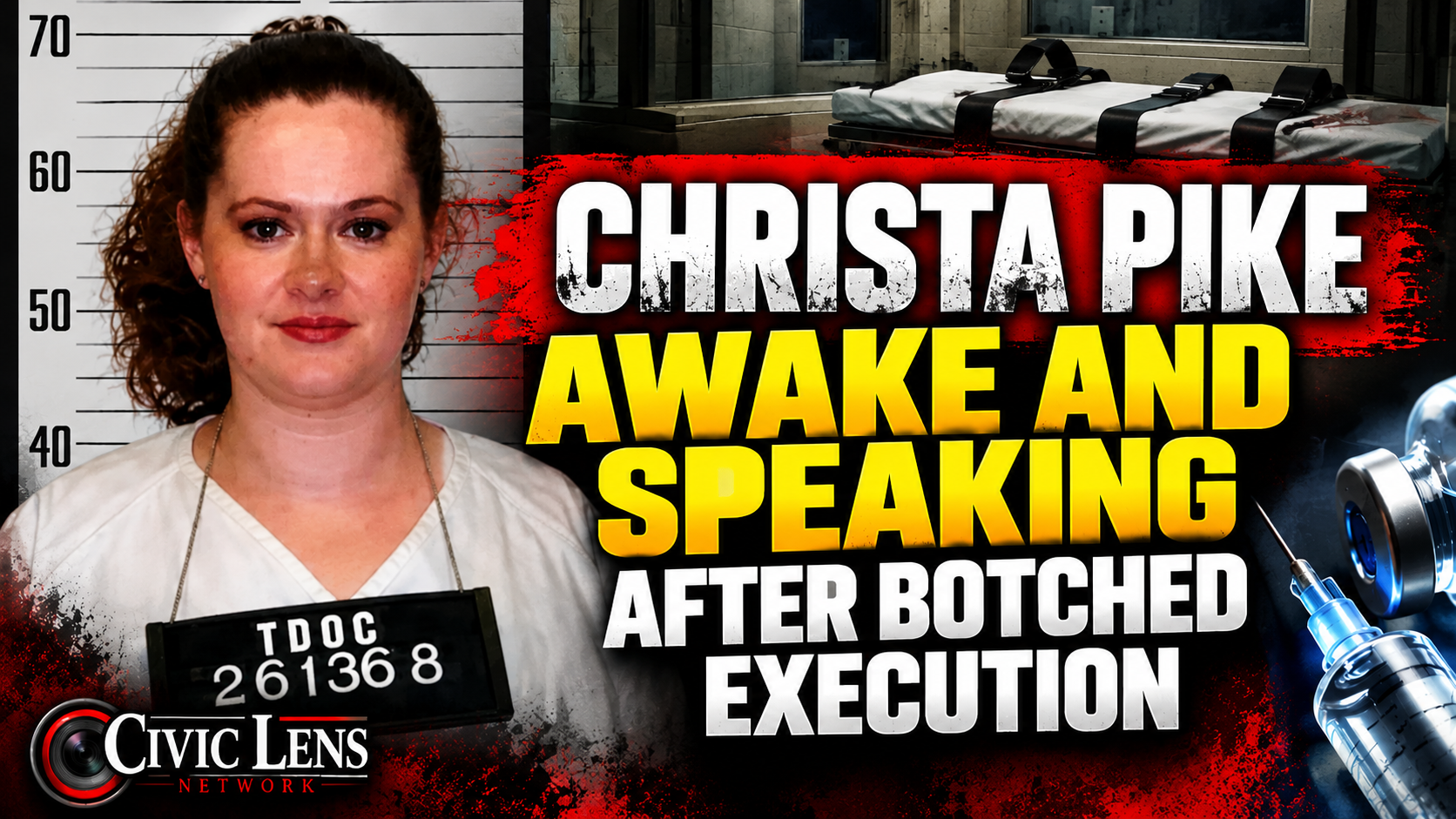
Christa Pike is conscious and speaking nearly a week after Tennessee tried to execute her, her attorneys said Tuesday. In a statement issued October 6, lawyers for the 50 year old inmate reported that she remains under critical medical care in a Nashville area hospital. “Against all odds, Christa Pike is conscious, speaking, and continues to receive critical medical care,” the statement said. “Despite the severe damage she endured to her arms, she is still handcuffed and shackled to the bed.
Her recovery is medically unprecedented. Her prognosis remains unclear but, at a minimum, we expect a long recovery.” The attorneys thanked hospital staff and first responders for treating her and said she is taking recovery one day at a time. As recently as Sunday, they had described her as unconscious and on a ventilator while doctors worked to clear pentobarbital from her system.
Pike survived two doses of pentobarbital during the September 30 attempt at Riverbend Maximum Security Institution. Media witnesses said the curtains opened around 7:26 p.m. Pike gave last words expressing peace and readiness. Minutes later she complained of severe pain in her arm.
One witness reported her saying, “My arm feels like it’s about to burst open,” and that one spot was throbbing. She continued breathing, took deep breaths, yawned, and later snored loudly with her mouth open. Witnesses described sounds of choking or gasping, and at points her body lifted or flexed. Curtains closed and reopened as a second dose was given.
She could still be heard snoring and breathing after the second dose. The microphone was cut and witnesses were asked to leave around 8:53 p.m. An ambulance then took her to a hospital. Her attorneys have said both arms arrived swollen, burned, and blistered.
In court filings they alleged that intravenous lines were poorly placed, that multiple needles were used, and that the drug entered surrounding tissue rather than the bloodstream. Those claims remain allegations pending review. State officials have not confirmed the cause. The Tennessee Department of Correction said the night of the attempt that it followed every step of the state’s lawful execution protocol approved by the attorney general’s office.
The department added that the protocol does not allow further procedures beyond what was carried out and that Pike had been taken to an off site medical facility. Governor Bill Lee called the outcome highly disappointing and ordered a comprehensive third party review. He postponed the remaining execution scheduled for 2026, that of Gary Wayne Sutton. Corrections Commissioner Frank Strada later submitted his resignation, saying he believed the department followed protocol but that stepping aside served the review.
Former U.S. Attorney Ed Stanton was retained to examine whether the protocol was followed and whether changes are needed. Pike was convicted of first degree murder and sentenced to death in 1996 for the January 12, 1995, killing of 19 year old Colleen Slemmer in Knoxville. Court records state that Pike, then 18, and her 17 year old boyfriend Tadaryl Shipp lured Slemmer, a Job Corps classmate, to a wooded area.
Slemmer was beaten and slashed over a period of time before Pike struck her in the head with a piece of asphalt. A pentagram was carved into her chest. Shipp received a life sentence. Slemmer’s mother, May Martinez, has said the failed attempt left the family facing more uncertainty.
She told a local station she had a feeling Pike would survive and that officials will decide what comes next. Tennessee has not said whether it will seek another execution date. The U.S. Supreme Court held in a 1947 case that a second attempt after an accidental failure does not automatically violate double jeopardy or the ban on cruel and unusual punishment.
Legal observers note that Pike’s case differs because two full doses were administered and she suffered documented injuries. Any future effort would face arguments under the Eighth Amendment concerning the method, the prior suffering, and her medical condition if lasting harm is found. Those arguments have not been ruled on. Investigators will need to establish why the doses did not kill her, including whether intravenous placement, drug delivery into tissue, the condition of the drug, or other procedural factors played a role.
The independent review and any preserved evidence are expected to address those questions. Pike’s death sentence remains in place while she receives care and her long term prognosis stays unclear.