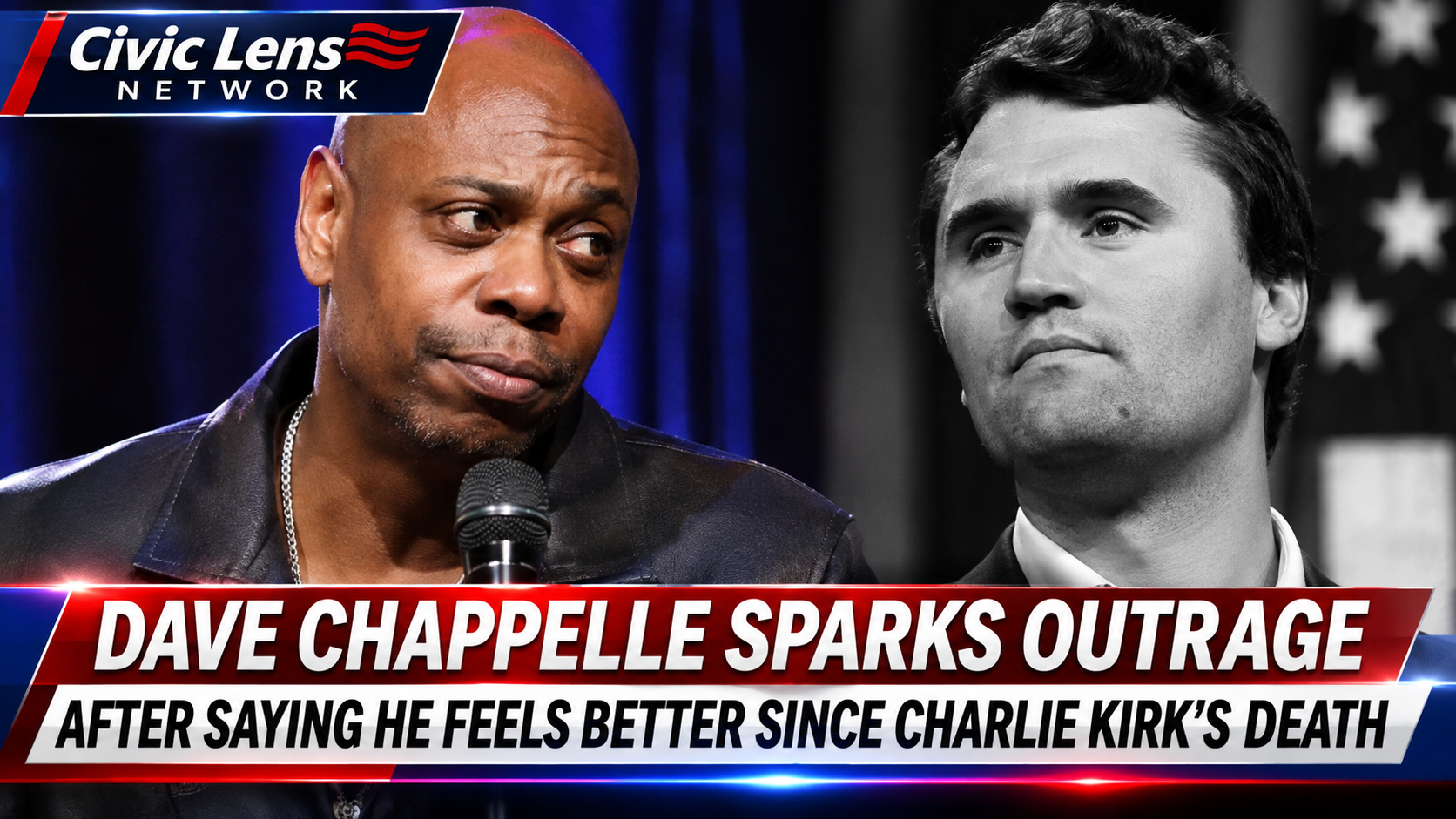
Comedian Dave Chappelle is facing fierce backlash after telling a packed audience at Madison Square Garden that he feels better following the assassination of conservative activist Charlie Kirk, turning the killing of a husband, father and political commentator into material for a stand-up comedy routine.
The remarks, captured in video footage that circulated across social media, have ignited a national debate over the boundaries of comedy, the treatment of political violence and whether American entertainers have become dangerously comfortable making light of assassination.
Chappelle made the comments during his Karmageddon tour at Madison Square Garden in New York City over the weekend.
The comedian acknowledged that his remarks might be controversial before telling the audience that he felt better since Kirk’s murder.
He continued by joking about unexpectedly finding himself in a good mood.
Audience members could be heard laughing at the routine.
For critics, the performance crossed a serious moral boundary. What Chappelle presented as comedy concerned the assassination of a real person whose family continues to live with the consequences.
A Joke That Sparked National Outrage
Charlie Kirk, the 31-year-old founder of Turning Point USA, was assassinated on September 10, 2025, while speaking at Utah Valley University in Orem, Utah.
Kirk had built a national following through conservative political activism, campus debates and his efforts to encourage young Americans to participate in political discussions.
His killing shocked the country and intensified concerns about threats against public figures.
More than a year later, Chappelle brought Kirk’s death into his stand-up performance.
The comedian opened the routine by discussing the dangers of being a public speaker, a subject with personal significance because Chappelle himself was attacked while performing onstage in Los Angeles in 2022.
He then suggested that Kirk’s murder had left him feeling unexpectedly better.
The comments were delivered as jokes, but critics questioned why the violent death of a political figure should become a source of laughter.
The controversy quickly spread beyond the arena as clips of the performance circulated online.
Political commentators, entertainers and members of the public condemned the remarks.
The backlash was not simply about whether Chappelle had the legal right to make the joke. It concerned whether the entertainment industry should treat the assassination of a political opponent as acceptable comedic material.
Erika Kirk Condemns Jokes About Political Assassination
Among the most powerful responses came from Charlie Kirk’s widow, Erika Kirk.
She condemned the growing tendency of comedians and commentators to turn political killings into entertainment.
Erika reminded the public that her husband was not merely a political personality or a subject for online arguments.
He was a husband and father whose death permanently changed the lives of his wife and two children.
She described the use of political assassination as a comedic punchline as deeply disturbing and warned that a culture willing to laugh at such violence risks losing respect for human life.
Her statement emphasized that political disagreements should never determine whether a person’s life deserves basic human dignity.
The reaction highlights a reality that can become lost in America’s increasingly hostile political environment.
Charlie Kirk’s family did not experience his assassination as a political argument or an internet controversy.
They experienced the permanent loss of someone they loved.
Elon Musk and Other Public Figures Respond
The controversy drew reactions from prominent public figures.
Elon Musk publicly condemned Chappelle’s comments, expressing shame over the comedian’s remarks.
Conservative commentator Benny Johnson also criticized the routine, arguing that making light of Kirk’s assassination should not be treated as ordinary comedy.
British broadcaster Piers Morgan questioned the remarks, particularly because Chappelle himself survived an attack while performing onstage.
The criticism reflected a broader concern about how political violence is discussed in public.
If threats against comedians, journalists and entertainers are considered unacceptable, critics argue that the same principle should apply to political activists regardless of their ideology.
Political disagreement does not erase a person’s right to live without violence.
The Contradiction in Chappelle’s Own Experience
One of the most striking aspects of the controversy involves Chappelle’s personal history.
In May 2022, the comedian was attacked during a performance at the Hollywood Bowl in Los Angeles.
A man rushed onto the stage and tackled him before security intervened.
The incident received national attention and raised concerns about the safety of performers.
Chappelle’s experience demonstrated how quickly a public appearance can turn dangerous.
Charlie Kirk was also speaking before a live audience when he was attacked, although the outcome was tragically different.
Critics have questioned how someone who personally experienced violence during a public performance could later joke about feeling better following another public speaker’s murder.
The circumstances were not identical, but both incidents involved individuals targeted while addressing an audience.
That shared experience makes Chappelle’s remarks particularly controversial.
Comedy, Free Speech and Responsibility
Dave Chappelle has built much of his career around provocative humor.
His comedy frequently challenges political sensitivities, social conventions and expectations about what entertainers should be allowed to say.
He has defended the importance of artistic freedom while facing criticism over previous performances.
That history makes the latest controversy more complicated than a simple dispute over offensive language.
Chappelle has the right to perform controversial material, and audiences have the right to criticize it.
But freedom of speech does not mean freedom from public accountability.
A comedian can legally joke about a murder while members of the public question the judgment behind that decision.
There is also an important distinction between joking about political beliefs and making the death of a political opponent the subject of laughter.
Chappelle’s defenders may view the routine as dark humor about his own feelings and fears rather than an endorsement of violence.
His comments began with a reference to the dangers of public speaking, and he acknowledged that his reaction was something he felt uncomfortable admitting.
The complete, unedited performance has not been publicly released, leaving some uncertainty about the broader context.
Nevertheless, the remarks themselves have been reported consistently, and the reaction they generated is undeniable.
The central controversy is not whether Chappelle intended to make an audience laugh.
It is whether laughter about an assassination contributes to a culture increasingly willing to minimize political violence.
A Growing Pattern of Jokes About Kirk’s Death
Chappelle is not the only entertainer facing criticism over remarks involving Charlie Kirk’s assassination.
Other comedians and political commentators have also made jokes referencing Kirk’s death.
The hosts of the political podcast I’ve Had It recently faced backlash after laughing at a joke about the assassination.
Following criticism and the loss of advertising support, the hosts issued an apology acknowledging that their reaction was insensitive.
The controversy has intensified concerns about how political hostility is influencing entertainment.
When violence becomes a recurring punchline, critics worry that the distinction between condemning an assassination and enjoying the death of a political opponent begins to disappear.
Not every offensive joke represents genuine support for violence.
However, repeated public laughter about political killings can still be disturbing to families and communities affected by those acts.
The debate extends beyond one comedian or one political movement.
It raises questions about the standards Americans should expect from influential public figures.
Charlie Kirk Previously Defended Chappelle
Another detail has drawn attention during the controversy.
After Chappelle was attacked onstage in 2022, Charlie Kirk publicly expressed concern about the legal response to the incident.
Kirk warned that failing to take attacks against public speakers seriously could encourage further political violence.
His remarks reflected the position that people should not be physically attacked because of what they say.
That history adds another dimension to the current controversy.
Kirk had defended the principle that Chappelle deserved protection from violence.
Now, following Kirk’s assassination, Chappelle is facing criticism for joking that he felt better after the conservative activist’s death.
For critics, the contrast illustrates the importance of applying the same standards to everyone, even when their political views are sharply different.
Where Does America Draw the Line?
The debate surrounding Chappelle’s performance ultimately reaches beyond entertainment.
Political violence has become a serious concern in the United States, with threats against public officials, activists and other prominent individuals contributing to an increasingly hostile public environment.
The assassination of Charlie Kirk demonstrated the devastating consequences when political disagreement turns into deadly violence.
His death left a family grieving and intensified fears about the safety of Americans who participate in public debate.
Chappelle’s controversial routine has now reopened the question of whether public figures are helping reduce those tensions or making them worse.
There is no evidence that Chappelle’s remarks encouraged anyone to commit violence, and making an offensive joke is not the same as advocating murder.
But critics argue that public figures with enormous audiences carry a responsibility to consider the consequences of how they discuss real tragedies.
The question is not whether comedy should be protected from government censorship.
It should.
The question is whether a society that condemns political assassination should also reconsider the practice of turning those killings into entertainment.
The Human Cost Behind the Headlines
For Erika Kirk and her children, the controversy is not an abstract debate about free speech.
It concerns the death of their husband and father.
While comedians, political commentators and social media users debate whether Chappelle’s routine crossed a line, the Kirk family continues living with a loss that no public controversy can reverse.
Chappelle’s remarks may have been intended as dark comedy, but they have also forced Americans to confront an uncomfortable question.
When a political opponent is murdered, should the reaction be determined by whether people agreed with that person’s beliefs?
A society committed to freedom of speech must also recognize that political disagreement never justifies violence.
And while Americans are free to laugh at offensive comedy, they are equally free to demand greater humanity from those who turn real deaths into punchlines.
The backlash against Dave Chappelle demonstrates that, for many Americans, the assassination of Charlie Kirk remains a tragedy that should never be reduced to a moment of entertainment.