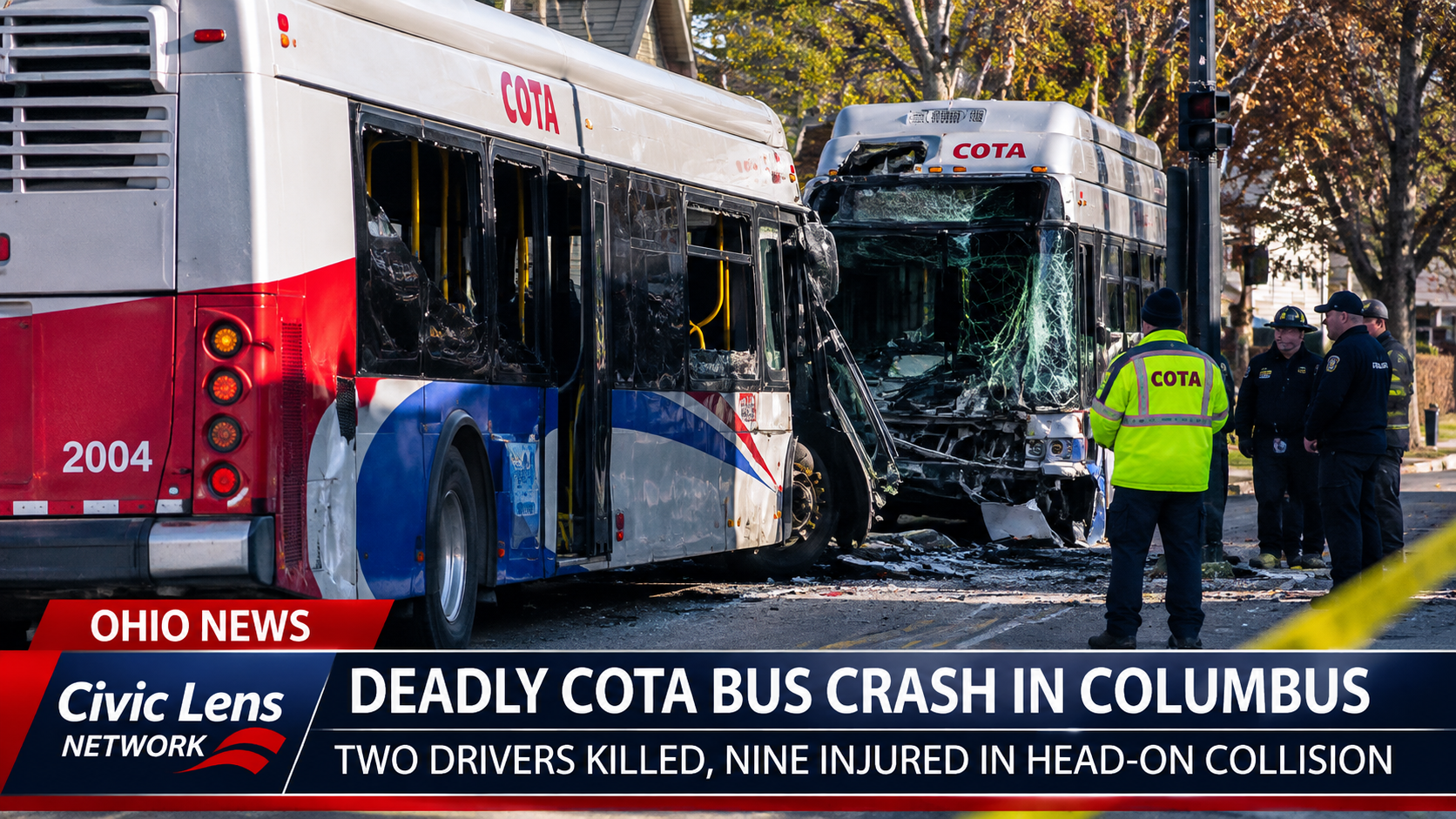
A devastating head-on collision involving two public transit buses in Columbus, Ohio, has left two drivers dead and nine other people injured, raising urgent questions about what caused one of the vehicles to cross into oncoming traffic during Monday morning’s rush hour.
The crash occurred shortly after 8 a.m. on November 23 near East 11th Avenue and North 6th Street, close to the Ohio Expo Center and State Fairgrounds.
According to Columbus police, two Central Ohio Transit Authority (COTA) buses collided head-on before a third vehicle became involved in the wreck.
Emergency responders arrived to find extensive damage to the buses, with firefighters forced to cut into the wreckage to reach people trapped inside.
One bus driver was pronounced dead at the scene. The second was transported to a nearby hospital in critical condition but later died from injuries sustained in the collision.
Nine additional people were transported to Columbus-area hospitals. Authorities reported that their injuries were not considered life-threatening.
Two Veteran Transit Drivers Identified
COTA identified the deceased drivers as 53-year-old Richard Terry and 60-year-old Paul Copeland.
Terry had worked for the transit authority since 2012, while Copeland joined the agency in 2008.
Together, the two men had spent decades serving Columbus-area passengers.
COTA President and CEO Monica Tellez-Fowler and Transportation Workers Union Local 208 President Tyson Brown issued a joint statement expressing their grief over the deaths.
The agency described both men as valued employees who had dedicated their careers to serving the community.
Their deaths have left colleagues mourning while investigators work to determine what happened in the moments before the collision.
Police Say One Bus Crossed the Double Yellow Line
One of the most significant findings in the preliminary investigation concerns the position of the buses immediately before impact.
Columbus Police Sgt. Joseph Albert said investigators believe one of the buses crossed the double yellow centerline and entered the path of the other.
The buses then collided head-on.
Authorities have not established why the bus crossed into opposing traffic.
That unanswered question is now central to the investigation.
Investigators must determine whether the movement resulted from a medical emergency, mechanical problem, driver error, road conditions, or another factor.
None of those possibilities has been established as the cause.
Local reporting indicates that investigators intend to review footage from nearby residential security cameras and cameras installed aboard COTA buses.
Such recordings could help establish the sequence of events leading to the collision.
Third Vehicle Involved in the Wreck
The collision also involved a third vehicle traveling through the area.
According to local reporting, a westbound COTA bus apparently crossed the centerline and struck an eastbound bus. Another vehicle traveling east then collided with the eastbound bus.
Four occupants of the third vehicle were among those injured, while the remaining injured individuals were aboard a transit bus.
Police reported that no pedestrians were injured.
The involvement of multiple vehicles complicated the emergency response, requiring firefighters, police officers, and medical personnel to assist victims across the crash scene.
Transit Agency Faces Difficult Questions
The collision has raised important questions about the safety of public transportation operations in Columbus.
COTA operates bus services throughout central Ohio, transporting passengers who rely on the system for employment, medical appointments, shopping, and other daily activities.
The safety of those passengers depends on properly maintained vehicles, qualified operators, and procedures designed to identify potential hazards.
While there is currently no evidence establishing that a mechanical defect or transit authority policy contributed to Monday’s crash, investigators will need to determine whether any preventable circumstances played a role.
The investigation could examine available vehicle data, maintenance records, operator information, and video evidence as authorities work to reconstruct the collision.
It would be premature to assign responsibility before those findings are available.
However, the severity of the accident makes a thorough investigation essential.
Columbus Officials Respond to the Tragedy
Columbus City Council President Shannon Hardin and Councilmember Lourdes Barroso de Padilla expressed condolences to the victims and their families.
The officials acknowledged the devastating timing of the tragedy, which occurred just days before Thanksgiving.
For the families of Terry and Copeland, the holiday season will now begin with an unimaginable loss.
COTA announced that it is cooperating with investigators and providing counseling and support services to affected employees.
Some bus operators were relieved from duty Monday as part of those efforts, and the agency warned that passengers could experience service delays or cancellations.
What Happens Next?
The Columbus Police Accident Investigation Unit is continuing its examination of the crash.
Among the most important unanswered questions are why the bus crossed the centerline, whether either driver had an opportunity to avoid the collision, and what evidence onboard cameras may reveal.
Investigators have not announced a final determination of the cause.
The tragedy serves as a reminder of how quickly an ordinary morning commute can turn deadly.
Two experienced public transit employees lost their lives while performing their daily responsibilities, and nine other people were hospitalized.
For Columbus residents, the immediate priority is supporting the victims and their families.
The next priority is determining exactly what happened and whether anything could have prevented the collision.
Until investigators establish those facts, the question at the center of this tragedy remains unanswered: Why did one of the buses cross into oncoming traffic?