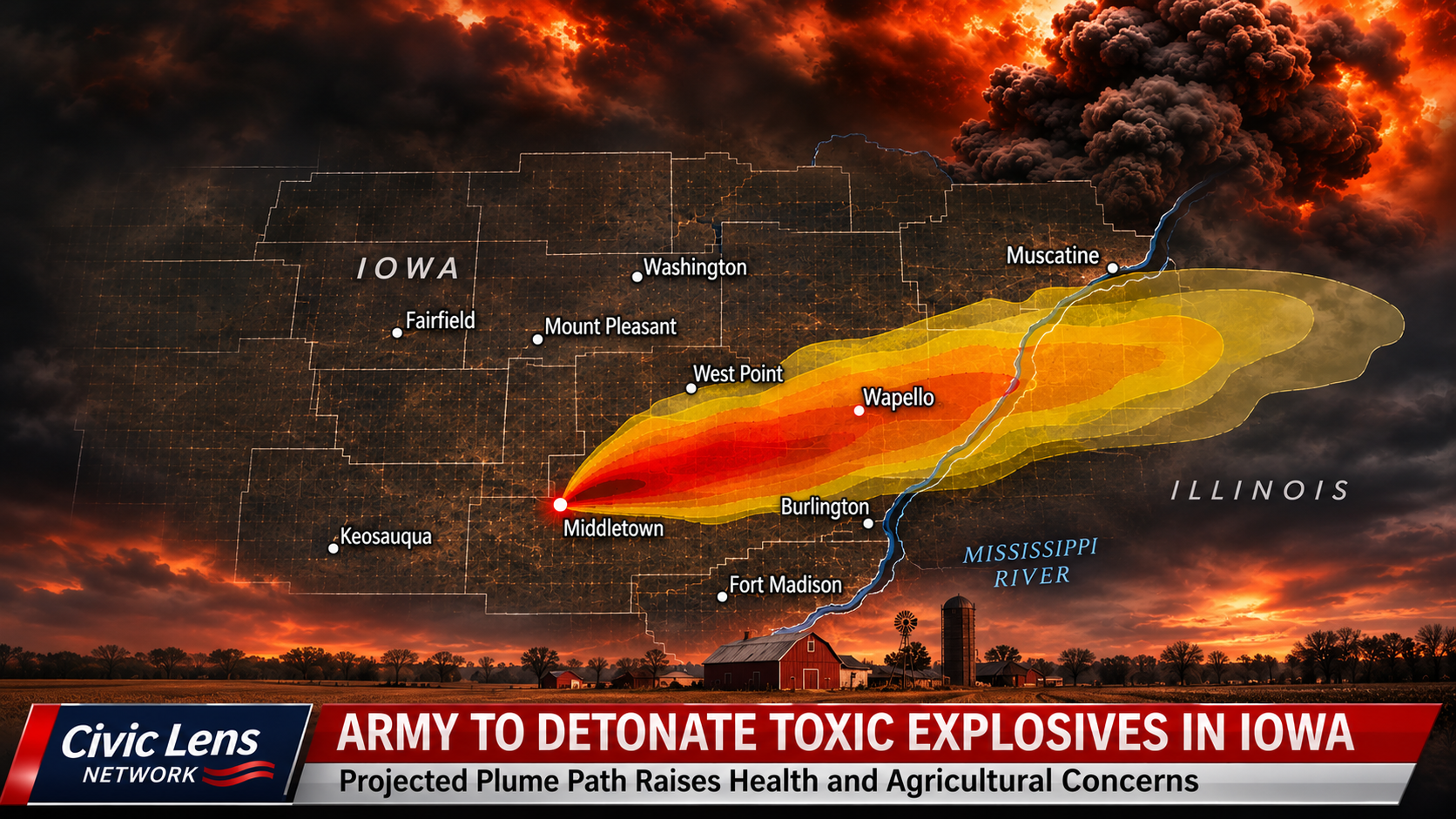
Thousands of Americans in southeastern Iowa are preparing for a potentially hazardous release of toxic lead particles after the United States Army announced it would proceed with the controlled detonation of approximately five tons of deteriorating lead azide at the Iowa Army Ammunition Plant in Middletown.
The operation is scheduled for Wednesday morning, November 25, just one day before Thanksgiving, following a federal appeals court decision clearing the way for the military to destroy the material.
The explosives are contained in 68 barrels that were transferred from a military facility in Texas to Iowa in 2009, during the Obama administration. Once used in military munitions, the compound is no longer needed and has become increasingly unstable after years in storage.
President Donald Trump has blamed the Obama administration for improperly storing the material. However, the stockpile remained at the facility through multiple presidential administrations, raising broader questions about federal oversight and why the situation was allowed to deteriorate.
Military officials contend that attempting to relocate or handle the barrels could trigger an accidental explosion. They also warn that falling temperatures increase the danger, leaving authorities with limited options.
But government records raise serious questions about whether this emergency could have been prevented.
A contractor was approached about disposing of the material as early as 2025. In March 2026, a technical panel reportedly recommended chemical neutralization, an alternative that could potentially have avoided releasing airborne lead particles.
A detailed treatment proposal was submitted in May. Just four days later, the Army decided to proceed with detonation instead. Military officials maintain that the condition of the barrels made chemical treatment unsafe, but questions remain about whether earlier intervention could have prevented the current predicament.
The immediate concern for residents is what happens after the explosion. Lead cannot simply be destroyed through combustion. Particles released during the operation could settle on homes, agricultural land, livestock facilities and waterways.
The U.S. Department of Agriculture has identified approximately 350 farms that could potentially be affected by the projected plume. Farmers have been encouraged to shelter livestock and protect animal feed and water supplies.
For agricultural families, the consequences could extend well beyond a temporary disruption. Contamination could require extensive soil testing, restrictions on agricultural production and costly remediation. Even uncertainty surrounding contamination could create financial difficulties for producers attempting to sell their products.
These are Americans whose livelihoods depend on property they have spent decades maintaining. They had no role in creating the hazardous stockpile, yet they now face the possibility of bearing its consequences.
The Army has installed containment barriers and implemented additional precautions intended to reduce the dispersal of toxic particles. Federal authorities also plan to conduct environmental monitoring before and after the operation.
Residents closest to the facility have been encouraged to temporarily evacuate, while people within a broader surrounding area have received shelter-in-place guidance.
Acting Army Secretary Adam Telle maintains that military specialists and federal agencies agree that a controlled detonation presents less danger than allowing the explosives to detonate unexpectedly.
President Trump temporarily intervened to prevent the operation from proceeding before the federal appeals court addressed the legal dispute. The court subsequently lifted its temporary restriction, acknowledging the dangers associated with both the planned operation and an uncontrolled explosion.
The decision allows the Army to move forward, but judicial clearance should not be mistaken for a guarantee that surrounding communities will escape contamination.
Congress should demand a comprehensive accounting of the stockpile’s storage history, inspection records, maintenance failures and the decision to abandon alternative disposal methods. Officials responsible for overseeing the material should be required to explain their actions under oath.
The federal government must also accept financial responsibility for any damage directly attributable to the operation. Individual property owners should not be forced to finance environmental testing, cleanup or the restoration of contaminated agricultural land because of failures within a federal military installation.
National security requires a capable military, but it also requires competent management of the resources entrusted to it. Supporting America’s armed forces does not mean shielding government administrators from accountability.
Whatever happens Wednesday, the destruction of the explosives must not mark the end of the investigation into how they became a threat to the very Americans the military is charged with protecting.