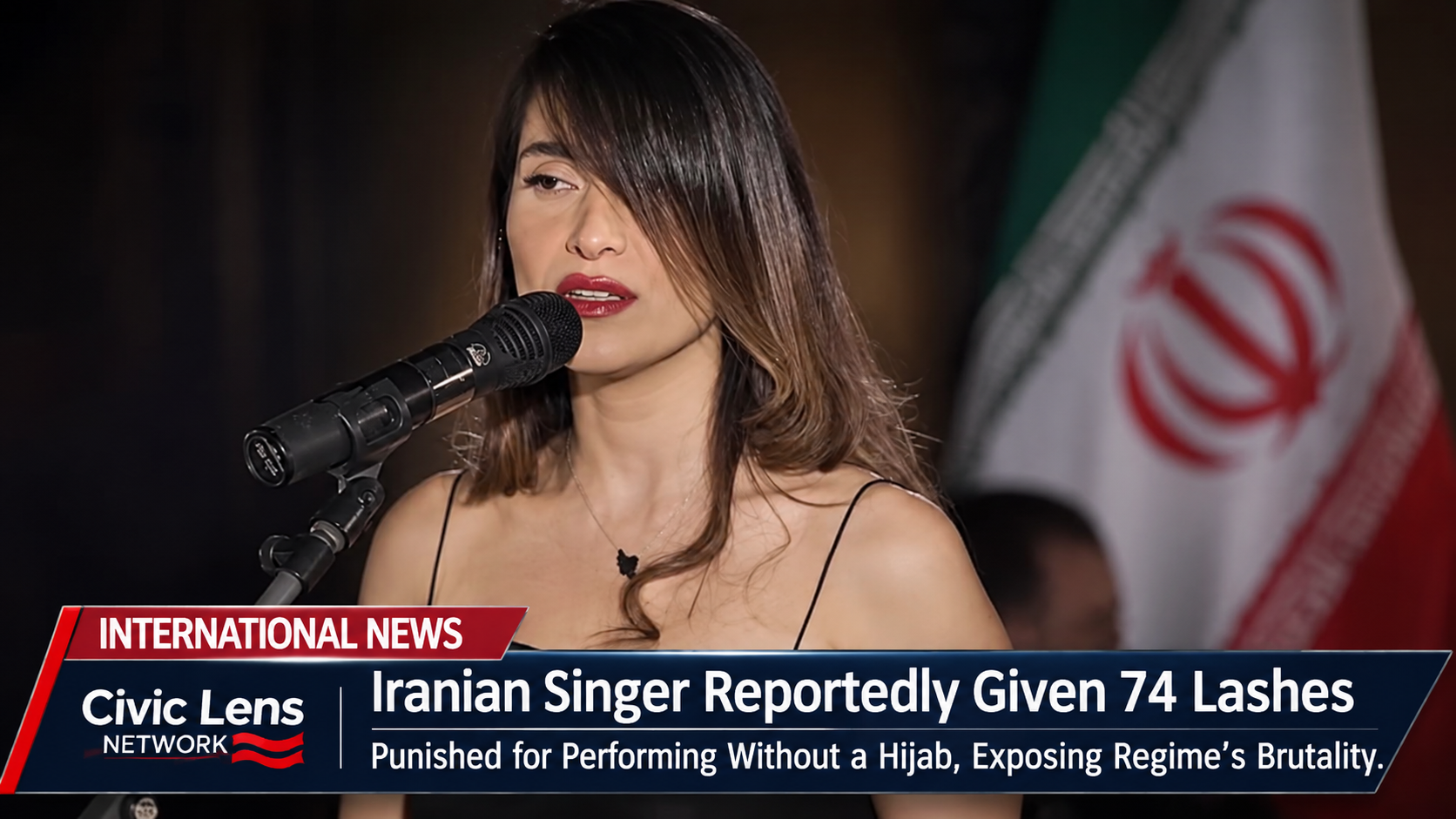
Iran’s Islamic regime has once again demonstrated the horrifying consequences of religious authoritarianism, reportedly carrying out a sentence of 74 lashes against 29-year-old Iranian singer Parastoo Ahmadi for performing without a government-mandated hijab.
Ahmadi and four members of her production team were each subjected to the punishment on Monday, November 23, according to attorney Mostafa Nili. Their alleged crime was not violence, theft, or threatening public safety. It was participating in a musical performance that defied the Islamic Republic’s oppressive restrictions.
The case originated in December 2024, when Ahmadi livestreamed a concert on YouTube from a historic caravanserai near the Iranian city of Qom. Wearing a sleeveless dress with her hair uncovered, she performed traditional Persian music alongside male musicians.
There was no live audience. Nevertheless, the recording attracted millions of viewers online, drawing the attention of Iranian authorities.
In June 2026, an Iranian court convicted Ahmadi and eight associates on charges related to public decency and the distribution of material authorities considered immoral. An appeals court subsequently upheld the punishment in September.
In addition to the flogging, the court imposed two-year restrictions on artistic activities and international travel.
The case offers a disturbing reminder of what happens when government power becomes inseparable from compulsory religious doctrine. Under Iran’s ruling establishment, something as ordinary as a woman singing can become grounds for physical punishment and the destruction of her professional livelihood.
Americans should recognize the enormous difference between voluntarily practicing a religion and living under a government that violently enforces religious obedience.
The United States was founded on principles that protect individuals from precisely this kind of government interference. Freedom of speech, freedom of religious expression and the right to live without compulsory religious observance are fundamental protections that should never be surrendered.
Iran’s mandatory hijab laws have faced growing resistance since the death of 22-year-old Mahsa Amini in September 2022. Amini died after being detained by Iran’s morality police over an alleged violation of the country’s dress requirements.
Her death ignited nationwide demonstrations, prompting a brutal government crackdown. Despite the danger, increasing numbers of Iranian women have continued appearing in public without head coverings.
Amnesty International previously called on Iranian authorities to overturn the sentences against Ahmadi and her colleagues, condemning flogging as an inhumane punishment that violates international protections against torture.
Yet the Iranian government reportedly proceeded with the punishment anyway.
Western leaders should stop treating the Iranian regime as though its systematic persecution of its own citizens is merely a cultural disagreement. Religious liberty does not mean granting governments the unquestioned authority to beat women who refuse to follow state-imposed religious requirements.
Nor should criticism of Iran’s ruling ideology be confused with hostility toward ordinary Iranian citizens or Muslims who freely practice their faith. Many Iranians have themselves demonstrated extraordinary courage in resisting the restrictions imposed upon them.
The distinction is essential. A woman who voluntarily chooses to wear a hijab is exercising her freedom. A government that physically punishes a woman for refusing to wear one is destroying it.
The reported flogging of Ahmadi should serve as a warning to Americans who take their constitutional freedoms for granted. Individual liberty is not guaranteed simply because a government claims to act in the name of morality.
A government that fears a woman singing is not demonstrating moral strength. It is demonstrating the insecurity of an authoritarian establishment that depends upon intimidation to maintain control.
America must remain unapologetic in its defense of constitutional liberty, individual sovereignty and freedom from religious coercion.
No government should possess the authority to whip a woman simply because she chooses to sing with her hair uncovered.