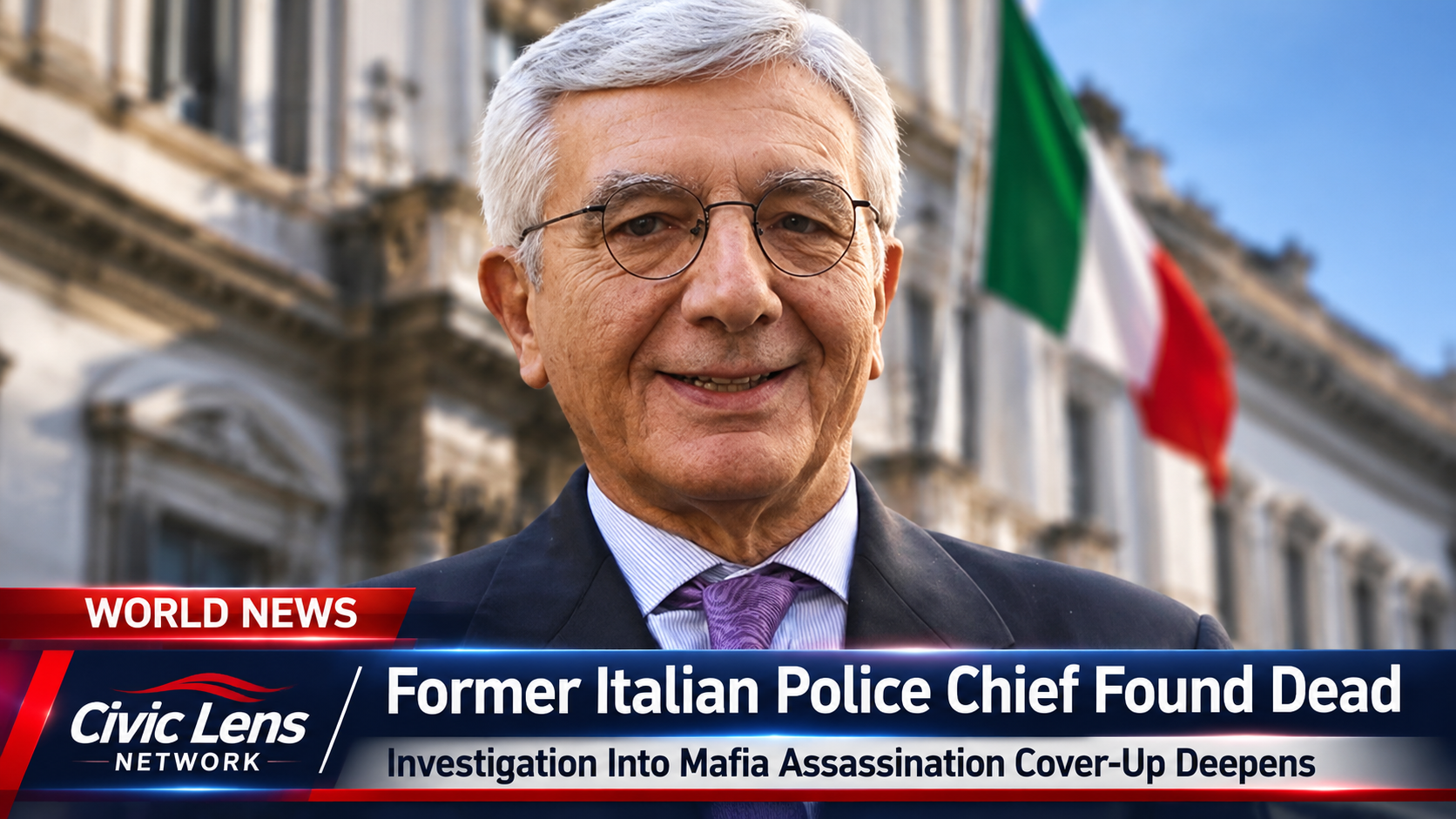
The death of one of Italy’s most powerful former law enforcement officials has sent shockwaves through the country’s political and security establishment, reopening questions surrounding one of the most notorious Mafia assassinations in Italian history.
Gianni De Gennaro, 78, who served as Italy’s national police chief from 2000 to 2007, was found dead Saturday, November 21, 2026, at his country home in Tuscany. Authorities are treating his death as an apparent suicide while prosecutors investigate the circumstances.
His death comes as investigators were examining allegations that he helped obstruct inquiries into the 1992 assassination of anti-Mafia magistrate Paolo Borsellino, a killing that has haunted Italy for more than three decades.
A Powerful Official Under Investigation
De Gennaro was no ordinary police officer. He spent decades working at the highest levels of Italian law enforcement, becoming one of the country’s most influential security figures during its long battle against organized crime.
His career included major responsibilities in the fight against Sicily’s notorious Cosa Nostra Mafia. He worked alongside prominent anti-Mafia investigators, including Giovanni Falcone, whose assassination in 1992 became a defining moment in Italy’s struggle against organized crime.
But De Gennaro’s reputation came under renewed scrutiny when prosecutors in Caltanissetta began investigating allegations of interference with the original inquiry into Borsellino’s murder.
Prosecutors recently sought to place De Gennaro under house arrest. A judge rejected that request, but prosecutors appealed the decision. A ruling on the appeal was expected December 1.
De Gennaro strongly denied wrongdoing.
He had not been convicted of any crime connected to the investigation, and the allegations against him remained unresolved at the time of his death.
The Assassination That Shook Italy
On July 19, 1992, a powerful car bomb exploded on Via D’Amelio in Palermo, killing Borsellino and five members of his police protection detail.
The assassination occurred just 57 days after another devastating Mafia bombing killed fellow magistrate Giovanni Falcone, Falcone’s wife and three police escorts.
The two murders became symbols of the Mafia’s willingness to attack the Italian state directly.
Investigations eventually exposed serious problems with the handling of evidence and testimony in the Borsellino case. Earlier convictions were overturned after revelations involving false confessions and allegations that investigators had steered the original inquiry in the wrong direction.
Questions about who participated in the assassination, who may have protected those responsible and whether officials deliberately concealed information have continued for decades.
One particularly controversial issue involves Borsellino’s missing red diary, which reportedly contained notes relating to his investigations. Its disappearance has remained a central subject of public controversy.
A Death Before Critical Legal Proceedings
De Gennaro’s death occurred before he could face further questioning in the renewed investigation.
He was expected to testify the following month, potentially providing information about events and decisions surrounding the original investigation.
According to Italian reporting, family members became concerned after they were unable to contact him. Authorities subsequently discovered his body at his home near Montiano in Tuscany.
Investigators reportedly recovered notes believed to be farewell messages.
Prosecutors in Tuscany have opened an investigation into the circumstances of his death, including possible incitement to suicide. That inquiry does not establish that another person caused his death, and authorities have not announced evidence of homicide.
An autopsy was pending.
Italy’s Leadership Reacts
Italian Prime Minister Giorgia Meloni expressed shock over De Gennaro’s death, recognizing his long career in public service.
His passing has also generated controversy over the investigation itself.
Salvatore Borsellino, brother of the murdered magistrate, publicly criticized the prosecutors investigating De Gennaro, arguing that the allegations were unfounded and questioning their handling of the case.
Those statements represent Salvatore Borsellino’s views, not established findings of misconduct by prosecutors.
The controversy illustrates how deeply divided Italy remains over the events surrounding the 1992 assassinations.
Questions That May Never Be Answered
De Gennaro’s death creates another complication in an investigation already burdened by decades of disputed evidence, overturned convictions and unanswered questions.
Investigators may continue examining documents, witness statements and other evidence, but they will no longer be able to question the former police chief directly.
His death does not prove that he participated in a cover-up. Nor does it establish that the allegations against him were false.
What remains undeniable is that more than 34 years after Borsellino’s assassination, Italy is still confronting allegations that elements of its own institutions may have interfered with the search for justice.
The original bombing killed six people. The subsequent investigations have consumed decades, damaged public confidence and raised difficult questions about accountability within law enforcement.
Now, with a former national police chief dead before the latest proceedings could be resolved, Italy faces another unanswered chapter in a case that has never fully released its grip on the country.