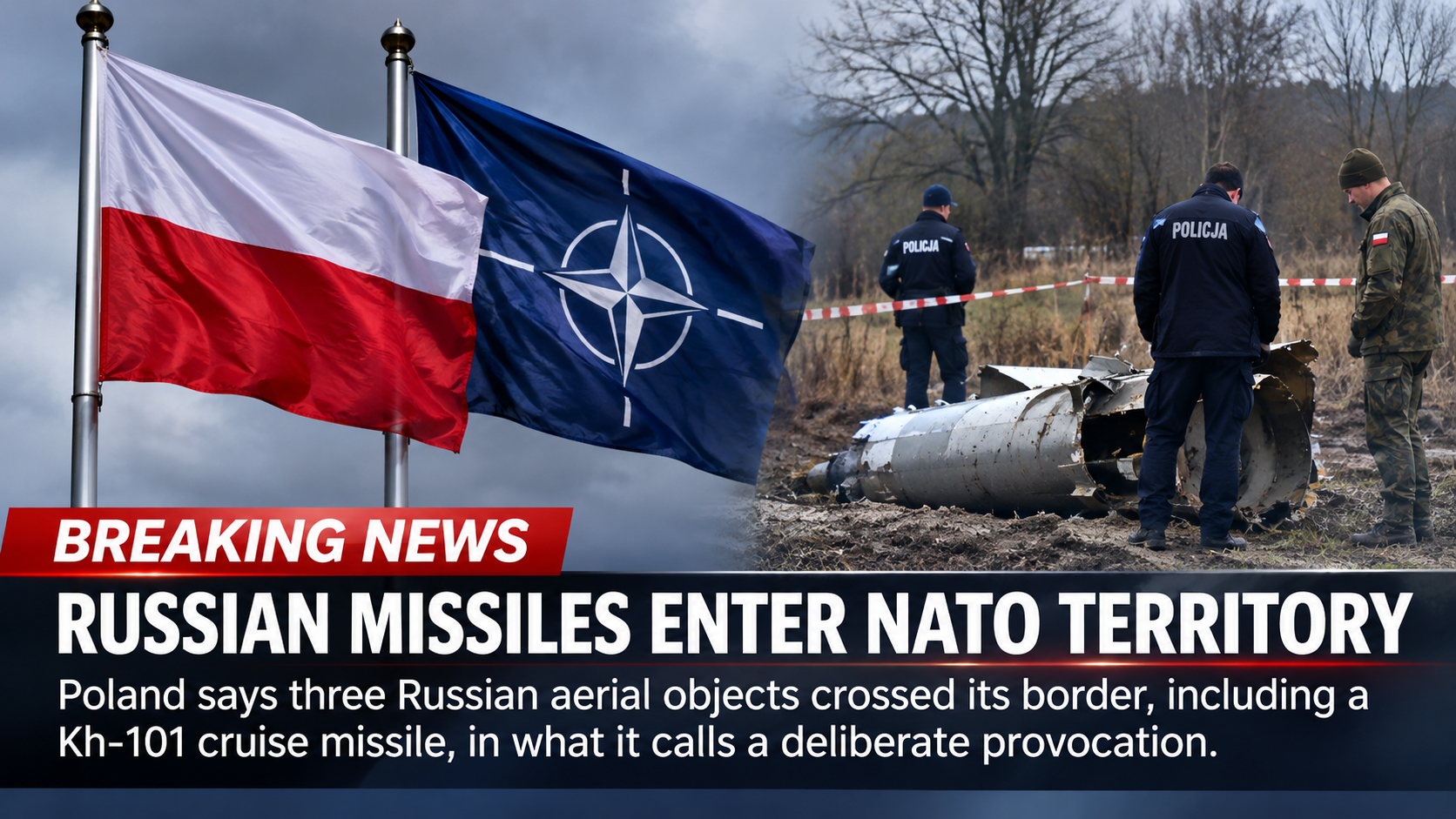
Russia’s war against Ukraine has crossed another dangerous boundary after Polish authorities confirmed that three Russian aerial objects entered NATO territory early Friday, November 20, 2026, including a Kh-101 cruise missile that crashed inside Poland.
Polish Prime Minister Donald Tusk accused Moscow of carrying out what appeared to be an intentional provocation, raising tensions between Russia and the Western military alliance at a time when European forces are conducting military exercises near the Ukrainian border.
The incident immediately triggered a military and diplomatic response, with NATO aircraft scrambled, Polish defense systems placed on alert and government officials convening emergency security discussions.
NATO Secretary-General Mark Rutte condemned the violations and reaffirmed the alliance’s commitment to defending Polish territory.
Although no injuries or significant infrastructure damage were reported in Poland, the incident has intensified concerns about the possibility of Russia’s war expanding beyond Ukraine.
Three Russian Objects Cross Into Poland
Polish Defense Minister Władysław Kosiniak-Kamysz confirmed that three objects entered the country’s airspace during Russia’s overnight bombardment of Ukraine.
One was identified as a Kh-101 cruise missile, a long-range weapon used by Russian forces to strike targets across Ukraine.
The missile came down near Nowy Lipowiec in southeastern Poland, approximately 50 kilometers from the Ukrainian border.
A second suspected missile landed near Rudnik nad Sanem, while a third object, believed to be a jet-powered drone, came down near Mołodycz.
Investigators were dispatched to all three locations to examine the wreckage and establish the circumstances surrounding the incursions.
Polish military officials reported that 11 aerial objects had been identified as potential threats to the country’s airspace during the Russian assault, with three ultimately crossing the border.
The Polish government said there was no continuing aerial threat after the incidents.
Poland Says the Timing Was No Coincidence
What makes the situation particularly concerning is the timing.
The Russian objects entered Poland while military personnel from 11 countries were participating in exercises in southeastern Poland.
The drills, involving members of the Western-led Coalition of the Willing, are intended to prepare allied forces for potential security responsibilities following a future peace agreement in Ukraine.
Polish officials noted that the incursions occurred near areas where those exercises were taking place.
Prime Minister Tusk suggested the timing and locations pointed toward deliberate Russian behavior rather than an accidental violation.
Defense Minister Kosiniak-Kamysz similarly described the incident as another Russian provocation.
However, investigators have not publicly established that the missiles or drone were deliberately directed toward Poland.
That distinction remains important as NATO evaluates the incident.
NATO Scrambles Fighter Jets
The Polish military activated its air-defense response as Russian missiles and drones approached the country’s borders.
Polish F-16 fighter jets and Swedish Gripen aircraft were operating in the region, supported by additional allied aircraft.
Air-defense systems, including Patriot batteries protecting strategically important locations, were placed on alert.
Military authorities said the first warnings were received at approximately 1:40 a.m. local time.
NATO Secretary-General Rutte confirmed that alliance aircraft were scrambled in response to the violations.
The incident also prompted Poland’s defense minister to seek additional NATO resources for the alliance’s eastern flank.
Among the requested capabilities are additional airborne early-warning and surveillance systems.
Poland is also seeking further consultations with NATO members about strengthening regional defenses.
Why an Attack on Poland Matters
Poland is a full member of NATO, meaning its security is directly connected to the collective-defense commitments of the United States and other alliance members.
Under Article 5 of the North Atlantic Treaty, an armed attack against one member can be treated as an attack against all.
However, an airspace violation does not automatically trigger Article 5.
NATO must assess the circumstances, including whether an incident constitutes an armed attack and what collective response is appropriate.
Friday’s incursions have not resulted in an announcement that Article 5 has been invoked.
Nevertheless, the presence of Russian military weapons on Polish territory creates a serious security concern.
The danger extends beyond the possibility of an intentional strike. A missile or drone entering NATO territory during a large-scale bombardment can create conditions for miscalculation, particularly when allied fighter aircraft and air-defense systems are operating nearby.
Massive Russian Attack Leaves Eight Dead in Ukraine
The Polish incidents occurred during one of Russia’s largest aerial assaults on Ukraine since the beginning of the full-scale invasion in 2022.
Ukrainian officials reported that Russia launched hundreds of drones and more than 100 missiles overnight.
At least eight people were reported killed, with dozens more injured.
Strikes damaged residential buildings, transportation infrastructure and energy facilities across multiple Ukrainian regions.
The bombardment also forced emergency electricity restrictions and disrupted essential services.
Russian authorities maintained that their attacks were directed toward Ukrainian military-related infrastructure.
The enormous scale of the assault placed additional pressure on air-defense systems throughout the region, including those protecting NATO’s eastern border.
Europe Faces Another Dangerous Escalation
The latest developments come as international efforts continue to find a negotiated end to the war.
European governments have repeatedly warned that Russia’s military operations present security risks extending beyond Ukraine itself.
Poland has experienced previous Russian drone and missile incursions, but Friday’s incident has renewed questions about whether existing defensive measures are sufficient.
The immediate priority for Polish investigators is determining exactly how the three objects entered the country and whether their trajectories indicate deliberate targeting.
For NATO, the challenge is responding firmly enough to protect allied territory without allowing an already devastating conflict to escalate into a direct military confrontation between Russia and the alliance.
No Polish casualties have been reported, and there has been no confirmed Russian attack intentionally directed at NATO forces.
But three Russian military objects entering a NATO member’s territory during a massive bombardment represent a serious development that Western governments cannot simply ignore.
The investigation and NATO’s response will help determine whether Friday’s events remain a dangerous border incident or become the beginning of a much larger confrontation.