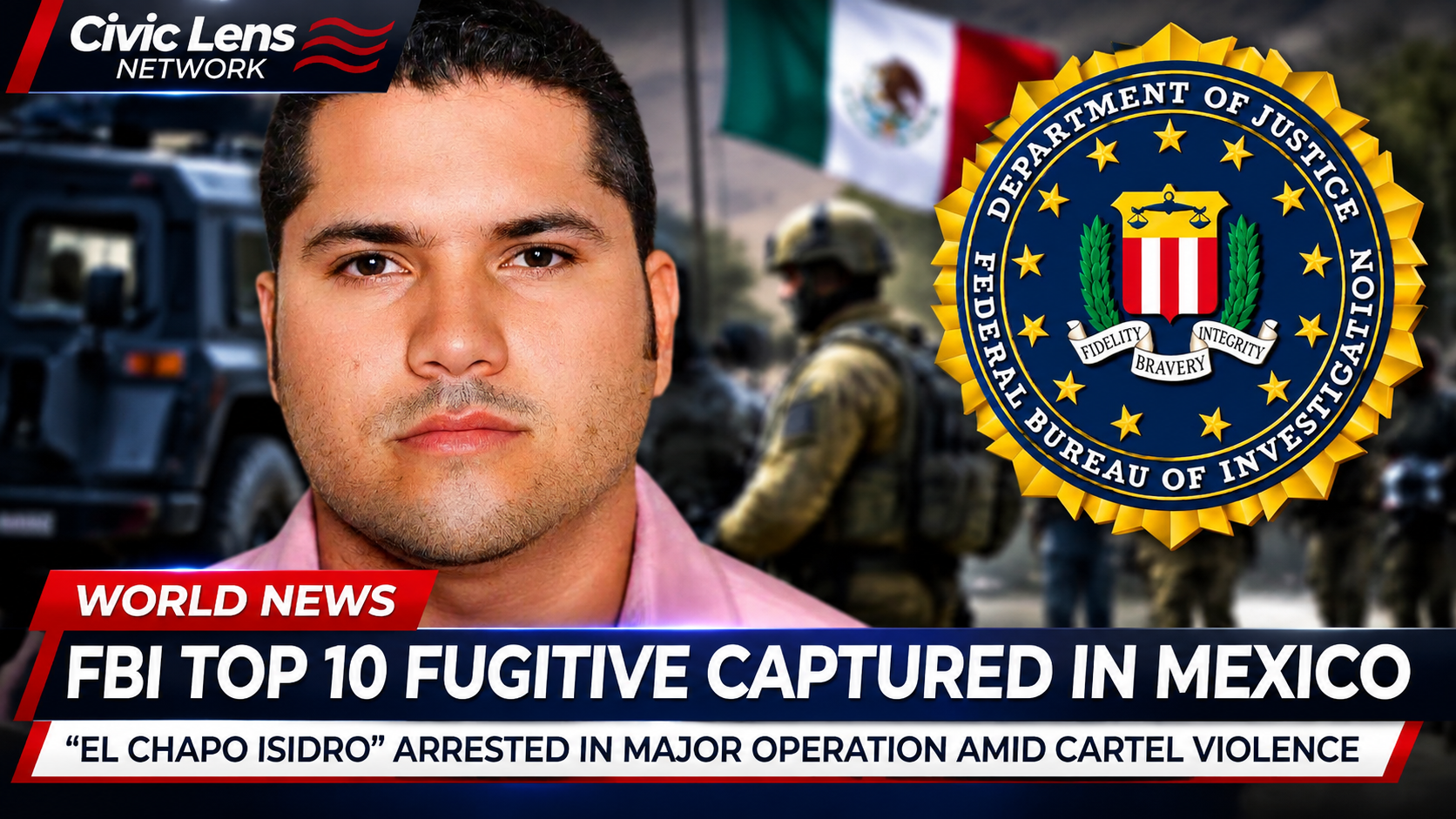
Mexican military forces have captured one of the FBI’s ten most wanted fugitives in a major operation that unleashed gun battles, burning vehicles, highway blockades, and widespread panic across the Mexican state of Sinaloa.
Fausto Isidro Meza Flores, better known as “El Chapo Isidro,” was arrested Friday night, November 20, during a coordinated military operation in Guasave, a city long associated with his alleged criminal organization.
Mexican authorities confirmed the arrest Saturday morning, describing an operation involving elite military units, intelligence coordination with the United States, and an intense confrontation with armed cartel members.
Two additional suspected senior members of the organization were also detained.
The capture represents a major victory for American and Mexican law enforcement agencies pursuing individuals accused of supplying enormous quantities of illegal drugs to the United States.
But the violent response demonstrated how much power heavily armed criminal organizations continue to exercise in parts of Mexico.
One of America’s Most Wanted Fugitives
Meza Flores had been on the FBI’s Ten Most Wanted Fugitives list since February 2025.
American authorities accuse him of leading the Meza-Flores Transnational Criminal Organization, also known as Los Mazatlecos, a powerful drug-trafficking network operating primarily in northwestern Mexico.
Federal investigators allege that his organization has been responsible for transporting substantial quantities of heroin, methamphetamine, cocaine, fentanyl, and marijuana into the United States.
The U.S. government had offered a reward of up to $5 million for information leading to his arrest and conviction.
Meza Flores was previously indicted in 2012 and again in 2019 on federal drug-trafficking charges. He also faces a firearms-related charge.
American authorities have additionally accused his organization of involvement in kidnappings, extortion, torture, and murder.
Those accusations remain allegations unless established through criminal proceedings.
Despite sharing a similar nickname, Meza Flores is not related to Joaquín “El Chapo” Guzmán, the former Sinaloa Cartel leader currently serving a prison sentence in the United States.
Mexican Special Forces Launch Surprise Operation
According to Mexico’s Defense Ministry, the operation was conducted using intelligence gathered through cooperation between Mexican and American agencies.
Elite units from the Mexican Army and National Guard moved into Guasave using a strategy designed to prevent the suspects from escaping.
Military personnel established a security perimeter around the location where Meza Flores was believed to be hiding.
The situation quickly escalated.
Mexican authorities reported that armed individuals attacked security forces with gunfire and explosives, forcing troops to enter the property and secure the suspects.
Alongside Meza Flores, authorities detained a man identified as Germán, nicknamed “Serafín,” described as a senior figure in the organization, and another man identified as José, an alleged financial operator.
The three were eventually transported to Mexico City aboard a Mexican Air Force aircraft.
The operation did not end when the suspects were taken into custody.
Cartel Gunmen Turn Streets Into a War Zone
As news of the arrests spread, armed groups reportedly launched attacks and established roadblocks across several communities in Sinaloa.
Vehicles were set on fire, trucks were positioned across highways, and gunfire echoed through residential and commercial areas.
At least ten roadblocks were reported around Guasave.
The violence became so severe that Mexican security forces reportedly struggled for hours to move Meza Flores safely out of the area.
Military helicopters operated overhead while heavily armed personnel attempted to restore control.
Residents described frightening scenes as families fled businesses and motorists abandoned travel plans to avoid becoming trapped in the violence.
The chaos even interrupted a professional baseball game in Guasave.
Spectators rushed to seek safety as reports of gunfire spread around the stadium, forcing the game to be suspended.
Businesses and vehicles were damaged or destroyed during the unrest.
As of Saturday’s initial reports, Mexican authorities had not announced confirmed casualties from the operation.
The extraordinary response illustrated a disturbing reality: Arresting a powerful cartel figure does not necessarily mean the organization immediately loses its ability to threaten entire communities.
A Major Development in America’s Fight Against Drug Trafficking
The arrest comes amid mounting pressure from Washington for Mexico to take stronger action against criminal organizations responsible for trafficking drugs into the United States.
President Donald Trump has repeatedly criticized the influence of Mexican cartels and warned that the United States could take additional measures if Mexican authorities fail to confront them.
Mexican President Claudia Sheinbaum’s administration has faced the difficult task of balancing cooperation with Washington against concerns about national sovereignty and the consequences of escalating military operations.
The capture of Meza Flores demonstrates that intelligence cooperation between the two countries can produce significant results.
However, arresting a cartel leader is only one part of dismantling an organization capable of producing, transporting, financing, and distributing illegal drugs across international borders.
The financial networks, weapons suppliers, corrupt officials, and replacement leadership structures that sustain these organizations must also be addressed.
Otherwise, the removal of one leader can create opportunities for rival factions or ambitious subordinates to fight for control.
Cartel Alliances Complicate the Situation
Meza Flores has been identified as a senior figure associated with the Beltrán Leyva criminal organization.
His network has also reportedly maintained an alliance with the Los Mayos faction of the Sinaloa Cartel.
Sinaloa has experienced prolonged violence involving rival criminal groups competing for territory, trafficking routes, and political influence.
Those conflicts have created dangerous conditions for ordinary residents, including families with no involvement in organized crime.
The removal of Meza Flores could weaken an important criminal network, but it could also create uncertainty over who will control its operations.
Mexican authorities will now face the challenge of preventing additional retaliatory attacks while attempting to dismantle the remaining organization.
What Happens Next?
Meza Flores faces criminal accusations in the United States, and Mexican authorities have confirmed that an extradition order exists.
His arrest could therefore eventually lead to prosecution in an American federal court.
However, the timing of any extradition has not been announced.
Investigators will also need to determine whether the arrests provide opportunities to identify additional members of the organization, uncover financial operations, and disrupt trafficking networks.
The detention of an alleged financial operator could prove particularly important if investigators obtain evidence identifying how the organization moves and conceals its money.
For American authorities, the arrest removes a longtime fugitive from the FBI’s most-wanted list.
For Mexican authorities, it represents a significant operational success against an organization accused of contributing to years of violence and drug trafficking.
But for the residents of Sinaloa, the immediate concern is much simpler: whether the gunfire will stop and whether they can safely return to their daily lives.
The capture of one of the FBI’s most wanted fugitives is a major achievement.
Whether it produces lasting improvements in public safety will depend on what happens after the military operation ends.