A dangerous military confrontation is escalating across the Middle East after Saudi-led coalition forces launched strikes against Yemen’s strategic Red Sea port of Hodeidah on Friday, November 20, while Iran-backed Houthi forces threatened new attacks against Saudi airports, shipping facilities, and critical infrastructure.
The rapidly deteriorating situation has placed commercial aviation, international shipping, and major energy facilities at risk as both sides demonstrate their willingness to expand military operations.
The latest escalation comes just one day after a Houthi attack damaged Riyadh’s tallest skyscraper, a landmark building housing Saudi Arabia’s powerful sovereign wealth fund.
What began as another round of fighting in Yemen has developed into a confrontation threatening some of the Middle East’s most economically important infrastructure.
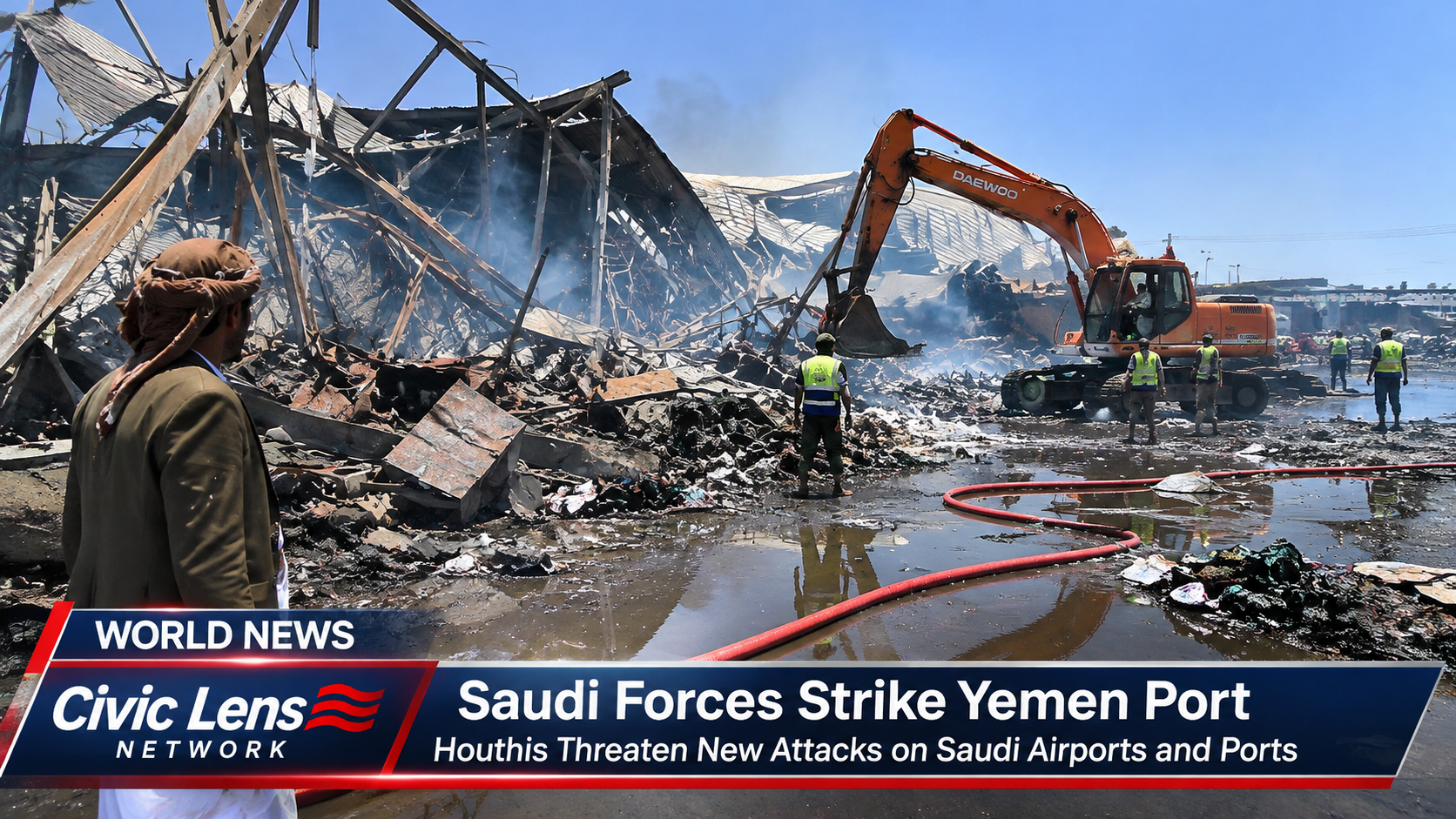
Saudi Forces Launch Strikes on Strategic Port
The Saudi-led military coalition announced Friday that it had struck facilities at Hodeidah, a major port on Yemen’s western coastline.
Coalition officials said the operation targeted infrastructure allegedly used by Houthi forces to smuggle weapons and transport ballistic missiles.
Saudi authorities claimed the strikes destroyed operational capabilities used by the group. Independent confirmation of the extent of the damage was not immediately available.
Before the attack, coalition officials issued an evacuation warning urging civilians to leave the port area.
Hodeidah is particularly important because it serves as a primary entry point for food, fuel, and other essential supplies entering Houthi-controlled northern Yemen.
Any prolonged disruption could create additional hardship for a population already suffering from years of war and economic instability.
Yemen’s information minister said the port remained operational following the strikes and that commercial supplies would continue moving through the facility.
Houthis Threaten Saudi Ports and Airspace
Houthi military spokesman Yahya Saree responded with warnings that Saudi Arabia’s Red Sea ports could become targets of retaliatory military operations.
The group specifically threatened facilities along the Saudi coastline, including the major commercial port city of Jeddah.
Saree urged shipping companies to remove their vessels from threatened ports and warned workers and nearby residents to evacuate.
The Houthis also instructed commercial airlines to avoid Saudi airspace, claiming additional military operations could take place within hours.
Their warning excluded airspace surrounding the Muslim holy cities of Mecca and Medina.
The group separately threatened a power station in Shuqaiq, southern Saudi Arabia.
These statements represent announced threats, not confirmation that the threatened facilities have been attacked.
Nevertheless, the warnings create serious uncertainty for international businesses operating throughout the region.
Riyadh’s Tallest Skyscraper Damaged in Missile Attack
Thursday’s strike against Riyadh marked another major development in the conflict.
A projectile associated with a Houthi attack struck the Public Investment Fund Tower, the tallest skyscraper in Saudi Arabia’s capital.
The building houses the kingdom’s sovereign wealth fund, an institution central to Crown Prince Mohammed bin Salman’s ambitious economic development plans.
Saudi civil defense authorities reported damage to several floors and nearby buildings but said no injuries had been reported.
The attack damaged windows and portions of the building’s exterior, demonstrating that even prominent structures within the capital’s financial district remain vulnerable.
It was the second attack this month to damage a major building in Riyadh’s financial district.
An earlier strike on November 8 damaged a building associated with Saudi oil giant Aramco.
The repeated targeting of high-profile economic facilities presents a growing challenge for Saudi authorities attempting to protect international investment and commercial activity.
Missile and Drone Attacks Continue
Saudi authorities also reported intercepting a ballistic missile and multiple drones targeting the kingdom on Friday.
Civil defense warnings were issued in southern areas, including Jazan, Abha, and Khamis Mushait, before officials announced that the immediate danger had passed.
Meanwhile, the Saudi-led coalition reported military operations against Houthi missile and drone capabilities in Yemen’s capital, Sanaa.
Fighting was also continuing in Saada and Taiz.
The repeated exchanges demonstrate that neither side has succeeded in preventing the other from launching additional attacks.
Saudi Arabia possesses advanced military aircraft, missile-defense systems, and extensive financial resources.
The Houthis, however, have demonstrated an ability to launch missiles and drones against targets deep inside Saudi territory.
That combination has created an increasingly dangerous military confrontation in which even successful interceptions do not eliminate the risk of damage from falling debris.
Global Shipping and Energy Supplies Face New Risks
The confrontation carries consequences extending far beyond Yemen and Saudi Arabia.
The Red Sea is one of the world’s most important commercial shipping corridors, connecting international trade routes through the Suez Canal and the Bab el-Mandeb Strait.
Threats against ports and commercial vessels can force shipping companies to reconsider routes, increase security precautions, and potentially raise transportation costs.
Saudi Arabia’s energy infrastructure is particularly important to global markets.
The kingdom remains one of the world’s largest oil exporters, and its pipelines, refineries, terminals, and pumping stations represent critical components of international energy supply.
Houthi forces have repeatedly claimed attacks against Saudi oil infrastructure, although Saudi authorities have not confirmed every claimed strike.
The East-West Pipeline has become especially important as an alternative route for Saudi oil exports during disruptions affecting the Strait of Hormuz.
Further attacks against energy infrastructure could place additional pressure on shipping operations and regional economic stability.
Houthi Forces Advance Toward Aden
While missiles and drones dominate international attention, the ground war inside Yemen is also intensifying.
Houthi forces have captured additional territory along Yemen’s Red Sea coastline, forcing Saudi-backed government forces to withdraw toward the southern port city of Aden.
Aden currently serves as the temporary capital of Yemen’s internationally recognized government.
Government-aligned forces have been preparing defensive positions as concerns grow about a possible Houthi offensive.
The situation is complicated by divisions among factions nominally aligned against the Houthis, including disagreements over the political future of southern Yemen.
Those divisions could make a coordinated defense more difficult if Houthi forces launch a major assault.
The renewed fighting follows years of relative calm after a 2022 truce, with hostilities intensifying again in July 2026 amid the broader regional war involving Iran.
A Conflict With International Consequences
The latest attacks demonstrate how quickly Yemen’s conflict can threaten neighboring countries and international economic interests.
Saudi Arabia is a major American security partner, while the Houthis maintain close ties with Iran.
That alignment gives the fighting wider strategic significance, particularly as the United States and its regional partners confront continuing instability.
However, the possibility of a broader regional confrontation should not be confused with confirmation that additional countries have entered the latest exchange of attacks.
For now, the confirmed developments include Saudi-led strikes against Hodeidah, damage to Riyadh’s tallest skyscraper, reported missile and drone interceptions, and explicit Houthi threats against Saudi infrastructure.
Whether the threatened attacks occur remains uncertain.
The immediate danger is that each new strike creates pressure for retaliation, increasing the possibility that the confrontation expands beyond its current battlefield.
With major ports, commercial airports, financial institutions, and energy infrastructure increasingly exposed, the consequences could extend well beyond the countries directly involved.
The question now is whether either side intends to contain the confrontation—or whether the Middle East is approaching another dangerous expansion of a war already affecting international security and trade.