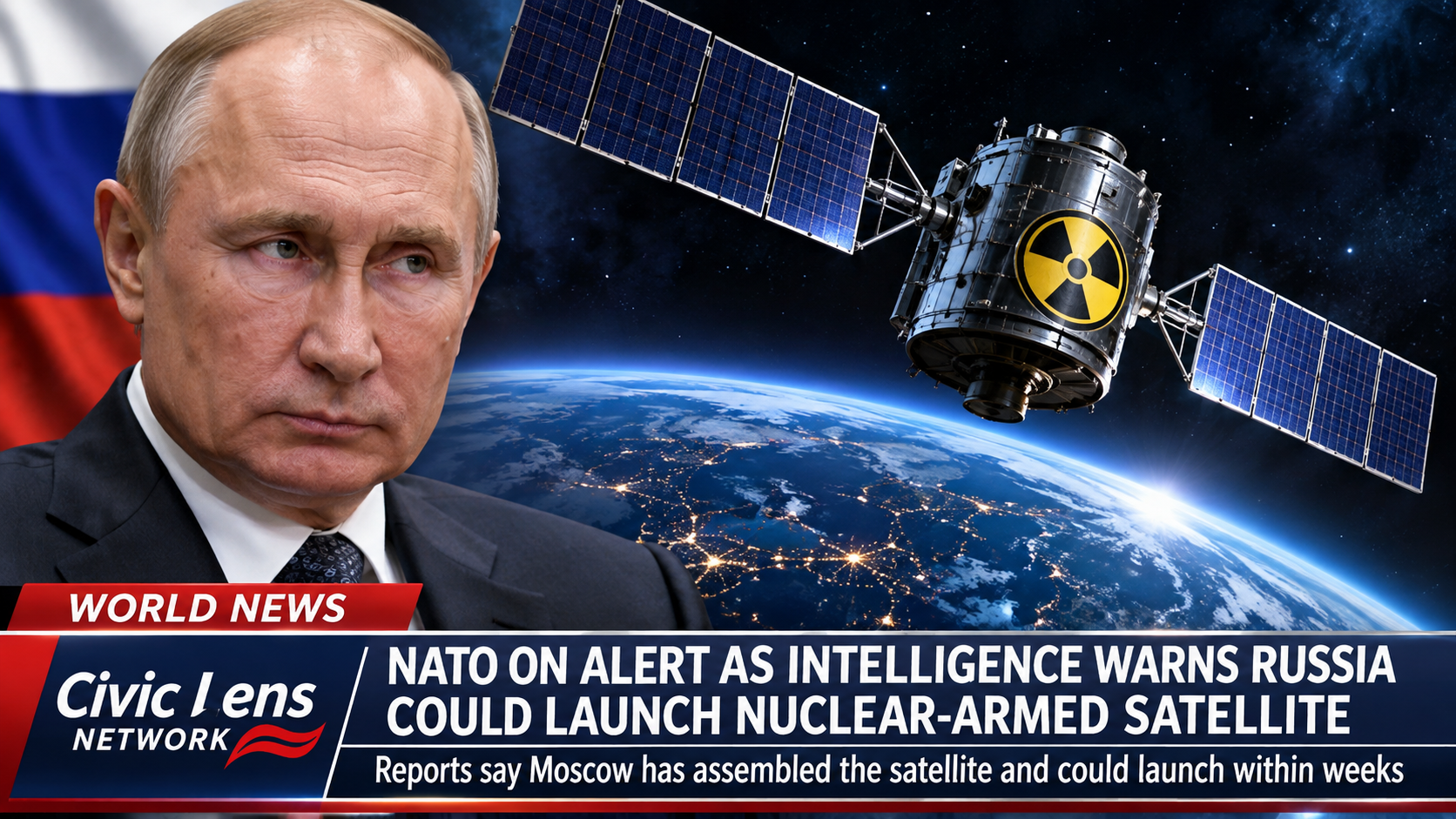
Western intelligence agencies are warning that Russia may be preparing to launch a nuclear-armed satellite into orbit before the end of 2026, raising serious concerns about the security of American military communications, global navigation systems, and thousands of satellites operating above Earth.
A joint investigation published November 23 by German broadcasters NDR and WDR and the newspaper Süddeutsche Zeitung reports that intelligence services from NATO countries believe Moscow has already assembled the satellite, identified as Sputnik-S.
According to the investigation, the spacecraft was completed several years ago and is being stored somewhere in the greater Moscow region.
Intelligence assessments circulated among Western governments in early November reportedly indicated that Russia could launch the satellite within 60 days, potentially placing a nuclear weapon in orbit as early as December.
Although the intelligence reports have not been independently verified publicly, the allegations have prompted a response from NATO leadership.
NATO Responds to the Warning
Speaking alongside German Chancellor Friedrich Merz in Berlin on Monday, NATO Secretary General Mark Rutte emphasized that the alliance’s defense responsibilities extend beyond traditional military territory.
Rutte said NATO continuously evaluates threats to its members, including those involving space-based systems.
He assured reporters that the alliance would protect its members and account for emerging dangers in orbit.
The comments represent a public acknowledgment of the seriousness of space security concerns, although Rutte did not independently confirm that Russia has completed a nuclear-armed spacecraft or approved its launch.
A Weapon That Could Cripple Modern Technology
Unlike a conventional nuclear missile designed to destroy targets on the ground, the suspected Russian weapon would reportedly be intended to disable satellites through a nuclear explosion in space.
Such a detonation could produce electromagnetic effects capable of damaging satellite electronics while also generating radiation that threatens spacecraft over an extended period.
The consequences could reach far beyond military operations.
American GPS services, satellite communications, weather forecasting, aviation navigation, financial infrastructure, and emergency response networks all depend to varying degrees on equipment operating in space.
A sufficiently powerful attack could disrupt large portions of those systems, potentially affecting civilian life across multiple continents.
Military satellite networks would be particularly important targets. American and allied forces rely on space-based technology for secure communications, intelligence gathering, navigation, and coordinating operations.
Commercial systems could also be affected, including SpaceX’s Starlink network, which has played an important role in supporting Ukrainian military communications.
The extent of the damage would depend on the weapon’s characteristics, the altitude of detonation, and the vulnerability of individual satellites. A complete global communications shutdown is not an established consequence.
American Intelligence Has Warned About This Threat Before
The latest reports follow years of concern within the United States about Russia’s development of anti-satellite weapons.
In February 2024, the White House publicly acknowledged that Russia was developing a troubling space-based capability.
American officials subsequently warned that Moscow was pursuing technology potentially capable of destroying large satellite networks through a nuclear detonation.
More recently, the U.S. Defense Intelligence Agency warned that a nuclear-armed satellite could cause widespread damage to spacecraft providing essential commercial, scientific, and national security services.
The possibility of such a weapon also raises major legal questions.
The 1967 Outer Space Treaty prohibits countries from placing nuclear weapons or other weapons of mass destruction into Earth orbit.
Russia is a party to that agreement.
Deploying a nuclear weapon aboard an orbiting satellite would therefore represent a serious violation of an international treaty designed to prevent an arms race involving weapons of mass destruction in space.
Russia Rejects the Allegations
The Kremlin has dismissed the latest reports.
Russian presidential spokesman Dmitry Peskov questioned the credibility of the claims, criticizing their reliance on anonymous intelligence sources and unconfirmed possibilities.
Russia’s embassy in Berlin also rejected the allegations, describing them as part of a propaganda campaign.
Russian officials maintain that the country’s space activities are peaceful and comply with international obligations.
No publicly verified evidence currently establishes that Sputnik-S carries a nuclear warhead, that a launch has been ordered, or that Russia has deployed a nuclear weapon into orbit.
A New Security Challenge for the United States
The reported threat highlights a growing vulnerability in modern military and civilian infrastructure.
Satellites are no longer simply scientific instruments or communications conveniences. They are essential components of national defense, transportation, financial systems, and everyday technology.
A weapon capable of disabling large numbers of satellites could threaten American infrastructure without directly striking American territory.
The latest intelligence allegations do not establish that such an attack is imminent. They do, however, raise urgent questions about how the United States and its NATO allies would respond if Russia attempted to deploy a nuclear weapon in space.
For now, the most important unanswered questions are whether the reported spacecraft actually carries a nuclear weapon, whether Moscow intends to launch it, and whether Western governments can prevent a new nuclear confrontation from extending into Earth’s orbit.