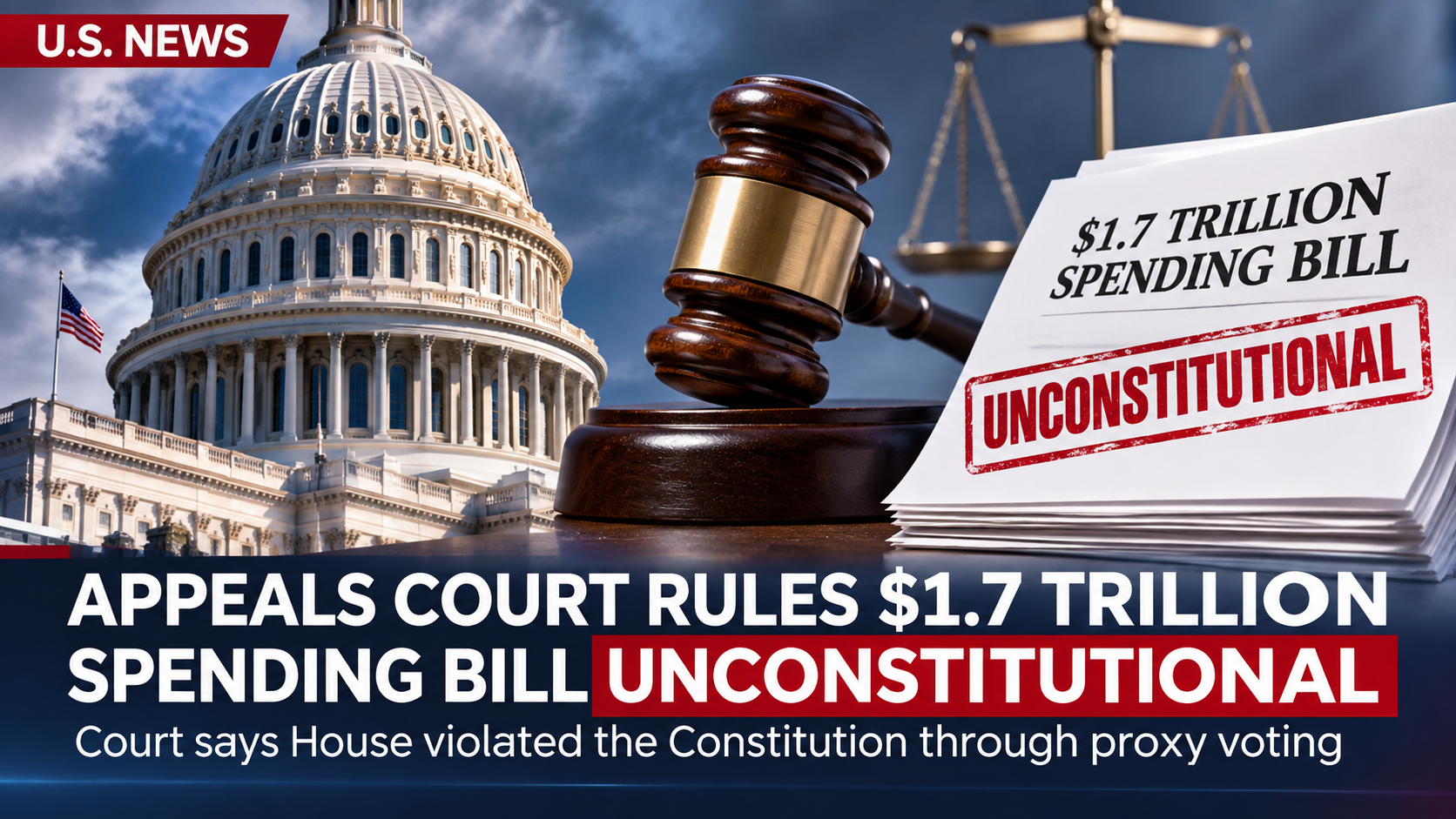
A federal appeals court has delivered a major constitutional ruling against the way Congress passed a $1.7 trillion spending package during the Biden administration, finding that lawmakers violated the U.S. Constitution by allowing absent members of the House of Representatives to be counted toward the quorum required to conduct legislative business.
The November 20 decision by the U.S. Court of Appeals for the Fifth Circuit raises significant questions about congressional authority, emergency voting procedures, and whether other federal laws approved under similar circumstances could face constitutional challenges.
In a closely divided 9-8 ruling, the court determined that the House improperly relied on pandemic-era proxy voting rules when it approved the Consolidated Appropriations Act of 2023 in December 2022.
The decision does not invalidate the entire spending package. However, the court upheld an injunction preventing federal authorities from enforcing one of its provisions against the state of Texas.
Congress Passed the Bill Without Enough Members Physically Present
The controversy centers on voting procedures introduced in May 2020 under then-House Speaker Nancy Pelosi.
During the COVID-19 pandemic, the House adopted temporary rules allowing lawmakers to designate colleagues to cast votes on their behalf without requiring them to be physically present in Washington.
The arrangement continued into December 2022, when Congress approved the massive federal spending package shortly before Republicans regained control of the House.
The legislation passed the House by a vote of 225-201, with one member voting present.
But according to the court’s findings, 226 lawmakers participated through proxy voting. Only 205 members voted in person, fewer than the 218 required to establish a majority in the 435-member House.
That distinction became central to the constitutional challenge.
Article I of the Constitution requires a majority of each chamber to constitute a quorum for conducting legislative business.
The appeals court concluded that absent lawmakers could not be treated as physically present simply because House rules permitted another representative to vote for them.
Judges Say Congressional Rules Cannot Override the Constitution
Writing for the majority, Judge Cory Wilson, appointed by President Donald Trump, emphasized that Congress possesses considerable authority to establish its own operating procedures.
However, the court concluded that such authority does not extend to changing constitutional requirements.
The judges determined that the historical understanding of the Quorum Clause requires actual presence rather than representation through another lawmaker.
The ruling represents a significant judicial rejection of a voting practice that Congress used for more than two years.
It also establishes a potentially consequential precedent: A congressional majority cannot necessarily satisfy constitutional attendance requirements by adopting internal rules that redefine who is considered present.
Texas Challenge Triggered the Constitutional Showdown
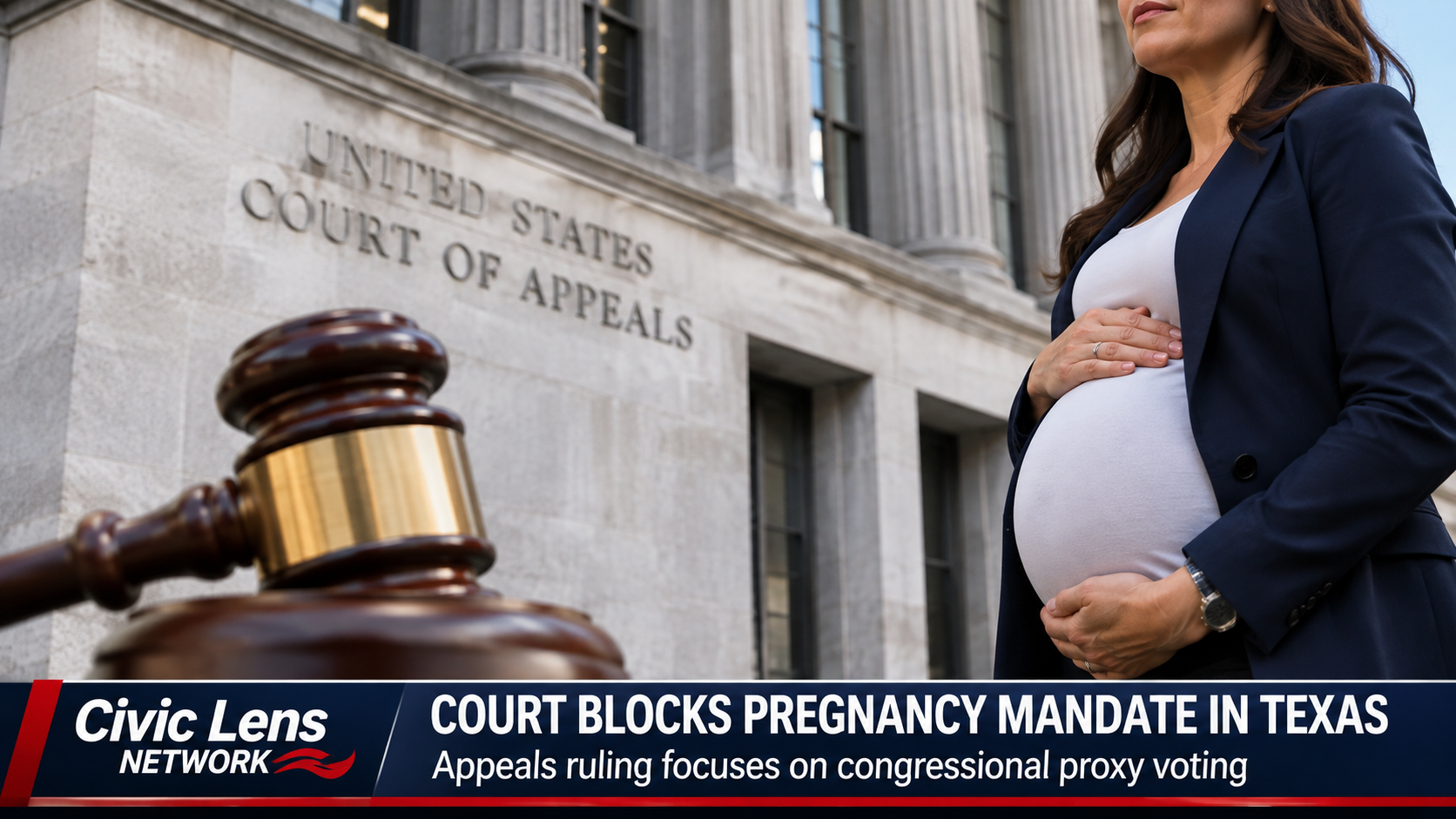
The legal battle began when Texas Attorney General Ken Paxton challenged the Pregnant Workers Fairness Act, a provision included in the larger spending legislation.
The law requires covered employers to provide reasonable workplace accommodations for pregnancy-related conditions.
Paxton argued that the legislation was improperly enacted because the House lacked a constitutionally valid quorum when approving the spending package.
A federal district court initially sided with Texas and blocked enforcement of the provision against the state.
The Fifth Circuit has now upheld that injunction.
Importantly, the court did not order the cancellation of the $1.7 trillion spending package or declare every provision unenforceable nationwide.
Its immediate legal remedy applies to the specific enforcement dispute involving Texas.
Could Other Biden-Era Laws Be Challenged?
The broader implications may prove more significant than the immediate dispute.
Congress used proxy voting for numerous legislative measures between 2020 and early 2023.
If the Fifth Circuit’s interpretation survives further judicial review, litigants could attempt to challenge additional legislation passed without enough lawmakers physically present.
Such challenges would not automatically succeed. Courts would still need to consider the circumstances of each law, who has standing to challenge it, and what legal remedies are available.
Nevertheless, the ruling creates a constitutional argument that could be raised in future litigation.
The decision also highlights a fundamental question about the limits of government power during emergencies.
Although the pandemic prompted extraordinary changes to congressional operations, the court’s majority concluded that those circumstances did not authorize the House to disregard constitutional quorum requirements.
Eight Judges Strongly Disagreed
The decision was far from unanimous.
Eight judges dissented, arguing that the majority improperly imposed a physical-presence requirement not explicitly stated in the Constitution.
Judge James Graves, appointed by former President Barack Obama, challenged the majority’s interpretation and questioned why the ruling addressed the constitutional validity of the larger spending legislation while limiting the practical remedy to one provision.
The dissenters also raised concerns about judicial interference with Congress’s authority to establish its own procedures.
Their objections could become important if the dispute reaches the Supreme Court.
The Justice Department has continued defending the legislation, including under the Trump administration.
A Constitutional Question That Could Reach the Supreme Court
The ruling may ultimately require the nation’s highest court to determine how much discretion Congress possesses when establishing quorum procedures.
A Supreme Court decision could clarify whether lawmakers must physically attend congressional proceedings to satisfy the Constitution or whether alternative voting arrangements can be permitted under certain circumstances.
For now, the Fifth Circuit’s decision stands as a significant constitutional rebuke of the House’s pandemic-era voting procedures.
The central issue extends beyond the $1.7 trillion spending package, President Biden, or the particular workplace protections involved.
It concerns whether Congress can modify constitutional requirements through its own procedural rules.
The Fifth Circuit’s majority has answered that question with a firm limitation on congressional authority.
Whether the Supreme Court agrees could determine the lasting significance of one of the most consequential congressional procedure rulings in recent years.