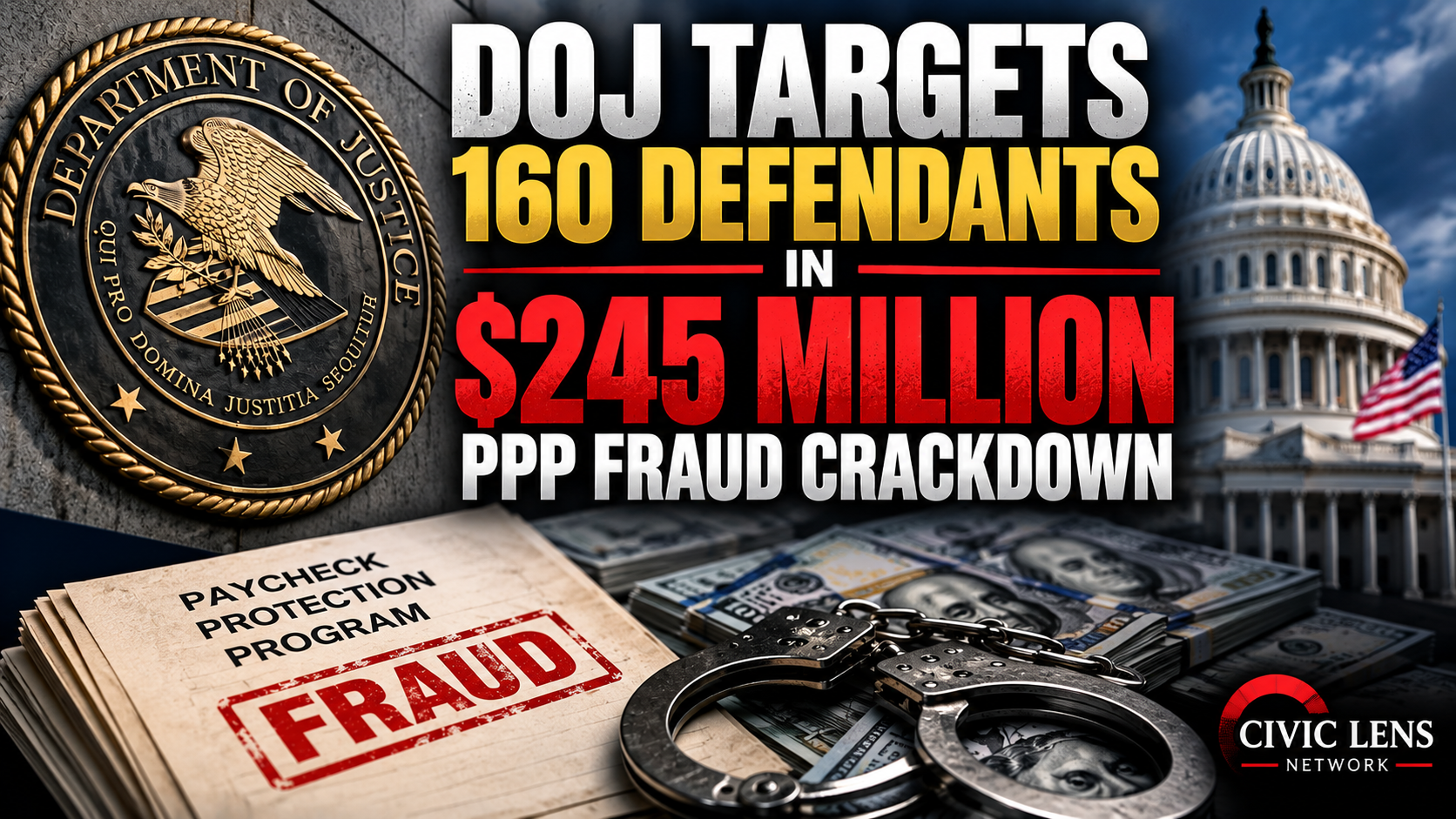
WASHINGTON and CLEVELAND — The Justice Department has announced the results of a nationwide summer enforcement campaign against alleged fraud in pandemic era Small Business Administration loan programs. The effort, called Operation No Doze, produced criminal actions against more than 160 defendants tied to about $245 million in intended losses to taxpayers. The national results were released on Sept. 14, 2026, during the Heartland Fraud Partnership Summit in Kansas City, Missouri. Local offices continued to identify their own cases in the days that followed.
On Sept. 16, the U.S. Attorney’s Office for the Northern District of Ohio said it participated in three cases connected to the initiative. The campaign ran from June 12 through Sept. 1.
It targeted alleged abuse of the Paycheck Protection Program and the COVID-19 Economic Injury Disaster Loan program, both administered by the SBA after Congress created emergency relief during the pandemic. PPP loans were designed to help small businesses keep workers on payroll. Many loans were later forgiven if borrowers certified that the money was used for eligible costs. Prosecutors say some applicants treated those programs as a source of personal cash.
According to the Justice Department, defendants charged during the surge allegedly fabricated businesses, submitted false payroll and revenue claims, stole identities, and concealed foreign ties on applications. Officials described the criminal cases as one part of a larger effort that also includes borrower suspensions and debt collection. The numbers, as reported by the Department of Justice During the surge, SBA Office of Inspector General investigators and federal prosecutors in the National Fraud Enforcement Division and more than 40 U.S.
Attorney’s Offices obtained felony charges against nearly 80 defendants accused of about $100 million in intended losses. About 43 defendants pleaded guilty in SBA related COVID fraud cases involving about $44 million in intended losses. About 40 defendants were sentenced in cases involving nearly $100 million in intended losses. Combined, the Justice Department said the effort reached more than 160 criminal defendants and about $245 million in intended loss.
Those figures count charges, guilty pleas, and sentencings during a defined window. They are not a full accounting of all pandemic loan fraud since 2020. An indictment is an accusation. Defendants who have not pleaded guilty or been convicted remain presumed innocent.
SBA Administrator Kelly Loeffler said the same period included the agency’s largest action to date against suspected SBA fraud, with 870,000 suspended borrowers tied to $39 billion in suspected fraudulent PPP and COVID EIDL activity. Suspended borrowers are barred from future SBA small business and disaster loans and from programs such as 8(a) contracting. The agency said it is sending demand letters and referring debts to the Treasury Department for collection.
Those administrative suspensions are separate from criminal charges and do not, by themselves, establish criminal guilt. Why prosecutors launched the surge The Justice Department created the National Fraud Enforcement Division on April 7, 2026, describing it as the first new DOJ division in 20 years and tying it to the White House Task Force to Eliminate Fraud, chaired by Vice President JD Vance.
Officials said the division was formed to concentrate resources on fraud against federal benefit programs, including leftover pandemic loans that remain within an extended limitations period. Congress previously lengthened the statute of limitations for many COVID relief fraud offenses to 10 years, which is why cases from 2020 and 2021 are still being charged in 2026. Attorney General Todd Blanche said pandemic loan relief was meant to keep small businesses alive during government lockdowns, not to finance personal spending.
He said defendants charged in the summer surge allegedly fabricated businesses, submitted false payroll and revenue claims, stole identities, and hid foreign ties on applications. Assistant Attorney General Colin M. McDonald, who leads the National Fraud Enforcement Division, said the summer work showed what coordinated federal and state investigators can do when they share cases and data.
SBA Inspector General William Kirk said the passage of time does not reduce the inspector general’s commitment to recover funds and pursue people who exploited programs created for businesses in crisis. How prosecutors say the schemes worked PPP loan size generally depended on reported payroll and employee counts. EIDL amounts depended on claimed economic injury and business operations.
According to charging documents summarized by the Justice Department, suspected schemes often followed a pattern: Applicants created or used companies that had little or no real payroll, then submitted applications claiming employees who did not exist or wages that were inflated. Some applications used stolen identities or names of people who did not authorize the filings. Supporting papers allegedly included fabricated tax forms, false bank statements, and false certifications that a business existed before the pandemic eligibility cutoff.
After funds landed in controlled accounts, prosecutors allege proceeds were spent on personal expenses, real estate, brokerage accounts, or transferred in ways charged as money laundering. Some cases also allege applicants hid foreign ownership, foreign work locations, or ineligibility under SBA affiliation rules. Those descriptions are allegations in charging papers unless a defendant has pleaded guilty or a court has entered a conviction.
Ohio’s place in the nationwide operation Both the Northern District of Ohio and the Southern District of Ohio were listed among the 44 U.S. Attorney’s Offices that took part in Operation No Doze. On Sept. 16, the Northern District of Ohio told local media it was involved in three cases tied to the initiative. The office highlighted a July guilty plea from Cuyahoga County and a previously announced Lorain County indictment.
Ohio already had a large administrative footprint in the SBA’s separate suspension campaign. On June 4, the SBA announced it had suspended 27,486 Ohio borrowers connected to about $1.1 billion in suspected fraudulent PPP and COVID EIDL activity. That statewide suspension figure is much larger than the criminal caseload announced this month. It reflects suspected ineligibility or fraud indicators used for program exclusion and collections, not a mass indictment.
The June announcement in Ohio also accompanied Justice Department charges against four people accused in a Southern District of Ohio case of submitting fraudulent PPP applications on behalf of businesses, including health care providers, and then using loan proceeds for personal expenses. Prosecutors in that matter alleged more than $1.4 million in COVID-19 relief funds. Those defendants were charged. They have not been described in official records as convicted in connection with this week’s surge announcement.
U.S. Attorney David M. Toepfer of the Northern District of Ohio said many people treated economic lifelines meant for small businesses as a cash grab. He said the office would prosecute people who obtain stimulus funds for personal benefit through lies and deception.
Northern District of Ohio: Travius Holloway guilty plea Travius Holloway, 36, of Richmond Heights, pleaded guilty to one count of wire fraud. According to the U.S. Attorney’s Office, he obtained a fraudulent PPP loan of $121,865 for his production company and also obtained $370,982 in fraudulent COVID era unemployment benefits. He is scheduled to be sentenced on Oct.
- Wire fraud carries a statutory maximum of 20 years in prison. A federal judge will determine the sentence after reviewing the plea, the advisory guidelines, and other statutory factors. Because Holloway pleaded guilty, the loan and unemployment figures described by prosecutors are admissions in that case, not mere accusations awaiting trial.
Northern District of Ohio: Lorain County indictment of a mother and two sons In July, a federal grand jury in Cleveland charged three Lorain County residents, Junera Holt Sr., 55, and her adult sons, Divante Holt, 32, and Richard Henry, 35, in an alleged multi year scheme to obtain more than $5 million from the IRS and pandemic era programs. The charges, announced by the U.S.
Attorney’s Office for the Northern District of Ohio and IRS Criminal Investigation, include conspiracy to commit wire fraud, wire fraud, aiding and assisting in the preparation of false tax returns, and conspiracy to commit mail fraud, wire fraud, and bank fraud. Junera Holt was also charged with filing a false tax return, aggravated identity theft, and bank fraud. Henry was also charged with bank fraud and engaging in monetary transactions in criminally derived property.
According to the indictment summarized by IRS Criminal Investigation, prosecutors allege two overlapping conspiracies from about 2019 through 2024. One allegedly used the defendants’ names, stolen identities, and shell companies to file false tax claims totaling about $1,533,395. The other allegedly targeted pandemic stimulus, mainly unemployment insurance, seeking about $3,273,455. Prosecutors also allege the defendants submitted fraudulent 2021 PPP applications for purported small businesses seeking at least $337,645.
Contemporaneous court reporting identified shell companies styled as food, convenience, logistics, and used car businesses, including entities named R and J’s Southern Style Cooking, Neighborhood Convenient Store, Uhuru Logistics, Eugenes, R and J’s Neighborhood Stop N Shop, and R and J’s Used Car Sales. Prosecutors allege some proceeds were used for a Chevrolet Camaro, shoes, and hotel rooms. Those remain allegations. The defendants have been charged.
They have not been convicted on this indictment. Junera Holt pleaded not guilty and was released on bond after arraignment in Cleveland. IRS Criminal Investigation and the Department of Labor Office of Inspector General led the investigation. Assistant U.S.
Attorneys Stephanie Wojtasik and Erica Barnhill are prosecuting the case. Agencies in the enforcement action The Justice Department listed 44 U.S. Attorney’s Offices and more than 20 federal and state investigative partners. Core agencies on the SBA loan cases were the National Fraud Enforcement Division, the SBA, and the SBA Office of Inspector General.
Other frequent partners included the FBI, IRS Criminal Investigation, Homeland Security Investigations, the Secret Service, the Labor Department inspector general, the Treasury Inspector General for Tax Administration, the Veterans Affairs inspector general, and multiple other inspectors general. On Sept. 14, officials also announced new federal and state information sharing agreements in Missouri, Nebraska, and Kansas. Vice President Vance, Attorney General Blanche, FBI Director Kash Patel, and Administrator Loeffler attended the Kansas City summit with Missouri state officials.
Examples from other districts, for scale The national release listed several large or unusual cases to show the range of alleged conduct. In the Western District of Missouri, Jamie Gray was charged with wire fraud and money laundering in a case prosecutors valued at $55,931,875 in intended loss. The indictment alleges Gray claimed to own dozens of pre pandemic businesses that, with one exception, were not operating by the Feb. 15, 2020, eligibility date, and that the one existing company did not know of Gray.
Gray has been charged and has not been convicted. In the Northern District of Iowa, a grand jury charged Adrian Rafael Pupo Perez and Helen Yaima Leyva Santiesteban with 47 counts of wire fraud, money laundering, and conspiracy. Prosecutors allege a network originally from Cuba submitted about 470 fraudulent PPP applications in the names of more than 100 people, seeking more than $4.5 million, of which about $2.4 million was disbursed. The two named defendants were described as fugitives.
They have been charged and have not been convicted. In the Northern District of Indiana, Pu Wang and Rui Li were charged in a case involving about $102,397. Prosecutors allege they obtained federal grant funds for their company, Vibronix, by falsely representing that the company had no Chinese affiliates and that funded work was performed in the United States when most of the work was allegedly performed in China.
Wang also allegedly certified in PPP applications that covered employees had their primary residence in the United States. Those are allegations pending in court. What the numbers do and do not show The $245 million figure is an intended loss total for criminal actions completed during a 12 week window. It combines new charges, guilty pleas, and sentencings.
It is much smaller than the SBA’s separate administrative estimate of $39 billion in suspected fraudulent PPP and COVID EIDL activity tied to 870,000 suspended borrowers. Officials have said demand letters and Treasury collections are meant to recover money even when a criminal case is not filed. For Ohio, the contrast is similar.
The Northern District’s publicly identified surge cases involve a $121,865 PPP loan admitted in a guilty plea, a charged PPP request of at least $337,645 inside a larger alleged $5 million scheme, and a third case the office has not named in public reporting this week. The SBA’s June suspension of 27,486 Ohio borrowers tied to about $1.1 billion remains an administrative action based on suspected fraud, not a finding of criminal guilt for each borrower.
Prosecutors say investigations will continue because the extended statute of limitations still covers loans issued in 2020 and 2021. Charged defendants who have not pleaded guilty are entitled to contest the government’s evidence in court.