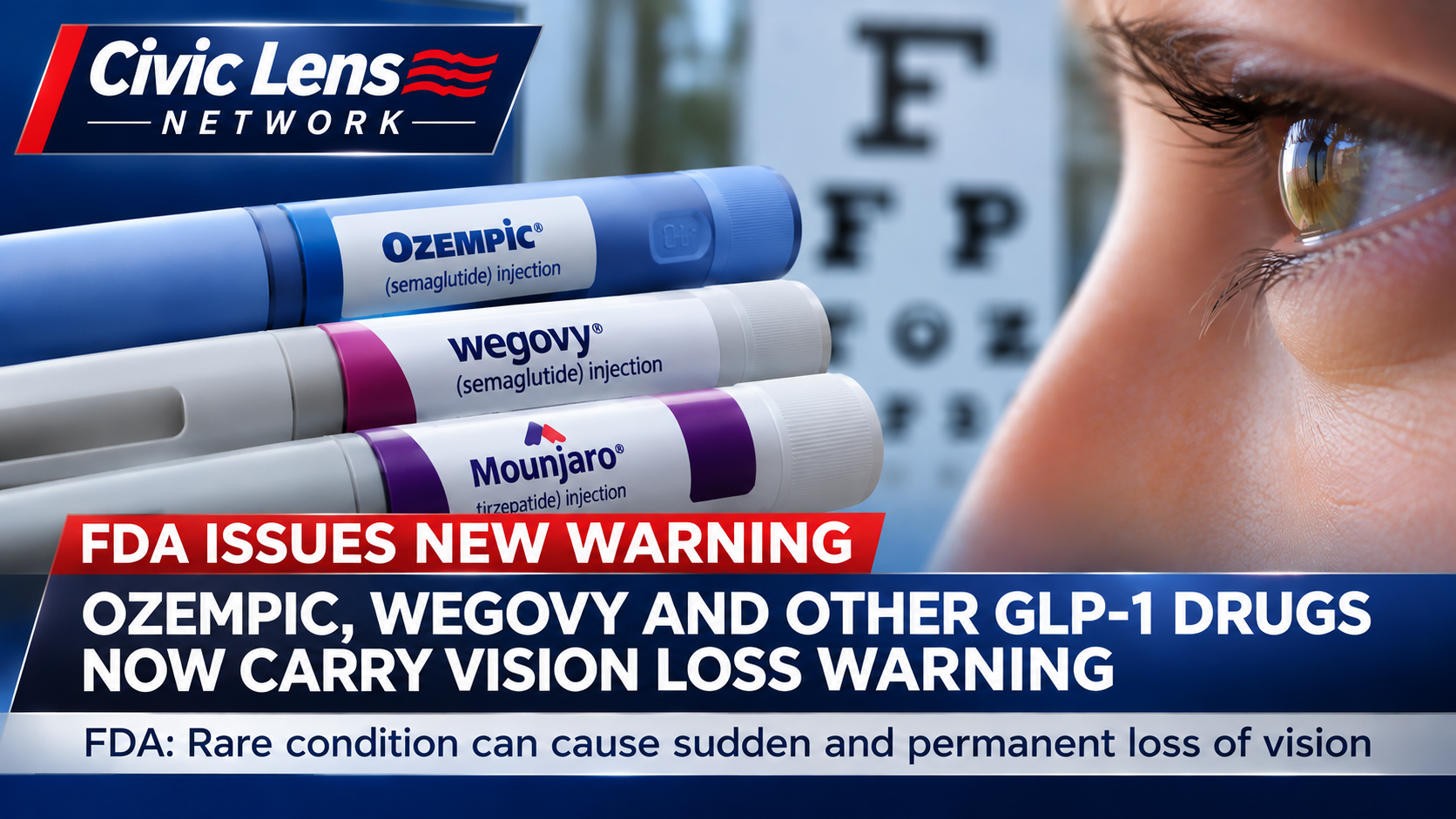
Millions of Americans who rely on popular weight loss and diabetes medications are facing a serious new safety warning after the U.S. Food and Drug Administration ordered drug manufacturers to disclose a potential risk of sudden and permanent vision loss.
The sweeping federal action, announced November 9, affects an entire class of medications known as GLP-1 receptor agonists, including Ozempic, Wegovy, Mounjaro and Zepbound.
These medications have become enormously popular for controlling diabetes, suppressing appetite and helping patients lose substantial amounts of weight. But federal regulators now say evidence warrants stronger warnings about a rare medical condition capable of permanently damaging eyesight.
The FDA is requiring manufacturers to add the potential risk to the Warnings and Precautions sections of their prescription labels.
The decision raises important questions about how much patients knew about the possible complications before beginning treatment and whether existing warnings adequately communicated the risks.
A Rare Condition With Devastating Consequences
At the center of the FDA’s announcement is a condition called non-arteritic anterior ischemic optic neuropathy, commonly abbreviated as NAION.
The condition develops when blood flow to the front portion of the optic nerve becomes insufficient. The optic nerve is responsible for transmitting visual information from the eye to the brain.
When its blood supply is disrupted, the resulting damage can cause sudden and sometimes permanent loss of vision.
Unlike many other serious eye conditions, NAION frequently develops without pain.
Patients may wake up one morning and discover that their vision has become blurry, that part of their visual field is missing or that they can no longer see clearly through one eye.
Symptoms can include sudden vision deterioration, blind spots, tunnel vision, distorted colors and reduced central visual sharpness.
There is no established treatment that reliably reverses vision loss caused by NAION.
For affected patients, the consequences can be life-changing, interfering with driving, reading, employment and everyday independence.
What Federal Investigators Discovered
The FDA’s decision followed an extensive examination of clinical trials, adverse-event reports, observational research and other scientific evidence.
Federal researchers analyzed 126 randomized clinical trials involving more than 134,000 participants.
Among patients receiving GLP-1 medications, investigators calculated approximately 6.4 cases of NAION per 100,000 person-years of treatment.
Among patients receiving a placebo or other non-GLP-1 glucose-lowering medications, the rate was approximately 3.8 cases per 100,000 person-years.
Although the absolute risk remained small, the difference contributed to regulators’ conclusion that stronger warnings were necessary.
The FDA also examined real-world medical data comparing patients taking GLP-1 medications with patients receiving other diabetes treatments.
Some comparisons identified an increased risk, while others did not produce statistically significant differences.
Investigators also acknowledged that diabetes, high blood pressure, sleep apnea and other medical conditions can independently increase the risk of NAION.
These overlapping risk factors make determining the exact role of GLP-1 medications particularly challenging.
Nevertheless, regulators concluded that the totality of the evidence supported warning patients about a potential increased risk.
Importantly, the FDA has not established that these medications directly cause every reported case of NAION.
Warning Extends Beyond Ozempic
Although Ozempic and Wegovy have attracted much of the public attention, the federal action extends beyond those two medications.
The warning requirement applies to approved GLP-1 receptor agonists, including medications marketed under the names Mounjaro, Zepbound, Trulicity, Victoza, Saxenda and Rybelsus, along with other products in the class.
The broad scope of the requirement is significant.
Rather than limiting the warning to one manufacturer or a single formulation, federal regulators determined that the potential safety concern warranted labeling changes across the medication class.
That means patients taking these drugs for different medical purposes may encounter the same new warning.
Some individuals receive GLP-1 medications for obesity, while others depend on them to manage type 2 diabetes or reduce the likelihood of serious cardiovascular complications.
For these patients, treatment decisions involve weighing potentially substantial medical benefits against an uncommon but serious possible complication.
Questions About Earlier Safety Warnings
Concerns about vision loss did not emerge overnight.
In 2024, researchers published findings identifying a possible association between semaglutide, the active ingredient in Ozempic and Wegovy, and NAION.
That research prompted additional scrutiny.
Federal investigators subsequently reviewed clinical trials, postmarketing reports and other evidence to determine whether the association warranted regulatory action.
The latest FDA decision marks a significant development in that process.
It also raises an important consumer protection question: When emerging research identifies a potentially irreversible complication, how quickly should manufacturers and regulators communicate that concern to patients?
Drug safety monitoring does not end when a medication receives federal approval. Serious adverse reactions can emerge after products enter widespread use, particularly when millions of patients begin treatment.
The purpose of postmarketing surveillance is to identify potential dangers that may not have been fully apparent during earlier clinical testing.
The FDA’s latest action demonstrates why continued monitoring is necessary even for medications that have already become household names.
Drug Manufacturers Face Growing Scrutiny
Novo Nordisk, the manufacturer of Ozempic and Wegovy, and Eli Lilly, which produces Mounjaro and Zepbound, are among the companies affected by the labeling requirement.
Novo Nordisk has maintained that available evidence does not establish a causal relationship between its medications and NAION.
Eli Lilly has said it is evaluating the FDA’s announcement.
The regulatory development also comes amid litigation involving patients who allege they experienced serious eye injuries after using certain GLP-1 medications.
Those allegations have generated questions about product safety, warning labels and what manufacturers knew about potential complications.
However, the existence of lawsuits does not establish that a medication caused an individual patient’s injury or that a manufacturer violated the law.
Such questions require examination of medical evidence, scientific findings and the facts of individual cases.
The FDA’s warning requirement is a regulatory safety measure, not a judicial determination of liability.
What Patients Should Watch For
Federal regulators are urging patients to recognize the symptoms of NAION and seek immediate medical attention if sudden visual changes develop.
Warning signs include painless vision loss in one eye, unexpected blind spots, reduced clarity, tunnel vision and unusual changes in color perception.
Because vision loss may become permanent, sudden changes should not be ignored or dismissed as ordinary temporary blurriness.
Patients experiencing abrupt vision loss should seek emergency medical evaluation, since other urgent eye and neurological conditions can produce similar symptoms.
The FDA is not recommending that everyone taking GLP-1 medications immediately discontinue treatment.
Abruptly stopping a prescribed diabetes medication without medical guidance can create additional health risks.
Instead, patients should discuss concerns with their prescribing healthcare professionals, particularly if they have previously experienced NAION or have other conditions affecting their eyes.
Healthcare professionals are being advised to promptly evaluate suspected cases and consider whether continued treatment is appropriate.
A Larger Question About Prescription Drug Safety
The rapid growth of GLP-1 medications has transformed the treatment of obesity and diabetes.
Their popularity has also placed unprecedented attention on the pharmaceutical companies producing them and the federal agencies responsible for overseeing their safety.
For many patients, these medications have delivered meaningful health improvements.
But the possibility of permanent vision loss, however uncommon, represents a serious consideration that deserves clear disclosure.
Patients have a right to understand both the benefits and the potential dangers of medications they are prescribed.
The FDA’s latest decision reinforces that responsibility.
It also illustrates the importance of continuing to examine medications after approval rather than assuming their safety profiles are permanently settled.
The available evidence does not suggest that most GLP-1 users will experience this complication. The condition remains rare.
Nevertheless, the consequences for an individual who develops permanent vision impairment can be profound.
For millions of Americans using these medications, the new warning is a reminder that even highly effective treatments can carry serious risks.
And for federal regulators and pharmaceutical manufacturers, the message is equally important: when credible evidence identifies a potentially devastating complication, patients deserve to know.