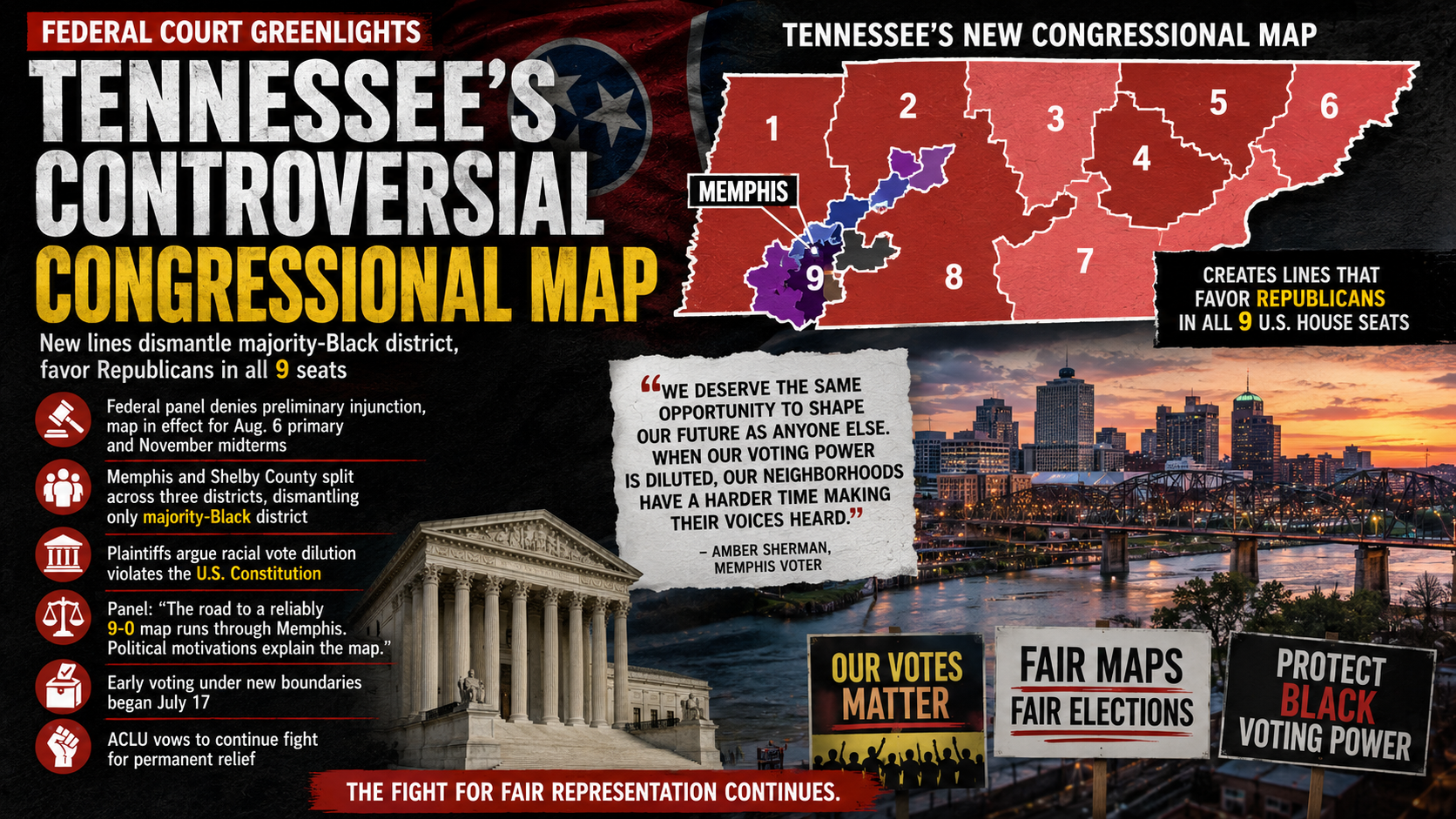
A three-judge federal panel on Thursday declined to issue a preliminary injunction against Tennessee’s newly redrawn congressional map, clearing the way for the plan to be used in the state’s Aug. 6 primary elections and the November midterms. The map, approved by the Republican-controlled legislature and signed by Gov. Bill Lee in May during a special session, divides the majority-Black city of Memphis and Shelby County across three districts. It dismantles the state’s only majority-Black congressional district, previously held by longtime Democratic Rep.
Steve Cohen, and creates lines that analysts say favor Republicans in all nine of Tennessee’s U.S. House seats. The decision came in Sherman v. Hargett, a lawsuit filed by Memphis voters and civil rights groups represented by the American Civil Liberties Union.
Plaintiffs argued the map intentionally diluted Black voting power in violation of the U.S. Constitution. They noted that the redraw followed a late-April U.S. Supreme Court ruling that weakened certain Voting Rights Act protections for minority voters by limiting race-based considerations in redistricting.
Republican lawmakers maintained the changes were driven purely by partisan goals—to eliminate the state’s sole Democratic-held seat—rather than race. Under a 2019 Supreme Court precedent, pure partisan gerrymandering is generally permissible. Defense attorneys told the court that racial data was not used in drawing the lines and that “the map was drafted for politics.” The panel, consisting of two Trump appointees and one Obama appointee, found the plaintiffs unlikely to succeed on the merits.
“The road to a reliably 9-0 map runs through Memphis,” the judges wrote. “Thus, political motivations readily explain the map’s dilutive effects.” They cited a lack of direct evidence of racial motivation. The ruling marks another win for Republican efforts in several states to redraw districts mid-decade after the Supreme Court’s decision, with the aim of strengthening the party’s narrow House majority.
Cohen, who represented the Memphis-based 9th District for nearly two decades, ended his reelection bid after the map was enacted. Early voting under the new boundaries began July 17, and officials noted that primary ballots had already been printed. Plaintiff Amber Sherman, a Memphis voter, called the outcome painful. “We deserve the same opportunity to shape our future as anyone else,” she said.
“When our voting power is diluted, our neighborhoods have a harder time making their voices heard.” ACLU attorneys said the case will continue as they seek permanent relief, arguing the map unlawfully fractures Black communities. The full litigation remains ongoing, but the map will govern this year’s elections.