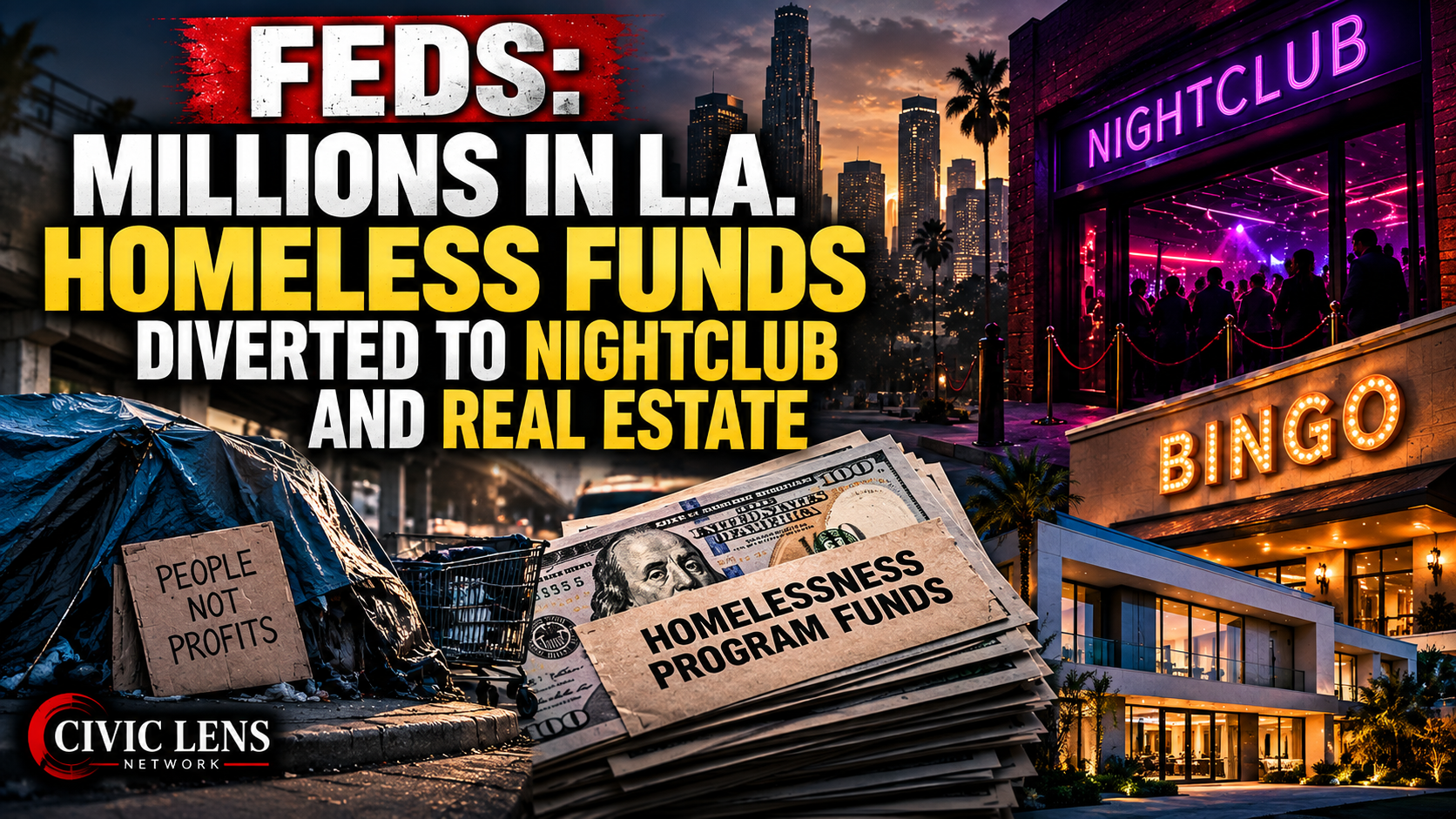
LOS ANGELES. Federal prosecutors on Wednesday charged three people tied to Los Angeles-area homelessness nonprofits with fraud and corruption, alleging that money meant to house and serve homeless people was instead steered into shell companies, commercial real estate, personal bills, and a high-end Inglewood nightclub with an adjacent bingo hall. The largest case targets Michael Young, 46, of Baldwin Hills, a founder of the Culver City nonprofit Home At Last.
Agents arrested Young on a federal criminal complaint charging wire fraud, a felony that carries a maximum sentence of 20 years in prison. The Justice Department said Home At Last received more than $118 million in public funds through contracts with the Los Angeles Homeless Services Authority, the City of Los Angeles, the County of Los Angeles, and the U.S. Department of Housing and Urban Development. LAHSA alone paid the nonprofit more than $75 million for homeless housing services, prosecutors said.
Those contracts were supposed to pay for interim housing and related services for people living on the street. The complaint alleges Young ran a years-long scheme that hid self-dealing behind fake vendors. Prosecutors say he created shell companies with no employees, no real offices, and no legitimate operations, then submitted fake competing bids, forged signatures, and fraudulent invoices to make those vendors look like independent contractors offering market-rate work.
Investigators say Young controlled the vendors’ bank accounts and used them to pull public money back to himself. The complaint alleges that sham-vendor fraud diverted more than $7.5 million. At a news conference, Assistant Attorney General Colin M. McDonald said Young, through Home At Last, received more than $100 million in taxpayer funds and misappropriated more than $12 million, sending money into shell companies, real estate, and “even a nightclub and bingo hall.”
Prosecutors say more than $1 million went to open and operate Six Seven Five Lounge, a restaurant and nightclub in Inglewood. They allege taxpayer money paid for a liquor license, an architect, a developer, and high-end finishes. Officials also allege funds paid for commercial real estate unrelated to homeless housing, nearly $50,000 for a luxury trip to Tahiti, and about $140,000 to restore a vintage Chevrolet Impala. “Taxpayers did not sign up to fund this nightclub,” McDonald said.
Young has not been convicted. An indictment or complaint is only an accusation. He made an initial court appearance Wednesday and was released on $500,000 bond, with arraignment set for Oct. 22.
No public statement from Young or a defense attorney was available. A second case charges Donye Mitchell, 55, also known as Danya Mitchell, of Orange, the CEO and executive director of The Big Blue Umbrella. He is charged with wire fraud. Prosecutors say he applied in January 2024 for more than $9 million from Epidaurus, which does business as Amity Foundation, a nonprofit funded by Los Angeles County.
Amity later awarded more than $1.2 million for housing and mental health services. The complaint alleges Mitchell falsely claimed his group was a major homeless-housing provider and misstated its work with Special Service for Groups and its HOPICS division. After money arrived, prosecutors say he lied about staffing and spending and used grant funds for inflated salary payments, his own bail-bond costs, credit-card debt, transfers to relatives, rent, and PlayStation charges.
Amity disbursed about $315,000 before terminating the contract in May 2025 over spending concerns and missed milestones. Mitchell was first described as a fugitive Wednesday morning and later appeared in federal court after his arrest. He has not entered a plea. The third new case is a 21-count indictment against Lakiya Malone, 48, of South Los Angeles, an employee of Special Service for Groups.
Malone’s job included referring homeless people to housing sites funded by HUD, LAHSA, and the city and county. Prosecutors accuse her of taking more than $180,000 in bribes and kickbacks from Alexander Soofer, executive director of Abundant Blessings, in exchange for priority referrals, including “ghost” participants who never lived at the sites.
The indictment alleges Soofer paid Malone and an entity she controlled, Grateful Hearts Realty & Consulting, under the guise of consulting fees, while files were padded with fake welcome letters, forged sign-in sheets, and falsified eligibility forms. Soofer allegedly received more than $17 million from Special Service for Groups during the scheme. Malone faces wire fraud, bribery, and conspiracy counts. She was arrested Wednesday and has not been convicted.
In a related earlier case announced with Wednesday’s charges, Soofer has agreed to plead guilty to one count of wire fraud and one count of money laundering. In a plea agreement, he admitted his role in the bribery scheme with Malone and admitted obtaining $23 million in public homelessness money, at least some through fraud, and pocketing at least $2 million for personal use and unrelated businesses. He has agreed to forfeit those proceeds. The plea has not yet been entered.
The FBI, IRS Criminal Investigation, and the HUD Office of Inspector General are investigating. First Assistant U.S. Attorney Bill Essayli said the cases show “a profound failure by the State of California and Los Angeles County to safeguard public funds.” LAHSA said it cooperated with investigators, canceled Home At Last contracts in June after “strong evidence of wrongdoing” and a failure to meet obligations, and is pursuing recovery of cash the IRS seized from an address linked to Young.
The agency said none of its employees were implicated. The alleged theft sits inside a much larger pipeline. Home At Last’s $118 million in public awards is only one contractor’s slice of regional homelessness spending that local officials have put in the billions of dollars a year. LAHSA spent more than $800 million in a recent fiscal year.
Since 2021 it has received more than $1 billion in federal funds, including about $220 million in 2024. HUD in June 2026 suspended further federal funding to LAHSA, citing financial-management failures, weak conflict-of-interest controls, and missing documentation. Los Angeles County has already pulled more than $300 million from the agency and created its own homelessness department. Independent audits found a significant deficiency in LAHSA’s internal financial controls.
In the Abundant Blessings matter, later audits and local reporting found the agency continued payments after its own compliance staff labeled the provider high-risk and after it obtained evidence of possible federal crimes.