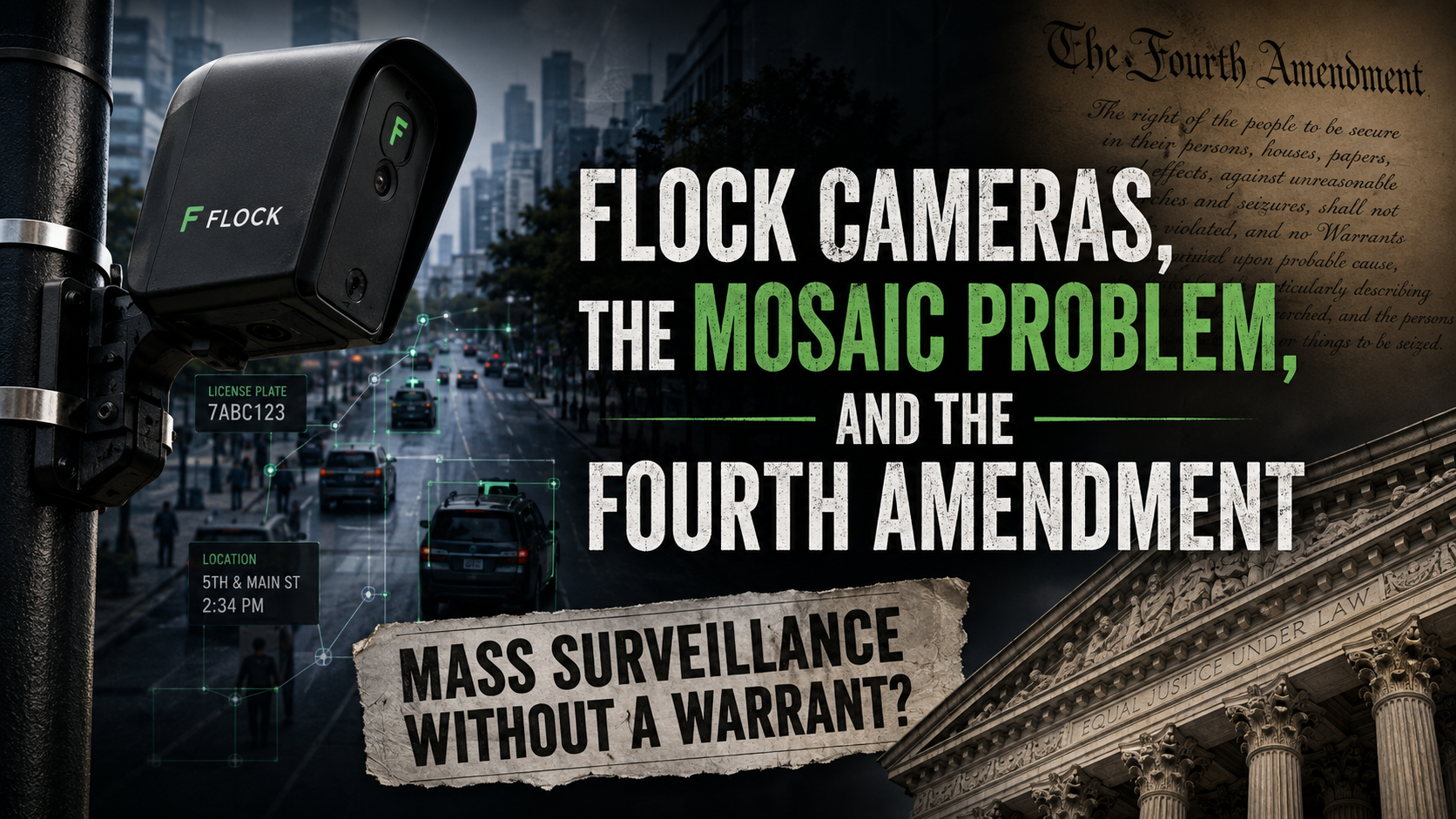
Flock Safety has rapidly deployed automated license plate reader cameras across the United States, with more than 115,000 units installed in under two years. These devices capture still images of nearly every vehicle that passes, recording the license plate number along with the precise time and location. Artificial intelligence then builds a fuller profile of each vehicle by noting distinctive features such as roof racks, bumper stickers, color, make, model, dents, or other markings.
The resulting data flows into a searchable database that is typically retained for about thirty days, though the period can be extended. Primary buyers include police departments, city governments, homeowners associations, commercial developments, universities, schools, and churches. Critics describe the network as the foundation of a nationwide mass surveillance system paid for in significant part by public funds, one that tracks ordinary daily movements far beyond traditional observation. License plate readers themselves are generally lawful.
Anyone standing in a place they are legally entitled to occupy may photograph activity occurring on a public roadway when that activity is open to public view. License plates displayed on public streets fall squarely into this category. The Supreme Court established in United States v. Knotts that a traveler on public roads has no reasonable expectation of privacy in the vehicle’s movements because those movements, stops, and destinations remain visible to any ordinary observer.
Later decisions have applied the same principle to limited queries of license plate records. When government agents collect or access the data, the Fourth Amendment enters the analysis. The Amendment guarantees the right of the people to be secure in their persons, houses, papers, and effects against unreasonable searches and seizures, and it requires that warrants issue only upon probable cause. Although the text never uses the phrase “right to privacy,” courts have long treated the Amendment as the constitutional shield against unjustified government intrusion.
Early interpretations focused on physical property. As technology advanced, the Court extended protection into the realm of information and electronic surveillance. The pivotal case is Katz v. United States.
Agents attached a listening device to the exterior of a public telephone booth without a warrant and overheard a conversation about illegal gambling. The government argued that no physical trespass had occurred and that the booth stood on a public sidewalk. The Court rejected both claims. It declared that the Fourth Amendment protects people, not places.
What a person knowingly exposes to the public is not protected, yet what that person seeks to preserve as private, even in an area accessible to the public, may receive constitutional protection if society recognizes the expectation as reasonable. The test therefore turns on two questions: whether the individual actually sought privacy, and whether that expectation is one society deems objectively reasonable. Flock maintains that each camera simply takes an isolated photograph of a publicly visible license plate and therefore raises no Fourth Amendment concern.
Isolated, intermittent observations of this kind remain constitutional under existing precedent. The difficulty arises when thousands of such observations are aggregated into a dense, searchable, nationwide database. A single photograph of a vehicle at an intersection reveals almost nothing. Hundreds or thousands of photographs taken over days or weeks can reconstruct where a person lives, works, worships, shops, seeks medical care, meets associates, or travels.
The resulting portrait is far more detailed than any ordinary observer, or even an entire police force acting without technological assistance, could realistically obtain. This aggregation is known as the mosaic problem. Individual data points that are harmless in isolation become constitutionally significant when combined. The whole is different in kind from the sum of its parts.
Supreme Court decisions involving prolonged location tracking have recognized that continuous or comprehensive monitoring of a person’s movements can invade a reasonable expectation of privacy even when every individual observation occurs in public. The distinction between intermittent snapshots and continuous reconstruction of daily life is therefore decisive. Courts have not spoken with one voice. Some rulings treat limited uses of license plate data as mere extensions of traditional sensory faculties and decline to require a warrant.
Others acknowledge that a sufficiently dense network retained over time may cross the constitutional threshold. At present the systems often operate in a legal gray zone by emphasizing that they function as ordinary license plate readers. Yet the expanding infrastructure is steadily assembling the very mosaic of private movements that the Fourth Amendment, under the reasonable expectation of privacy doctrine, is designed to shield from warrantless government scrutiny.
Searching that mosaic without probable cause and a valid warrant raises serious constitutional questions that remaining litigation will continue to confront.