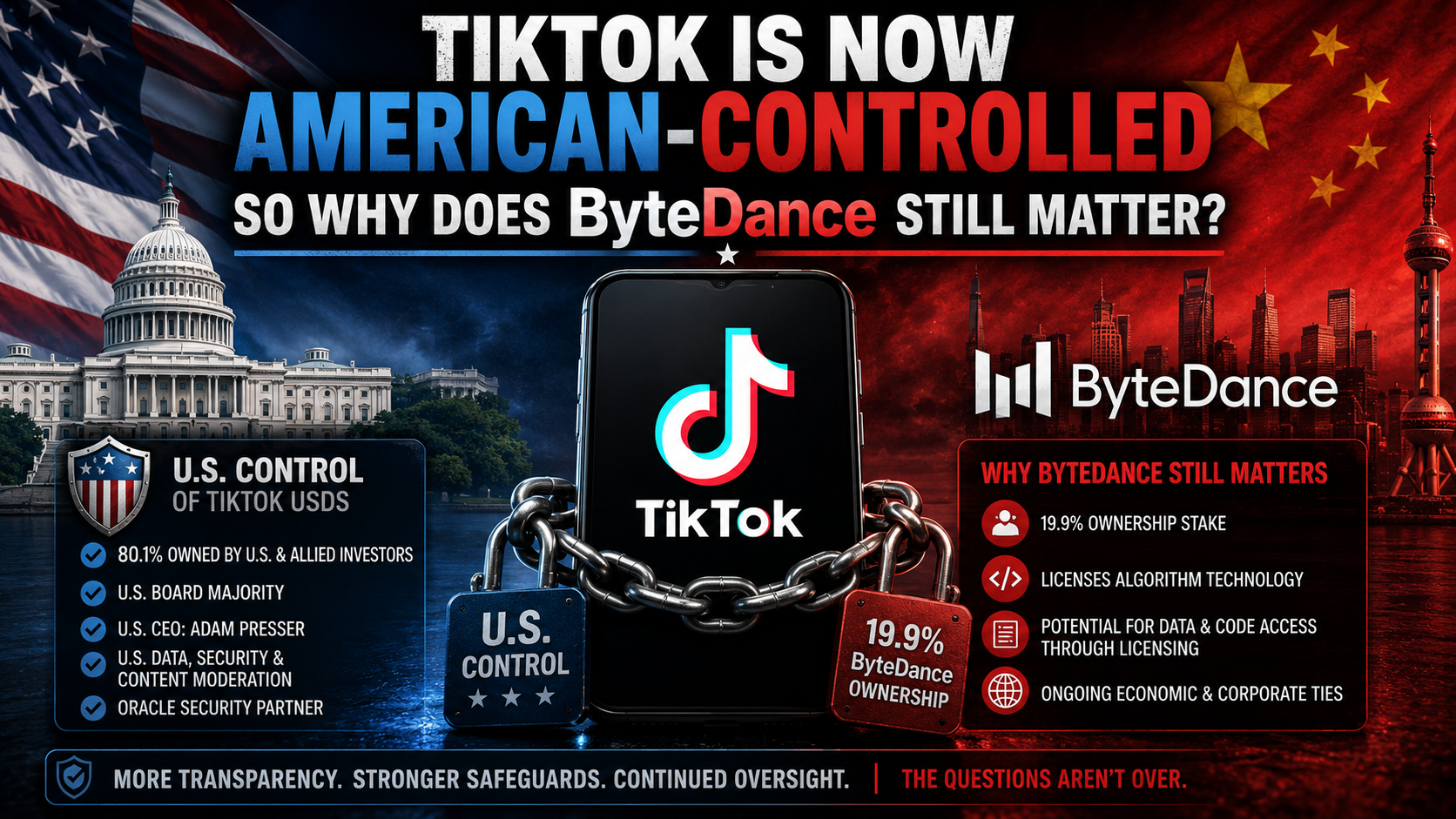
TikTok has undergone one of the most consequential corporate restructurings in the history of social media. After years of warnings from Washington that TikTok’s relationship with its Chinese parent company ByteDance posed a potential national security threat, the platform’s American operations were reorganized in January 2026 under a new company known as TikTok USDS Joint Venture LLC. On paper, the change is substantial. ByteDance no longer holds majority ownership of the American operation.
TikTok says the new U.S. company controls American user data, security, content moderation and the recommendation system used for American users. American and international investors now own the overwhelming majority of the joint venture. But there is one important detail that has kept the controversy alive. ByteDance has not completely disappeared.
It retains a 19.9 percent ownership stake in the U.S. joint venture, and technology originally developed by ByteDance, including technology associated with TikTok’s recommendation system, continues to play a role in the American platform through a licensing arrangement. That distinction is critical. It would be inaccurate to simply claim that China controls TikTok USA. There is currently no public evidence establishing that the Chinese government directs TikTok USDS or makes its day-to-day moderation decisions.
But it is equally inaccurate to suggest that TikTok’s connection to ByteDance has been completely severed. The real situation is considerably more complicated. What Exactly Happened to TikTok in America? For years, the central concern surrounding TikTok was relatively straightforward.
TikTok’s parent company ByteDance was founded in China. American officials worried that Chinese laws and ByteDance’s corporate position could potentially give Beijing leverage over a platform used by an enormous number of Americans. The concern wasn’t simply about whether someone in China could see an American teenager’s dance video. The bigger concerns involved data and influence.
TikTok’s recommendation system determines what millions of people see when they open the application. Unlike a traditional social network where users primarily see content from people they deliberately follow, TikTok’s For You feed can determine what information suddenly reaches millions of people. That makes control of the recommendation system extraordinarily powerful. Congress eventually passed legislation designed to force ByteDance to divest TikTok’s American operation or potentially lose access to the U.S. market.
After a long political and legal battle, a new structure emerged. TikTok USDS Joint Venture LLC officially launched in January 2026. Under the new arrangement, ByteDance retained a 19.9 percent interest. Oracle, Silver Lake and MGX became major investors, each with a 15 percent stake, while additional investors hold other portions of the company.
The result is that ByteDance is now a minority shareholder rather than the controlling shareholder of the U.S. operation. Who Runs TikTok USA? The person at the center of the new American TikTok structure is Adam Presser. Presser was appointed CEO of TikTok USDS Joint Venture LLC by its board.
He was hardly an outsider brought in after the restructuring. Presser had already risen through TikTok’s leadership. He previously served as chief of staff to TikTok global CEO Shou Zi Chew before becoming TikTok’s head of operations. His responsibilities later expanded to include Trust & Safety, placing him near the top of the management structure responsible for the policies governing content moderation and platform safety.
Presser eventually moved into leadership of TikTok’s U.S. data-security organization before becoming CEO of the newly formed American joint venture. That makes Presser one of the most important people in the TikTok story. Under the current structure, he is the executive running the U.S. joint venture. What Does TikTok USDS Actually Control?
This is where the difference between the old TikTok structure and the new arrangement becomes significant. TikTok says its U.S. joint venture has authority over the areas Washington was most concerned about. Those include American user data, cybersecurity, the U.S. recommendation system and Trust & Safety operations. Trust & Safety is especially important.
When users complain that their videos were removed, accounts were suspended, content was restricted or videos became ineligible for recommendation, those decisions fall somewhere within TikTok’s broader enforcement and moderation infrastructure. TikTok USDS says the American organization now has decision-making authority over Trust & Safety policies and content moderation within the U.S. ecosystem. Therefore, a questionable moderation decision involving an American account cannot automatically be attributed to China or ByteDance. There would need to be evidence demonstrating such involvement.
That evidence has not publicly emerged. Then Why Is ByteDance Still Part of the Story? Because ByteDance still owns part of the company and remains connected through technology licensing. ByteDance retains 19.9 percent of TikTok USDS.
That does not constitute majority control. But it is also not zero. More importantly, the recommendation technology that made TikTok extraordinarily successful did not suddenly cease to exist when the ownership structure changed. The American operation has a licensing arrangement involving ByteDance technology.
And that has caught the attention of Congress. Senator Edward Markey of Massachusetts sent a detailed letter to TikTok USDS leadership in May questioning how independent the new American operation truly is from ByteDance. Markey specifically sought information about the licensing agreement between TikTok USDS and ByteDance. His questions went directly to the heart of the controversy.
What exactly is being licensed? How much of the recommendation system originated with ByteDance? Does TikTok USDS receive future updates? Could information flow back to ByteDance?
How thoroughly can American engineers inspect the underlying code? And what happens when ByteDance changes the technology? Those questions matter because ownership and technological dependence are two different things. Imagine an American company purchasing control of a sophisticated machine while continuing to license the machine’s operating technology from its former foreign owner.
The American company may genuinely control the machine. But regulators would still want to understand exactly what the licensing agreement permits the former owner to do. That is essentially the debate now surrounding TikTok. The Algorithm Is the Big Question TikTok’s recommendation algorithm is arguably its most valuable technology.
It determines which videos appear in a user’s For You feed. Every interaction can potentially influence what comes next. Watch a video longer than usual. Skip another immediately.
Search for a particular subject. Like something. Share something. Follow somebody.
TikTok’s system takes enormous amounts of behavioral information and attempts to predict what will keep each individual user watching. That power is exactly why lawmakers became concerned about foreign influence. A recommendation system doesn’t need to completely censor something to influence what people see. It can simply recommend one subject more frequently and another less frequently.
Small changes multiplied across millions of users could theoretically have enormous consequences. This is why the TikTok debate was never only about privacy. It was also about information distribution. TikTok Says the American Algorithm Is Protected Under the new arrangement, TikTok says the U.S. recommendation system is secured within the American-controlled environment.
The company says the recommendation algorithm for U.S. users is being retrained using American user data. Oracle also plays a major role. Oracle serves as a trusted security partner and provides infrastructure associated with the protection of American TikTok data and systems. The idea is to create barriers preventing unauthorized foreign access.
TikTok USDS also says it conducts security reviews of relevant source code. If everything operates as designed, ByteDance would provide licensed technology without controlling how TikTok USDS deploys the American system. But critics want substantially more transparency before accepting that conclusion. Congress Is Asking Questions Senator Markey has been particularly vocal about the remaining uncertainty.
In May 2026, he requested detailed information from TikTok USDS and Oracle about the arrangement. Among other things, Markey wanted the companies to explain the precise terms of the ByteDance licensing agreement. He also questioned how source-code reviews would work. That presents a legitimate technical challenge.
Large modern platforms contain staggering amounts of code. Reviewing code for malicious functionality is difficult enough. Reviewing enormous and continuously evolving systems while also deploying updates and security patches makes the job even harder. Markey therefore questioned whether the safeguards are sufficient to prevent potential algorithm manipulation.
Importantly, those are concerns and questions raised by a U.S. senator. They are not proof that manipulation has occurred. That distinction matters. The Justice Department Has Reached a Different Conclusion There is also significant evidence supporting the argument that TikTok USDS genuinely operates independently.
In July 2026, the Justice Department’s Office of Legal Counsel examined the new arrangement while considering whether TikTok could be permitted on federal government devices under applicable law. Its conclusion was important. The Justice Department determined that TikTok USDS functions independently of ByteDance for purposes of its legal analysis. DOJ specifically considered ByteDance’s continuing minority ownership.
Its opinion concluded that ByteDance retaining a minority stake did not, by itself, mean ByteDance controlled the joint venture. That gives the new corporate arrangement significant legal credibility. In other words, this isn’t simply TikTok declaring itself independent. The U.S.
Justice Department has examined the structure and concluded that the new joint venture functions independently from ByteDance in the context it analyzed. What About Shou Zi Chew? Another connection deserves attention. Shou Zi Chew remains CEO of global TikTok.
He also serves on the board of the American TikTok USDS joint venture. That doesn’t automatically give Chew control over the American company. The joint venture has a seven-member board designed so that Americans constitute a majority. But Chew’s presence demonstrates that the global TikTok organization and TikTok USDS are not completely unrelated entities.
That is important when describing the arrangement accurately. TikTok USDS isn’t an entirely unrelated American social-media company that purchased the TikTok name and started from scratch. It remains part of a complicated global TikTok ecosystem. Who Controls Content Moderation?
For American creators, this may be the most important question of all. TikTok says TikTok USDS has authority over U.S. Trust & Safety and content-moderation policies. That places responsibility for American moderation decisions within the U.S. organization.
Individual videos are obviously not reviewed by CEO Adam Presser. TikTok operates at enormous scale. Enforcement involves automated systems, human reviewers, moderation teams, appeals systems, policy specialists, managers and senior Trust & Safety leadership. Those operations ultimately exist within a corporate management structure.
Under today’s arrangement, responsibility for the U.S. moderation ecosystem ultimately reaches the leadership of TikTok USDS. That means allegations of systematic political, religious or ideological suppression in the United States should be investigated by examining the American moderation operation and its algorithms rather than simply assuming that Beijing personally ordered the decision. Evidence should determine the conclusion. Could China Still Influence TikTok?
This is the question that produces the most disagreement. There are really two separate questions. The first is whether China currently controls TikTok USDS. Available evidence does not establish that it does.
ByteDance is a minority shareholder, TikTok USDS has an American-majority governance structure, and the Justice Department has concluded that the joint venture functions independently from ByteDance under its legal analysis. The second question is whether the continuing ByteDance relationship creates a possible avenue for influence or dependence. That question is more complicated. The licensing relationship exists.
ByteDance retains intellectual property. ByteDance retains an economic interest in the American operation. And TikTok remains connected to a larger global platform. Those facts explain why lawmakers continue asking questions.
They do not prove Chinese government control. They demonstrate why oversight continues. Why the Difference Matters The TikTok debate frequently collapses into two extreme positions. One side says TikTok is simply controlled by China.
The other says TikTok is now completely American and ByteDance has nothing meaningful to do with it. Neither description captures the full picture. TikTok USDS is majority owned outside ByteDance. It has its own CEO.
It has an American-majority board. It says it independently controls U.S. data protection, algorithm security and moderation. Oracle provides substantial security infrastructure. The Justice Department has recognized the joint venture as functioning independently from ByteDance in its legal analysis.
At the same time, ByteDance retains 19.9 percent ownership. TikTok USDS continues licensing important technology associated with the platform from ByteDance. Global TikTok CEO Shou Zi Chew remains on the joint venture’s board. And lawmakers are still demanding more information about exactly how the technological relationship works.
Both sets of facts can be true simultaneously. The Question TikTok Still Needs to Answer The most important issue going forward may therefore not be who technically owns TikTok. It may be who ultimately controls the technology determining what Americans see. TikTok has become more than an entertainment application.
For millions of people it functions as a search engine, news distributor, political forum, advertising platform and cultural gatekeeper. That gives its recommendation system enormous influence. If TikTok USDS independently controls that system, then the 2026 restructuring represents a major separation from ByteDance. If important portions of that system remain dependent on decisions or technology controlled by ByteDance, lawmakers will continue questioning whether the separation went far enough.
The public deserves enough transparency to determine which is true. TikTok’s new structure provides significantly greater American control than existed previously. But ByteDance remains part of the equation. The accurate conclusion is therefore more nuanced than either side’s slogan.
TikTok USA is no longer majority controlled by ByteDance. There is currently no established evidence that the Chinese government controls TikTok USDS or directs individual American moderation decisions. But ByteDance still owns nearly one-fifth of the American joint venture and remains connected through licensed technology. Whether those remaining connections represent little more than a commercial relationship or an unresolved national-security vulnerability is precisely what lawmakers are now trying to determine.
Until the licensing arrangements and technical safeguards become more transparent, that question is unlikely to disappear. For TikTok’s millions of American users, creators and businesses, it may ultimately be the most important question surrounding the platform: TikTok may now be American-controlled. But just how far does ByteDance’s remaining technological reach extend?