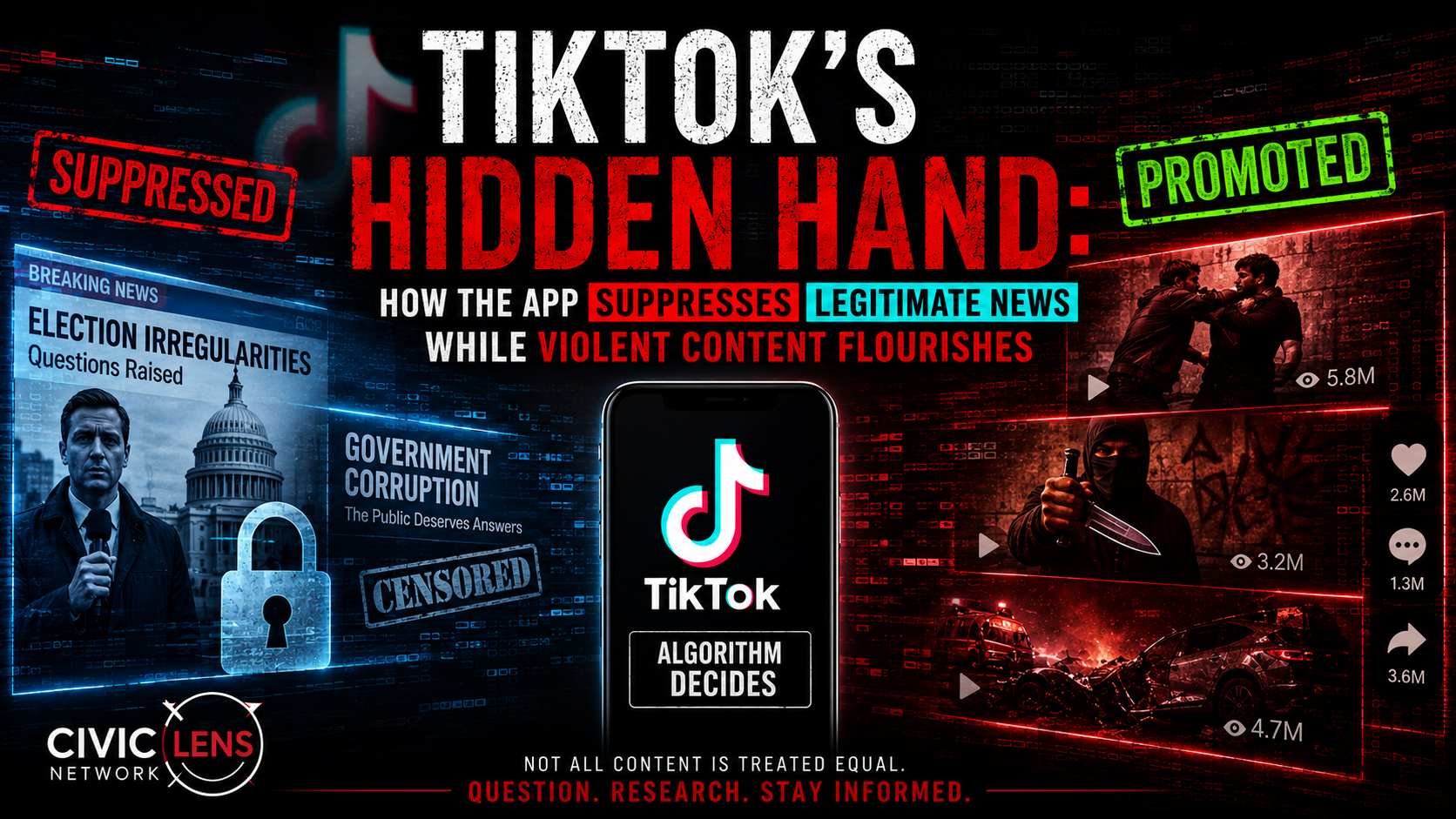
TikTok has become one of the most powerful forces shaping what millions of people see every day. Young users especially turn to it for information, entertainment, and a sense of what is happening in the world. Yet a growing number of creators, journalists, and everyday posters report the same frustrating pattern. Legitimate news stories and viewpoints that challenge certain narratives get buried, restricted, or silenced.
At the same time, violent and appalling videos continue to circulate with far less interference. The result feels unfair and intentional. Many independent news accounts describe a clear drop in reach when they cover serious topics. Videos about current events, government actions, or uncomfortable facts often receive far fewer views than expected.
Some creators say their posts appear to get zero distribution even when their follower counts are high. Others report strikes, limited visibility, or outright removals for content that does not clearly break any stated rules. The algorithm seems allergic to real news. It prefers dances, trends, light entertainment, and content that keeps people scrolling without thinking too hard.
This is not a new complaint. Years ago, when the U.S. government seriously considered shutting TikTok down, concerns centered on exactly this kind of control. The platform was accused of favoring certain stories while downplaying others. Critics pointed to its origins and the risk that sensitive topics would be managed in ways that served outside interests.
The app survived those challenges. It adapted. The methods became quieter and harder to prove in real time. Shadowbanning replaced open bans.
Reach simply collapsed without explanation. Appeals went nowhere. The effect remained the same: certain legitimate voices struggled to be heard. Meanwhile, violent and disturbing material often faces weaker barriers.
Users regularly encounter graphic fights, shocking injuries, and content that glorifies harm. Creators who document real violence or call attention to it sometimes face restrictions, while the original clips spread further. The platform’s moderation appears inconsistent. Political or news-related posts get scrutinized heavily.
Outrageous and harmful videos that drive engagement can slip through or even get pushed. The priority seems to be keeping people on the app rather than protecting the quality of information or shielding users from the worst material. News creators have spoken out about the pressure. Some have stepped back or left the platform after watching their audiences shrink during major news cycles.
They describe heavy-handed AI moderation that flags ordinary reporting. Words that describe events can trigger strikes. Context gets ignored. The system treats discussion of extremism or violence as promotion of it, even when the creator is clearly critical.
At the same time, the algorithm continues to surface attention-grabbing chaos because chaos holds eyes longer. This pattern matters because TikTok is not just another social app. For a large share of its audience, especially younger people, it functions as a primary news source. When the platform makes it difficult for independent reporting to spread, the public conversation narrows.
People see more of what the system rewards and less of what it quietly discourages. Viewpoints that do not fit the preferred flow lose oxygen. Stories that deserve scrutiny get less attention. The information environment becomes skewed without anyone needing to issue a formal order.
The company has always insisted it does not want to be a news platform. That claim rings hollow when the app’s design and moderation choices actively shape which news reaches people. An algorithm trained to maximize time spent will naturally favor emotion, conflict, and simplicity over careful reporting. When human moderators are reduced and AI takes over most decisions, the bias becomes harder to correct.
Creators report that appeals feel useless. There is often no clear path to human review. The rules shift or get applied unevenly depending on the topic. Years of government scrutiny focused on these exact risks.
Officials worried about foreign influence over what Americans see and hear. They worried about the power to amplify some ideas and suppress others at scale. TikTok responded with promises of changes, data safeguards, and better moderation. Many of the same complaints persist.
The platform learned to operate more carefully. It avoids the most obvious red flags while still controlling the flow of information in subtle ways. Reach collapses. Certain hashtags underperform.
News accounts notice the pattern and begin to self-censor just to survive. Violent content presents a parallel failure. The same systems that quickly limit a news video about real events can allow graphic material to circulate longer. Engagement metrics appear to outweigh consistent safety standards.
When outrage and shock drive views, the algorithm has little incentive to clean it up aggressively. The result is a feed that can feel both sanitized of serious discussion and polluted with the worst of human behavior. Users notice. Many have stopped trying to post serious content because the effort brings no return.
Others leave the platform entirely after repeated experiences of being silenced. The message is clear: stick to safe, light, non-controversial material if you want the algorithm to work for you. Challenge the preferred narrative or report something uncomfortable, and the reach disappears. That is not free speech.
It is managed speech. The platform’s size makes the problem larger. Hundreds of millions of people in the United States alone use it regularly. When an app of that scale decides, through code and policy, which stories matter and which do not, the consequences reach far beyond any single creator.
Public understanding of events becomes filtered. Trust in the information environment erodes further. People sense that something is off even if they cannot always point to the exact mechanism. TikTok has faced these accusations for years.
The concerns that once led lawmakers to consider a ban have not vanished. The company has simply become better at operating in the gray areas. Legitimate news continues to struggle for oxygen while violent and appalling videos remain easy to find. The pattern is consistent enough that many who once posted freely now say there is no point.
The platform does not appear to pay attention to those voices. It pays attention to engagement numbers and the quiet control of what spreads. This is not healthy for a society that relies on open information. An app that can elevate or bury stories at will holds too much power.
When that power is used to limit legitimate reporting while tolerating the worst visual content, the public has every reason to question whether the platform deserves its place. The same issues that raised alarms years ago are still present. They have just become harder to see clearly. The silence around real news and the persistence of violent material together paint a troubling picture of what the algorithm values most.