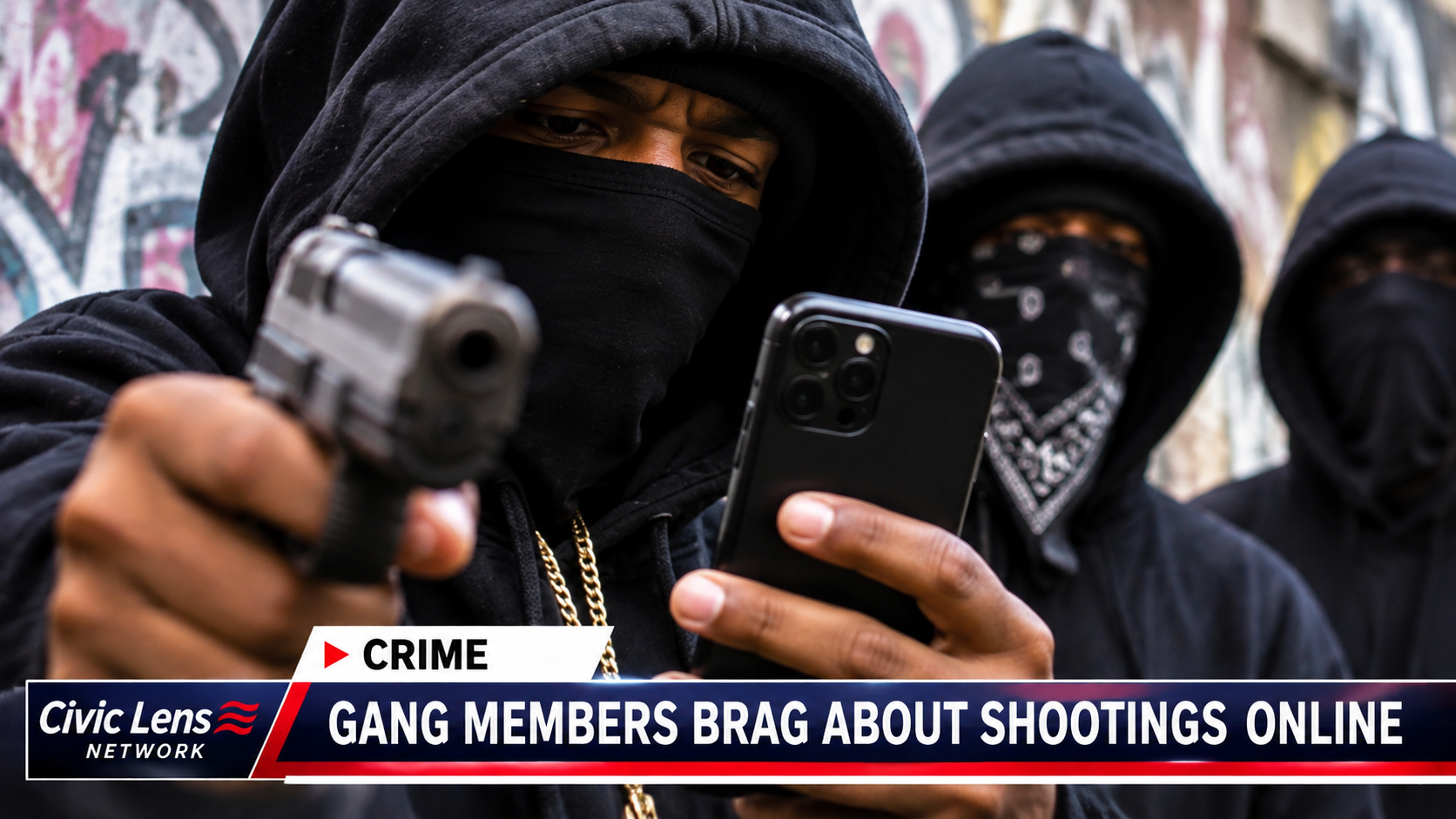
Criminal investigators in New Jersey are exposing a disturbing trend among street gangs: Members are increasingly using social media to boast about shootings, threaten rivals and promote criminal activity, sometimes providing police with evidence that can be used against them.
During a November 19 hearing before the New Jersey State Commission of Investigation, law enforcement officials described how gang members have turned platforms such as Instagram and TikTok into digital stages for displaying weapons, celebrating violence and building their reputations.
Some gang members have even recorded songs describing shootings they allegedly committed, identifying themselves and referencing their intended victims.
The testimony revealed how modern organized crime has adapted to social media, transforming what once happened quietly on neighborhood streets into content available to millions of internet users.
Criminals Publicly Bragging About Their Own Violence
Captain Erik Hoffman of the New Jersey State Police told investigators that some neighborhood gang members commit shootings and then produce music describing what happened.
According to Hoffman, these individuals sometimes identify themselves in their songs, reference people they have targeted and discuss ongoing disputes with rival gangs.
Rather than attempting to conceal their involvement, some appear interested in gaining recognition for it.
Investigators say these online posts can become valuable sources of intelligence, helping detectives identify suspects, establish gang affiliations and understand conflicts that may lead to additional violence.
However, investigators must still independently verify claims made online. A person boasting about a crime does not automatically establish that the person committed it.
Detective Joseph Procopio of the Atlantic County Prosecutor’s Office explained that social media videos frequently feature firearms and other displays intended to intimidate competing gangs.
Those same videos can also attract new members.
Social Media Has Become the New Gang Graffiti
For decades, street gangs used graffiti to identify territory, communicate threats and advertise their presence.
Investigators say social media now serves many of those same purposes, but with a dramatically larger audience.
Cheryl Annese, an intelligence agent with the Camden County Prosecutor’s Office, described social media as a modern version of gang graffiti.
Instead of spray-painting symbols on buildings, gang members can publish videos, photographs and messages that instantly reach people across entire cities.
These posts can identify affiliations, communicate threats and advertise criminal organizations.
The consequences can be deadly.
Procopio testified that he has personally investigated shootings triggered by social media disputes.
An insult that once might have remained confined to a particular neighborhood can now circulate widely, escalating tensions between rival groups.
The public nature of these confrontations can intensify the pressure to retaliate.
A Real Murder Case Shows the Danger
The problem is not limited to investigators’ testimony.
On November 6, federal prosecutors in New Jersey announced the convictions of two men associated with the Sex, Money, Murder set of the Bloods street gang.
Tyler Shorter, 22, and Amir Canty, 23, were convicted of racketeering conspiracy, murder in aid of racketeering and firearms offenses.
According to federal prosecutors, Shorter and a rival gang member had exchanged threatening music videos and songs before a deadly confrontation in Newark in November 2022.
Prosecutors said Shorter shot and killed the rival, while Canty served as the getaway driver.
The victim was also a rapper associated with a rival gang.
Federal authorities said social media and drill rap music were used to promote the gang’s reputation and intimidate rivals.
Both defendants face mandatory life sentences without parole, with sentencing scheduled for March 2027.
The case demonstrates how online gang rivalries can become connected to real-world violence and how digital material can help investigators reconstruct criminal activity.
Organized Crime Is Changing Beyond Social Media
Thursday’s hearing examined more than online gang activity.
Investigators described an evolving organized crime environment involving traditional Mafia families, neighborhood gangs, motorcycle gangs, illegal gambling operations and interstate firearms trafficking.
Authorities identified Atlantic City, Pleasantville, Vineland, Bridgeton and Salem as areas experiencing organized gang activity.
Investigators also reported that criminal organizations increasingly cooperate across traditional boundaries when financial opportunities arise.
Traditional Mafia groups remain involved in illegal gambling, loan sharking and other criminal enterprises.
Meanwhile, neighborhood gangs have developed relationships with criminal networks outside New Jersey, including connections used to obtain firearms from other states.
Authorities described arrangements in which people legally eligible to purchase guns acquire weapons that eventually reach individuals prohibited from possessing them.
The combination of interstate trafficking, online communication and organized criminal relationships creates additional challenges for law enforcement.
Younger Recruits and Growing Online Influence
Investigators also warned that some gangs are recruiting increasingly younger members.
Social media contributes to the problem by presenting gang membership through images of money, weapons, status and perceived power.
Videos designed to intimidate rivals can simultaneously function as advertisements for criminal organizations.
Investigators say prison connections can also strengthen gang networks.
Individuals who enter correctional facilities affiliated with neighborhood gangs sometimes develop relationships with larger national organizations and bring those affiliations back to their communities after release.
These developments have complicated the structure of organized crime, allowing local groups to establish relationships beyond their original neighborhoods.
Police Are Turning Criminal Posts Into Evidence
Although social media has created new opportunities for gang recruitment and intimidation, it has also provided investigators with an expanding source of information.
Detectives can examine publicly available posts to identify individuals, recognize weapons, document threats and understand relationships between criminal organizations.
Videos may also help establish timelines and reveal connections between suspects.
However, online evidence requires authentication, and investigators must distinguish genuine admissions from exaggeration, fictional performances or attempts to build an intimidating reputation.
The growing reliance on digital evidence reflects a broader transformation in criminal investigations.
What once required extensive surveillance or confidential informants may sometimes begin with information that suspects voluntarily publish online.
Despite the Warnings, Shootings Are Declining
One important finding from Thursday’s hearing was that overall shooting violence in New Jersey has been declining.
Hoffman projected that the state could finish 2026 with fewer than 500 shootings, potentially the lowest annual total since statewide tracking began in 2009.
That improvement is significant.
Nevertheless, investigators warned that organized crime continues to evolve even as shooting totals decline.
The State Commission of Investigation plans to release a final report containing its findings and recommendations for legislative and regulatory reforms.
For law enforcement, the challenge is increasingly about understanding criminal organizations that operate simultaneously on neighborhood streets and across digital platforms.
And for gang members who publicly celebrate criminal activity, the technology they use to promote themselves may ultimately help authorities identify and prosecute them.
The same social media posts intended to build a criminal reputation can become evidence in a courtroom.