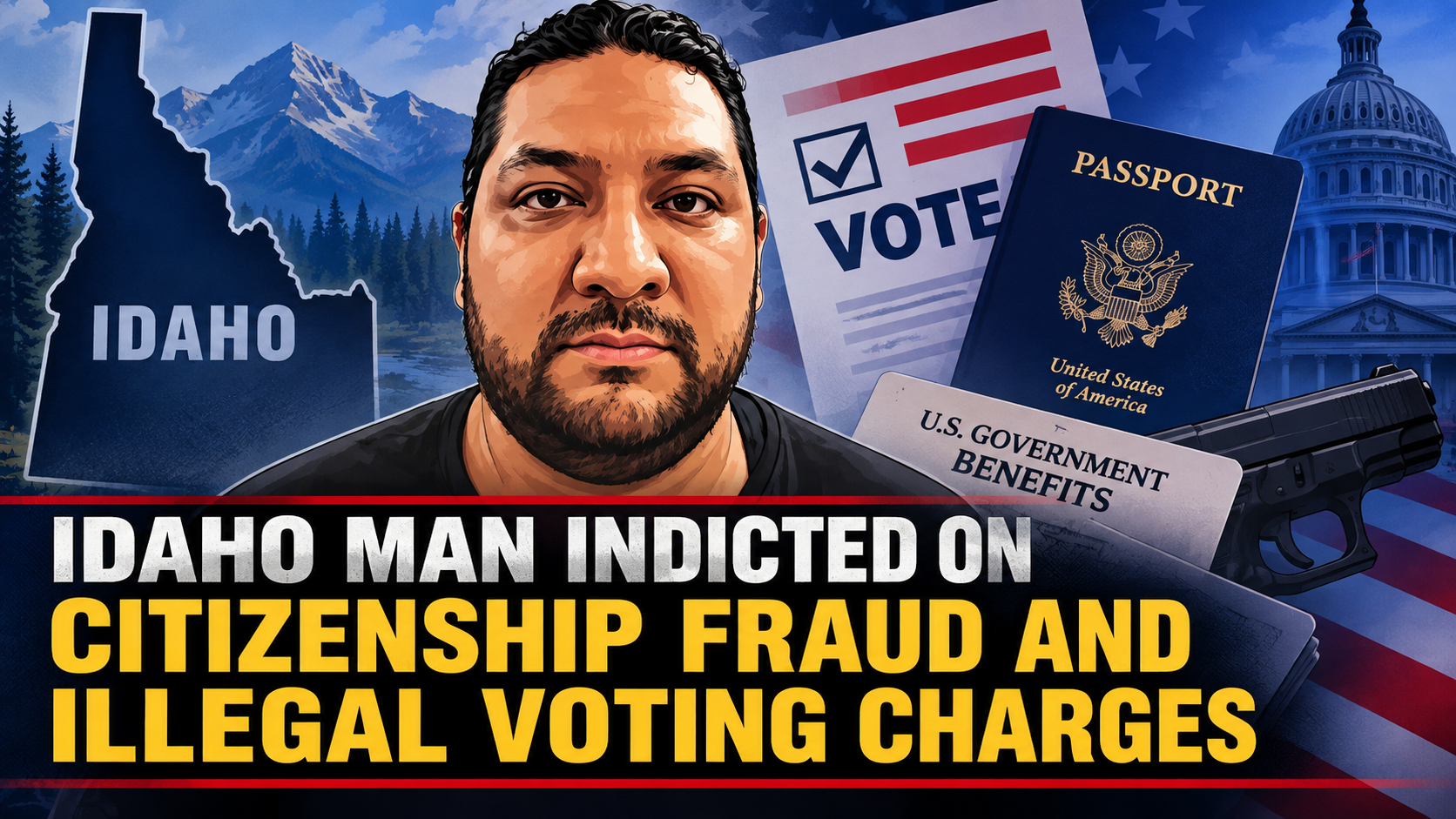
BOISE, Idaho. A federal grand jury in Boise has charged Fredy Avila Gomez with a series of offenses that prosecutors say began with a false claim of United States citizenship and a fraudulent birth certificate. The U.S. Attorney’s Office for the District of Idaho announced the indictment on September 18, 2026.
According to that announcement and a companion statement from the Justice Department in Washington, Gomez is a Mexican national whom federal prosecutors describe as an illegal alien. The charges remain allegations. Gomez is presumed innocent unless and until a court finds him guilty beyond a reasonable doubt. What prosecutors say happened Federal prosecutors allege that from at least March 2017 through about June 2026, Gomez knowingly devised a scheme to defraud departments and agencies of the United States and the State of Idaho.
The agencies named in court records summarized by the U.S. Attorney’s Office include the U.S. Department of Health and Human Services, the Centers for Medicare and Medicaid Services, and the Idaho Department of Health and Welfare. The alleged scheme, prosecutors say, started with identity documents.
Gomez allegedly obtained Idaho identification cards by using a false and fraudulent birth certificate and by falsely claiming to be a United States citizen or national. Prosecutors further allege that he then used those identification cards and the birth certificate to obtain a United States passport, Medicaid benefits, and a firearm.
The same indictment alleges that Gomez falsely claimed to be a United States citizen in order to register to vote and later cast ballots in two Idaho elections, one in May 2022 and one in November 2024. Public election calendars show that Idaho held its statewide primary on May 17, 2022, and its presidential general election on November 5, 2024.
Federal announcements do not identify the county where Gomez allegedly registered, the polling place or ballot method he allegedly used, or the specific contests marked on those ballots. The Justice Department’s national announcement on September 18 listed Gomez among 16 people charged across several states in cases involving alleged illegal voting, illegal voter registration, or related election crimes. Officials said investigators in that group of cases also uncovered related allegations such as wire fraud, passport fraud, and unlawful firearm purchases.
How investigators say the case came together Public records do not yet describe the first tip that led agents to Gomez. The U.S. Attorney’s Office has not released the indictment itself in the materials circulated to the press, and no charging affidavit has been quoted in official statements. What officials have said is which agencies investigated.
U.S. Attorney Bart M. Davis credited Homeland Security Investigations, the Bureau of Alcohol, Tobacco, Firearms and Explosives, the Health and Human Services Office of Inspector General, and the U.S. Department of State’s Diplomatic Security Service.
That combination of agencies matches the range of alleged conduct. Homeland Security Investigations commonly handles immigration status and document fraud. The Diplomatic Security Service investigates passport fraud. The HHS inspector general investigates Medicaid and other health program fraud.
ATF investigates firearm purchase forms and unlawful possession. Idaho officials had separately spent recent years reviewing voter rolls for possible noncitizen registrations. After a 2024 review that used Idaho Transportation Department records and the federal SAVE immigration database, the Secretary of State’s Office said it sent data on about 30 possible noncitizen registrants or voters to the Idaho State Police. State officials later said Idaho State Police referred about a dozen people, and in later correspondence about 15 cases, to the U.S.
Attorney’s Office for possible prosecution. In July 2026, the Idaho Attorney General’s Office said Secretary of State Phil McGrane had not received an update showing that those referrals had produced federal charges. Federal prosecutors have not said whether Gomez was one of those referred cases. The public record therefore supports only a narrower statement: the indictment arrived after a multiagency federal investigation and amid a broader state and federal effort to examine noncitizen registration.
Why the case is being brought now The alleged conduct, as described by prosecutors, spans more than nine years and continued into June 2026. The indictment was returned in mid September 2026 and announced the same week the Justice Department publicized a nationwide set of election related charging decisions. The Idaho office also placed the case in the context of the Justice Department’s National Fraud Enforcement Division, created in April 2026 to focus on fraud against government programs. Assistant U.S.
Attorneys Sean Mazorol and Darci Crane are prosecuting the case. Gomez was scheduled for an initial appearance on September 21, 2026, before U.S. Magistrate Judge Debora K. Grasham in the U.S.
District Court for the District of Idaho. As of the latest official notices reviewed for this article, prosecutors had not released a detailed account of that hearing. The charges, in plain language The U.S. Attorney’s Office listed eight charge titles.
Officials have not published the numbered counts or the precise statute citations in the public announcement. The titles correspond to well established federal offenses. The descriptions below explain what those offenses generally allege. The statutory maximums listed are the usual federal maxima for those offense categories.
They are not a prediction of any sentence. Wire fraud. This charge generally alleges that a person used interstate wire communications, such as electronic benefit systems, online applications, or other electronic transfers, as part of a scheme to obtain money or property by false pretenses. The usual statutory maximum is 20 years in prison.
The U.S. Attorney’s Office said that if Gomez is convicted, he faces a maximum of 20 years in federal prison, which matches the top exposure commonly associated with this count. Theft of government funds. This charge generally alleges that a person stole, embezzled, or knowingly converted money or property belonging to the United States.
In benefit cases, prosecutors typically argue that a defendant obtained federal payments he was not entitled to receive. If the value exceeds $1,000, the usual statutory maximum is 10 years. False statement of citizenship in order to vote. This charge generally alleges that a person knowingly claimed to be a United States citizen for the purpose of registering to vote or voting in a federal, state, or local election.
The usual statutory maximum is five years. Voting by alien. This charge generally alleges that a person who is not a United States citizen voted in an election for federal office, such as president, vice president, or members of Congress. The usual statutory maximum is one year.
False statement in application of passport. This charge generally alleges that a person willfully and knowingly made a false statement in a passport application, or used a passport obtained by a false statement. The usual statutory maximum is 10 years. Fraud in connection with identification documents, production.
This charge generally alleges the unlawful production, transfer, or possession of false identification documents, or the use of stolen or false identifying information, in a way that affects federal interests. Maximum penalties vary by the specific subsection, and can range from several years to 15 years or more in aggravated cases. False statement during purchase of a firearm.
This charge generally alleges that a person knowingly made a false statement on a federal firearms transaction form, such as claiming to be a citizen or denying a prohibited status, in connection with buying a gun from a licensed dealer. The usual statutory maximum is 10 years. Unlawful possession of a firearm. This charge generally alleges that a person possessed a firearm even though federal law prohibited that possession.
In cases involving a person alleged to be in the country unlawfully, prosecutors commonly rely on the federal ban on firearm possession by certain aliens. The usual statutory maximum for that category of offense is 15 years. A federal district judge, not the prosecutor’s press office, would determine any sentence after considering the U.S. Sentencing Guidelines and other statutory factors.
Conviction on multiple counts would not automatically add every maximum together. Immigration consequences, including possible removal proceedings, can follow a conviction but have not been separately announced as part of this criminal case. What remains unknown Several facts that readers often expect in a completed criminal case are not yet public. Officials have not released Gomez’s age or city of residence in the charging announcements.
They have not identified the issuer of the alleged fraudulent birth certificate, the date of the alleged passport application, the amount of Medicaid benefits allegedly obtained, the type of firearm allegedly purchased, or the county election office that processed the alleged voter registration. They have not said whether Gomez has entered a plea, been detained, or been released pending trial. Those omissions matter because an indictment is a formal accusation, not a finding of guilt.
Federal prosecutors must still prove each element of each charge beyond a reasonable doubt. Gomez will have the right to counsel, to contest the evidence, and to require the government to prove that he was not a citizen, that he knew the statements were false, and that he used the documents and benefits in the ways alleged. The case now sits at the first stage of the federal process.
The public record established so far is this: a Boise grand jury has accused Fredy Avila Gomez of building a false claim of U.S. citizenship on a fraudulent birth certificate, then using that claim to obtain Idaho identification, a U.S. passport, Medicaid benefits, a firearm, voter registration, and ballots in the May 2022 and November 2024 Idaho elections.