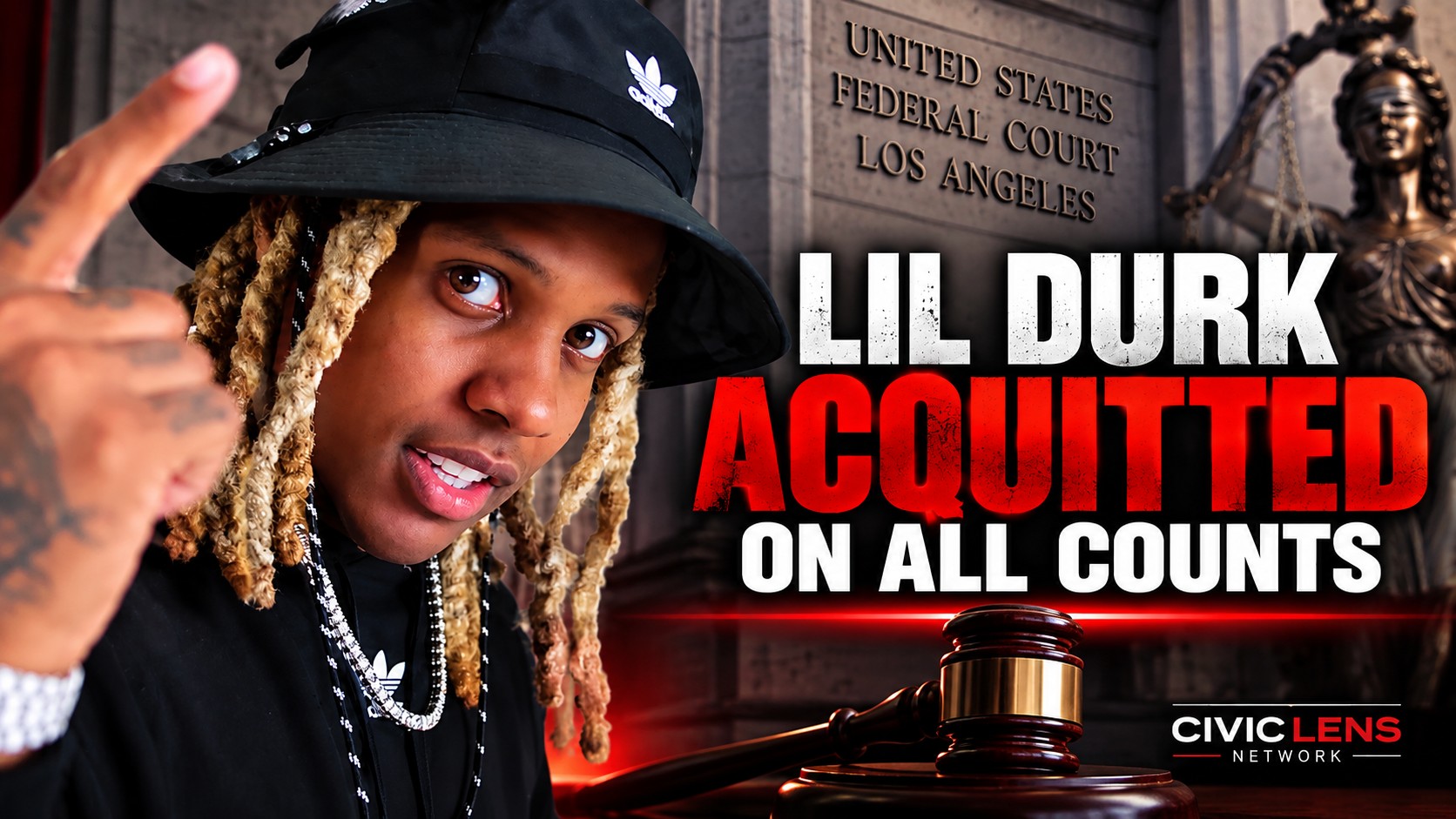
A federal jury in downtown Los Angeles found Grammy-winning Chicago rapper Lil Durk not guilty on Friday, September 11, 2026, of all five charges in a case accusing him of orchestrating a 2022 plot to kill rival rapper Quando Rondo. The shooting instead killed Rondo’s cousin. Durk, whose legal name is Durk Banks, 33, had been on trial before U.S. District Judge Michael W.
Fitzgerald in the Central District of California. Jurors began deliberating on Wednesday, September 9, and returned the verdict after three days. Banks kept his head down as the clerk read the counts. After the second not guilty finding, he wiped away tears.
His wife, India Royale, put her arm around his mother in the gallery. The acquittal does not mean the jury found that no crime occurred. The same panel convicted two co-defendants of stalking offenses tied to the same shooting. It means the government did not prove beyond a reasonable doubt that Banks committed the five crimes charged against him in this trial.
The charges and the verdict Banks was found not guilty of: 1. Conspiracy to commit stalking 2. Stalking using a dangerous weapon 3. Stalking resulting in death 4.
Conspiracy to use interstate commerce facilities to commit murder-for-hire resulting in death 5. Use of interstate commerce facilities to commit murder-for-hire resulting in death A conviction on the murder-for-hire counts could have carried a life sentence. Tried with him were Deandre Dontrell Wilson, also known as OTF Dede, and David Brian Lindsey, also known as Browneyez. Jurors convicted Wilson and Lindsey of conspiracy to commit stalking, stalking using a dangerous weapon, and stalking resulting in death.
They acquitted both men of the murder-for-hire charges. Stalking resulting in death carries a maximum sentence of life in prison. Wilson’s attorney, Craig Harbaugh, said in a statement after the verdict, “We thank the jury for seeing there was no murder for hire.” What prosecutors alleged Federal prosecutors said Banks ordered and financed an attempt to kill Tyquian Bowman, the Atlanta rapper known as Quando Rondo.
They said the motive was revenge for the November 6, 2020, killing of Dayvon Bennett, known as King Von, a close friend of Banks and an artist on Banks’s Only the Family label. An associate of Bowman was later charged in Bennett’s death. Those charges were dropped. According to the government’s theory, Banks put a bounty on Bowman and used members and affiliates of Only the Family to carry it out.
Prosecutors said a group flew from the Chicago area to California in August 2022, tracked Bowman for hours, and then ambushed his black Cadillac Escalade. The shooting happened on the afternoon of August 19, 2022, at a gas station at Beverly and La Cienega boulevards, across from the Beverly Center shopping mall in Los Angeles. Authorities said three men left a white sedan, opened fire, and fled.
Prosecutors told the jury the gunmen fired at least 18 rounds and used multiple firearms, including a weapon modified to function as a machine gun. Bowman survived. Saviay’a Robinson, 24, also known as Lul Pab, was struck and later died. Robinson had been traveling with Bowman.
The official 2024 charging announcement from the U.S. Attorney’s Office for the Central District of California alleged that flight records, credit-card charges, hotel bookings, ski-mask purchases, and a stolen vehicle were tied to Banks’s circle and, in some instances, to cards or accounts connected to him. Prosecutors also pointed to a text they attributed to Banks around the time one-way flights were booked: “Don’t book no flights under no names involved wit me.” Assistant U.S.
Attorney Ian Yanniello told jurors in closing that Banks “used his money, his power, and his influence to try to kill his biggest opp.” He said Banks was not alleged to have been one of the gunmen on the ground, but that the plot “doesn’t happen without him.” Assistant U.S. Attorney Michael Morse compared Banks’s later attempt to shift blame onto others to a customer blaming a delivery service for a package the customer had ordered.
The cooperating witnesses The government’s case rested heavily on three men who pleaded guilty and testified under cooperation agreements: Kavon Grant, known as OTF Vonnie or Cuz, Banks’s former personal assistant. Grant testified that Banks directed him to obtain a stolen vehicle and that the group was told to fly into San Diego rather than Los Angeles to reduce the chance of detection. Grant said he handled guns, masks, lodging, and logistics.
Courthouse reporting on the trial said Grant also described Banks asking after the shooting whether they “got him,” and reacting to news of Robinson’s death by saying they had “got somebody.” Kacey Hester, known as OTF Jam, who identified himself as one of the shooters. Hester testified that he was recruited on August 18, 2022, shortly after leaving prison on an attempted-murder case, and that he heard Banks in the background of a call arranging the trip.
Trial reporting said Hester also claimed Banks later indicated that killing Robinson still counted even though Bowman had not been hit. Keith Jones, known as Flacka, identified by prosecutors as another shooter. Jones testified that he was recruited by FaceTime and that co-defendants said Banks had offered a large cash reward. One account of his testimony put that figure at $1 million.
All three men testified that Banks was not present at the shooting. Multiple trial accounts also reported that they said Banks never paid them. That last point became central to the defense. Lead defense lawyer Drew Findling told jurors the prosecution had brought “a bounty case with no money” and called the record “a tsunami of reasonable doubt.”
What the defense argued Banks’s lawyers, including Findling and Brian Steel, did not try to persuade the jury that the Los Angeles shooting never happened. They argued that the government had not proved Banks ordered it, paid for it, or joined a murder-for-hire conspiracy. Their main alternative theory was that Grant, not Banks, organized the trip and the attack. Grant had access to Banks’s accounts, cards, and inner circle.
The defense noted that Banks fired Grant in early 2023. Findling asked the jury why a man would fire the person he had supposedly assigned to lead a killing. He called Grant a “master of deception” who had, in the defense’s telling, manipulated investigators. Findling said Grant was determined to avenge Bennett, who was Grant’s cousin.
Steel described the cooperators as “snitches, cooperators, rats” seeking to cut their own exposure to life sentences. He said Hester’s early interviews were not recorded and that later statements looked rehearsed. The defense played jail calls in which Hester discussed doing “whatever it takes” to avoid time. Steel also suggested Hester and Grant tried to align their accounts while in custody.
The defense called witnesses to undercut the cooperators. Shekema Springfield, the mother of one of Bennett’s children and a U.S. Army officer, testified that Grant was “a liar and a thief,” that Grant and Bennett had been extremely close, and that she did not hear Banks discuss a revenge plot during memorial gatherings after Bennett’s death. Lashawntay Hester, Hester’s wife, testified that the recruiting phone call her husband described in her presence did not happen.
Prosecutors also introduced Banks’s lyrics and a video in which an actor portraying Bowman is chased and shot. The defense framed that material as artistic expression by a grieving musician, not a plan. Findling compared the video to a film scene rather than a real “get-back.” Judge Fitzgerald allowed some lyrics as evidence of state of mind after Bennett’s death, a ruling that drew criticism from artists and First Amendment advocates before and during trial.
Prosecutors also used a 2023 interview clip with podcaster DJ Akademiks. They argued Banks’s remarks about no longer seeing “slide for Von” comments amounted to an admission. The defense said the exchange was staged for promotional effect and asked to play more of the interview. The judge declined to reopen the record for that additional context.
Other evidence and its limits Beyond the cooperators, the government presented financial and travel records, GPS data placing Grant’s vehicle at Banks’s Encino rental before and after the shooting, hotel and mask purchases, and post-shooting texts. One group-chat message attributed to Banks discussed Hester being “ready to snitch” and said, “As long as we don’t break they can tell em whatever.” Those records could show association, travel, and concern after the fact.
The jury still had to decide whether they proved Banks joined a paid murder plot. The absence of a completed payment, the cooperators’ plea deals, conflicts between Hester’s account and his wife’s testimony, and Grant’s access to Banks’s money and phones all gave the defense arguments that did not require the jury to believe Banks was unconnected to the people who traveled to Los Angeles. Why the split verdict matters The split is one of the most important facts in the case.
Jurors were willing to find that Wilson and Lindsey joined a stalking conspiracy that resulted in Robinson’s death. They were not willing to find that the same facts proved a murder-for-hire scheme, and they were not willing to find Banks guilty of stalking or murder-for-hire. That pattern is consistent with a jury that accepted that a targeted pursuit and shooting occurred, but rejected the government’s proof that Banks commissioned a paid killing. An acquittal is not a finding that every government allegation was false.
It is a finding that the charged crimes were not proved beyond a reasonable doubt against Banks. What happens to Lil Durk now Banks was not released. He has been in federal custody since his October 2024 arrest near Miami International Airport, where authorities said he had booked international flights. He remains detained for a separate trial set to begin October 5, 2026, in the same downtown Los Angeles courthouse.
That trial involves racketeering-related counts added in a third superseding indictment in June 2026, including allegations of murder in aid of racketeering and firearms offenses. Those counts were severed from the case the jury just decided. First Assistant U.S. Attorney Bill Essayli said the office was “disappointed with the jury’s decision regarding Durk Banks” and looked forward to presenting evidence at the October trial, “when he will face racketeering murder and firearms charges.”
He also said the convictions of Wilson and Lindsey delivered justice to Robinson’s family. Findling told supporters after the verdict that Banks was thankful and that “the shackles must come off.” The detention status did not change on Friday. Banks’s lawyers have indicated they will continue to challenge his continued custody.
Robinson’s family, through counsel in a separate civil wrongful-death case in Cook County, Illinois, said they respected the criminal jury’s decision but would continue to pursue civil claims. Outside court, Banks’s father, Dontay Banks, offered condolences to Robinson’s family, saying he knew the pain of losing a son.
The legal bottom line A Los Angeles federal jury has now decided that Durk Banks is not guilty of conspiracy, interstate stalking, stalking resulting in death, or murder-for-hire in the August 19, 2022, shooting that killed Saviay’a Robinson. Two men tried beside him were convicted of stalking resulting in that death and acquitted of murder-for-hire. Banks remains in jail on other federal charges set for trial next month.
The criminal case that accused him of paying for a hit on Quando Rondo ended, on these counts, in a complete acquittal.