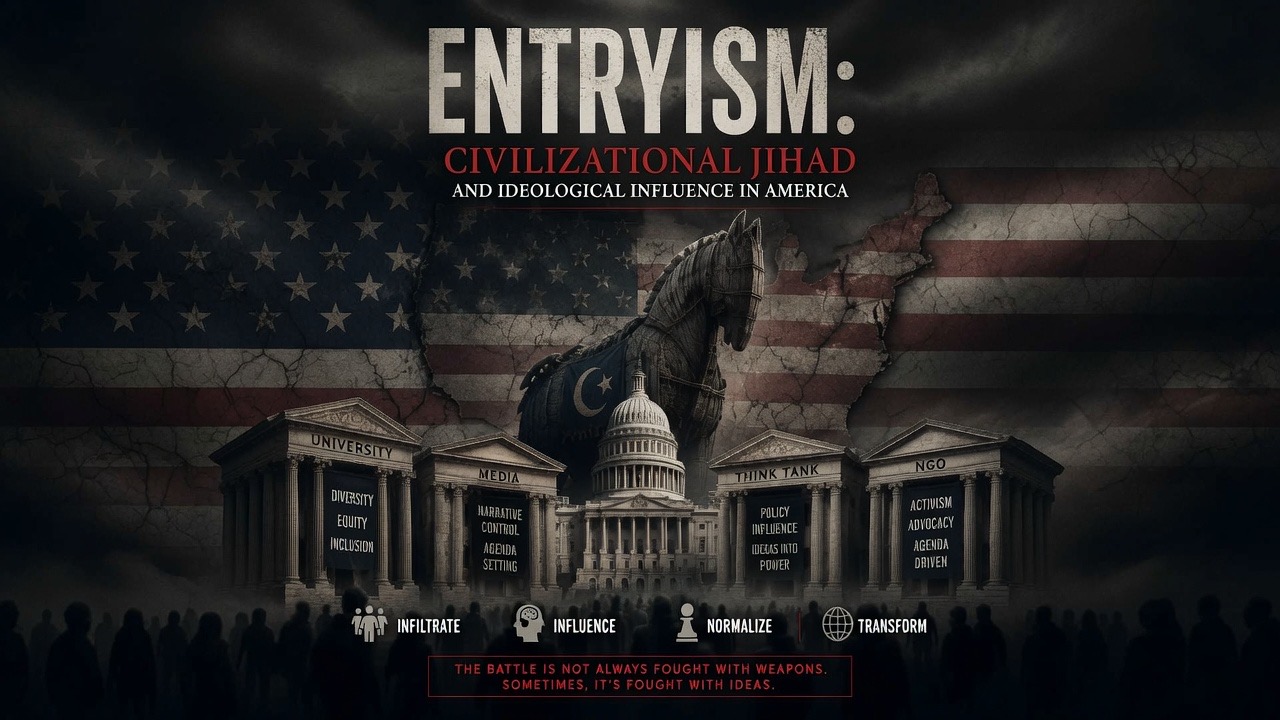
The Muslim Brotherhood emerged in Egypt in 1928 under Hassan al-Banna as a movement seeking to restore Islamic governance and society according to its interpretation of sharia. Its ideology frames Islam as a complete system for life, politics, and law, with the long-term aim of establishing a global Islamic order. Over decades, branches and networks spread beyond the Middle East, including into Western countries through immigration, student groups, and organizational building.
In the United States, Muslim Brotherhood members and sympathizers began establishing a presence in the mid-20th century, particularly among students arriving for higher education. By the 1960s, groups such as the Muslim Students Association formed, later evolving into broader networks including the Islamic Society of North America and related entities. These efforts focused on creating institutions that could serve Muslim communities while advancing broader ideological goals. A key document outlining strategy appeared in 1991.
Titled “An Explanatory Memorandum on the General Strategic Goal for the Group in North America,” it was written by Mohamed Akram, a figure associated with the Brotherhood’s North American structures and later linked to Hamas-related activities. Seized by federal authorities and introduced as evidence in the Holy Land Foundation trial, the memo described the objective as the “enablement of Islam in North America.”
This meant building a stable Islamic movement led by Brotherhood principles that expands the observant Muslim base, unifies efforts, presents Islam as a civilizational alternative, and supports a global Islamic state. The memorandum framed the process of “settlement” as a “Civilization-Jihadist Process.” It stated that work in America constitutes a kind of grand jihad aimed at eliminating and destroying Western civilization from within, sabotaging it by the hands of its own people and the believers so that God’s religion prevails.
The approach rejected open confrontation in favor of gradual absorption, coalition-building, and mastering cooperation while remaining rooted in Islamic identity. An attachment listed organizations considered part of or friendly to the network, many of which later became prominent in American Muslim advocacy, education, and community life. The underlying reason for this strategy stems from the Brotherhood’s foundational worldview. Leaders have consistently viewed Western secular systems as obstacles to Islamic supremacy.
Settlement allows the movement to grow demographically and institutionally without immediate resistance, using democratic freedoms of association, speech, and religion to expand influence. Success in North America would strengthen the global project by providing resources, legitimacy, and a base from which to support related causes abroad, including Palestinian groups historically tied to the Brotherhood such as Hamas. In practice, activities have centered on institution-building. Mosques and Islamic centers serve as hubs for education, social services, and recruitment.
Campus organizations engage students, shaping campus discourse around identity and foreign policy issues. Advocacy groups frame concerns in the language of civil rights, lobbying policymakers and media. Educational efforts promote curricula and programs that emphasize Islamic perspectives, sometimes challenging mainstream historical or cultural narratives. Political engagement includes voter mobilization, coalition work with other activist movements, and pressure campaigns on institutions accused of bias.
Financial networks have historically funneled support toward aligned causes, though major terrorism-financing prosecutions disrupted some channels. A step-by-step breakdown of the approach, drawn from the memorandum’s logic and observed patterns, runs as follows. First, establish a presence through settlement. Immigrants and students form core communities and organizations that provide religious, social, and cultural services, making the movement a natural part of the landscape.
Second, expand the base. Focus on youth, women, and families through schools, youth groups, and family programs that instill observant practice and loyalty to the ideological framework. Third, build organizational infrastructure. Create specialized entities covering education, media, finance, professional networking, and jurisprudence so that Islamic structures become self-sustaining and influential across sectors.
Fourth, shift mentality from isolation or confrontation to absorption. Engage host society institutions, form coalitions, and use legal and political tools available in democratic systems while preserving distinct identity and goals. Fifth, unify and direct efforts. Coordinate messaging and activities among groups so they advance shared priorities, whether domestic policy changes or support for international Islamic causes.
Sixth, present Islam as the alternative. Use media, academia, and public advocacy to critique Western shortcomings and position Islamic governance or values as superior solutions. Seventh, secure influence in key areas. Target education to shape future generations, civil society to control narratives, politics to affect policy, and interfaith or progressive alliances for protective cover and expanded reach.
Eighth, sustain long-term pressure. Maintain the process across generations until Western systems are sufficiently altered or weakened that Islamic dominance becomes feasible. Critics of the memorandum argue it represented one individual’s proposal rather than an officially adopted master plan, and that many listed groups have evolved independently or reject violent extremism. Supporters of the analysis point to the document’s court acceptance, the continuity of ideological language in Brotherhood writings, and documented overlaps in leadership, funding, and advocacy priorities.
Federal investigations and designations have targeted specific financing ties to designated terrorist organizations while treating broader ideological networks as free to operate under American law. The strategy relies on patience and adaptation. Open militancy would provoke backlash, so the emphasis remains on gradual cultural, institutional, and political transformation. Whether this constitutes legitimate community organizing or a form of entryism aimed at systemic change depends on one’s assessment of the stated goals versus public presentations.
The record shows a consistent ideological commitment to Islam as the solution, pursued through organized, multi-generational efforts inside open societies.