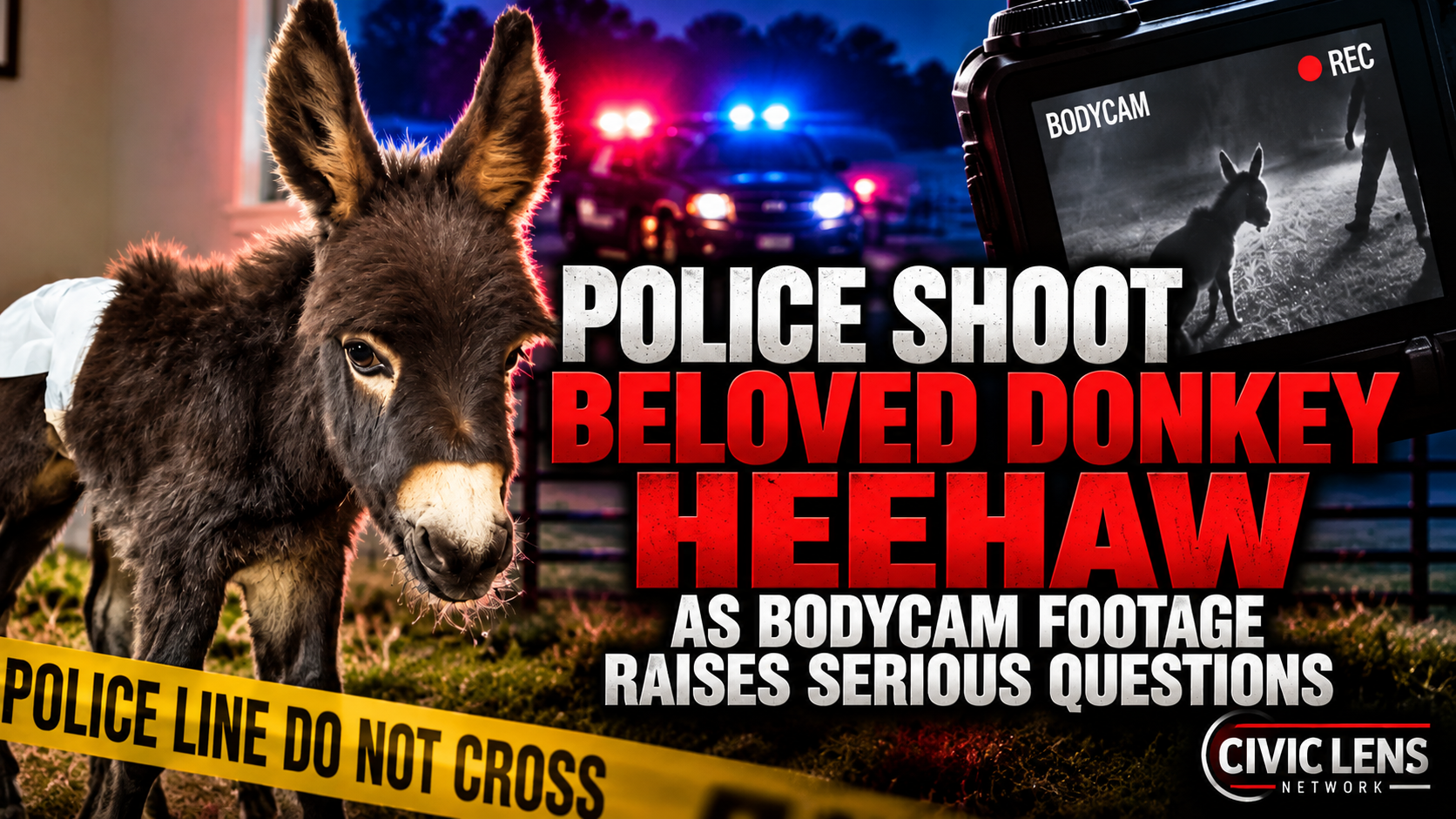
In the early morning darkness of August 30, 2026, Cedartown Police Officer Trenton Ryan Garner fired a single round from his Glock 17 into a one-year-old miniature donkey named HeeHaw. The animal collapsed in the enclosed pasture of Elsberry Riding and Farm along Grady Road, where he had lived his entire short life. Officers were assisting a multi-agency search for a missing 12-year-old girl. The child was later found safe at a nearby church.
HeeHaw was not. Newly released body-camera footage from October 9 has intensified scrutiny of Garner’s decision to use deadly force against the family pet. Owner Hannah Israel describes HeeHaw as a bottle-raised animal who greeted strangers the way many dogs do, with curiosity and an enthusiastic bray. He participated in petting zoos and visits to nursing homes.
Israel has called him her son. The officer’s written account and the video now available to the public tell conflicting stories. What the footage establishes, what it leaves open, and what remains unanswered have become central to a federal civil rights lawsuit, an independent state investigation, and a growing public demand for accountability when officers kill family animals. What the Bodycam Shows The footage, released as part of the ongoing legal proceedings, captures the nighttime encounter on the farm pasture.
Descriptions from those who have viewed it, including reporting by the New York Post, indicate that HeeHaw, standing roughly waist-high to the officers, approaches with his ears up. He is described as walking slowly or trotting inquisitively toward the group, which included a K-9 handler and a bloodhound team. Flashlights cut through the dark. A Polk County K-9 handler activates a Taser.
The device does not stop the animal. From roughly 10 yards away, Garner fires once. HeeHaw turns and moves away before collapsing. Moments later, Garner can be heard on the radio: “Firearm discharged at a donkey.
It was trying to attack us on a pasture.” The officer’s incident report states that horses in the pasture spooked and ran away as officers tracked along a fence line. A donkey on a hillside then “began to charge at us.” The Taser arc or deployment failed to deter him.
Garner wrote that he fired to prevent injury to the K-9 handler and the Haralson County bloodhound team. HeeHaw retreated up the hill and fell. Viewers and the family say the video does not depict the aggressive charge described in the report. Israel maintains that HeeHaw was doing what he had always done with people: approaching to greet them.
Legal analysts and commentators who have examined the clip note that the animal does not appear to rear, charge at speed, or display clear predatory or defensive aggression in the moments shown. The footage does not independently establish that HeeHaw posed an imminent threat of serious injury. It does establish that officers used a Taser and then a firearm against a small, approaching miniature donkey in his own pasture.
Whether the full context of the video, including any unreleased angles or earlier moments, supports Garner’s perception of danger remains an open question. The officer has not publicly elaborated beyond his report. He remains on administrative leave. Entry onto Private Property Officers entered the enclosed pasture without first notifying Israel or seeking her permission.
The lawsuit filed on September 11 in the U.S. District Court for the Northern District of Georgia, Rome Division, alleges that Garner and other officers had no warrant, no consent, and no exigent circumstances justifying entry onto the private pastureland. The complaint states that the missing girl was not on the property.
Law enforcement was engaged in an active search for a missing child, a circumstance that can support certain warrantless entries under the exigent-circumstances doctrine when officers reasonably believe a person is in immediate danger. The precise legal justification offered by the officers for crossing into this specific enclosed pasture has not been fully detailed in public statements. Israel has said she received a call around 12:45 a.m. informing her that a donkey had been “dispatched.”
She and a child then searched the dark pasture for some time before locating the body. The officers had left without pointing out the location. The distinction between a legitimate emergency search and an unjustified intrusion onto fenced private land is now part of the federal claims. Was Deadly Force Necessary?
Garner’s report frames the shooting as necessary to protect the K-9 handler and the bloodhound team after the Taser failed. The lawsuit alleges the opposite: that HeeHaw was young, small, and tranquil, that he posed no threat, and that no reasonable officer would have believed deadly force was required. Israel’s account of the animal’s temperament is consistent across her public statements. He was raised in the house from infancy, never known to bite or act aggressively, and comfortable around children and strangers.
Questions remain about alternatives. Could the officers have retreated farther, maintained greater distance while continuing the search, or used additional non-lethal methods? The video descriptions do not show an animal that has closed the distance aggressively or made contact. The single shot struck a miniature donkey that then moved away.
No officers or dogs were injured. These facts do not prove the shooting was unjustified, but they raise the possibility that less lethal options or simple withdrawal might have resolved the encounter without killing the animal. The Lawsuit and Constitutional Claims Hannah Michelle Israel’s complaint names Officer Trenton Ryan Garner in his individual capacity.
It brings three claims under 42 U.S.C. § 1983: unlawful entry and search in violation of the Fourth Amendment; unreasonable seizure and destruction of property in violation of the Fourth Amendment; and, in the alternative, deprivation of property without due process under the Fourteenth Amendment. The suit seeks compensatory damages, punitive damages, attorneys’ fees, and a jury trial. A separate $1 million demand was also sent to Cedartown officials and the Polk County Board of Commissioners.
The complaint alleges that Garner acted maliciously or with reckless disregard for clearly established rights. It emphasizes that officers left the carcass without identifying its location and provided only a terse phone notification. Qualified immunity will likely be a central issue; courts have not yet ruled on the claims. State Investigation and Public Response The Georgia Department of Agriculture’s Law Enforcement Division is conducting an independent investigation.
Agriculture Commissioner Tyler Harper has stated that the agency takes animal death investigations seriously and will examine the matter thoroughly and impartially before making any recommendation. As of October 11, no findings, disciplinary recommendations, or criminal charges have been announced. Cedartown Police Chief Jamie Newsome placed Garner on administrative leave and referred the matter to the state agency. The chief has reviewed the bodycam but has not publicly described its contents beyond confirming its existence.
The case has drawn national attention under the banner of Justice for HeeHaw. A GoFundMe for the farm has raised well over $100,000. Protests have occurred in Cedartown. Websites and social media accounts have formed to demand the full release of video and greater accountability.
Israel has expressed gratitude for the support while asking that efforts remain focused on answers rather than harassment. The family’s position is straightforward: a bottle-raised petting-zoo donkey was shot in his own pasture by officers who entered without notice, and the official justification does not match the video or the animal’s known character. Drone Footage and Remaining Gaps The lawsuit notes that a Rockmart Fire Department drone was assisting the search. Garner’s report indicates that drone operators witnessed the incident.
No drone footage has been publicly released or independently analyzed in available reporting. Such video could provide a wider view of distances, the animal’s speed and trajectory, and the officers’ positions. Its absence leaves a potential source of evidence unexamined by the public. Other gaps persist.
Full unedited bodycam audio and video from all officers present have not been released. Detailed statements from the K-9 handler have not been made public. The precise distance, the donkey’s exact speed, and any vocalizations immediately before the shot are described differently by the report and by those who have seen the clip. HeeHaw’s death has resonated because he was not a stray or a wild animal.
He was a small, hand-raised family member whose daily life involved gentle contact with people. His killing during a search that successfully located the missing child has prompted broader questions about police training, decision-making under stress, and the threshold for using firearms against pets. When officers enter private property and encounter animals that owners view as harmless, the line between perceived threat and ordinary animal behavior can determine whether a family pet lives or dies. The bodycam does not settle the matter.
It supplies visual evidence that many who have watched it say undercuts the characterization of an active attack. The officer’s report and radio transmission assert that an attack was underway. Between those accounts lie the unanswered questions of necessity, alternatives, and accountability. Was the shooting of HeeHaw justified under the circumstances officers faced that night, or does the available evidence suggest that deadly force against a family animal should trigger stricter scrutiny and clearer standards when law enforcement operates on private property?