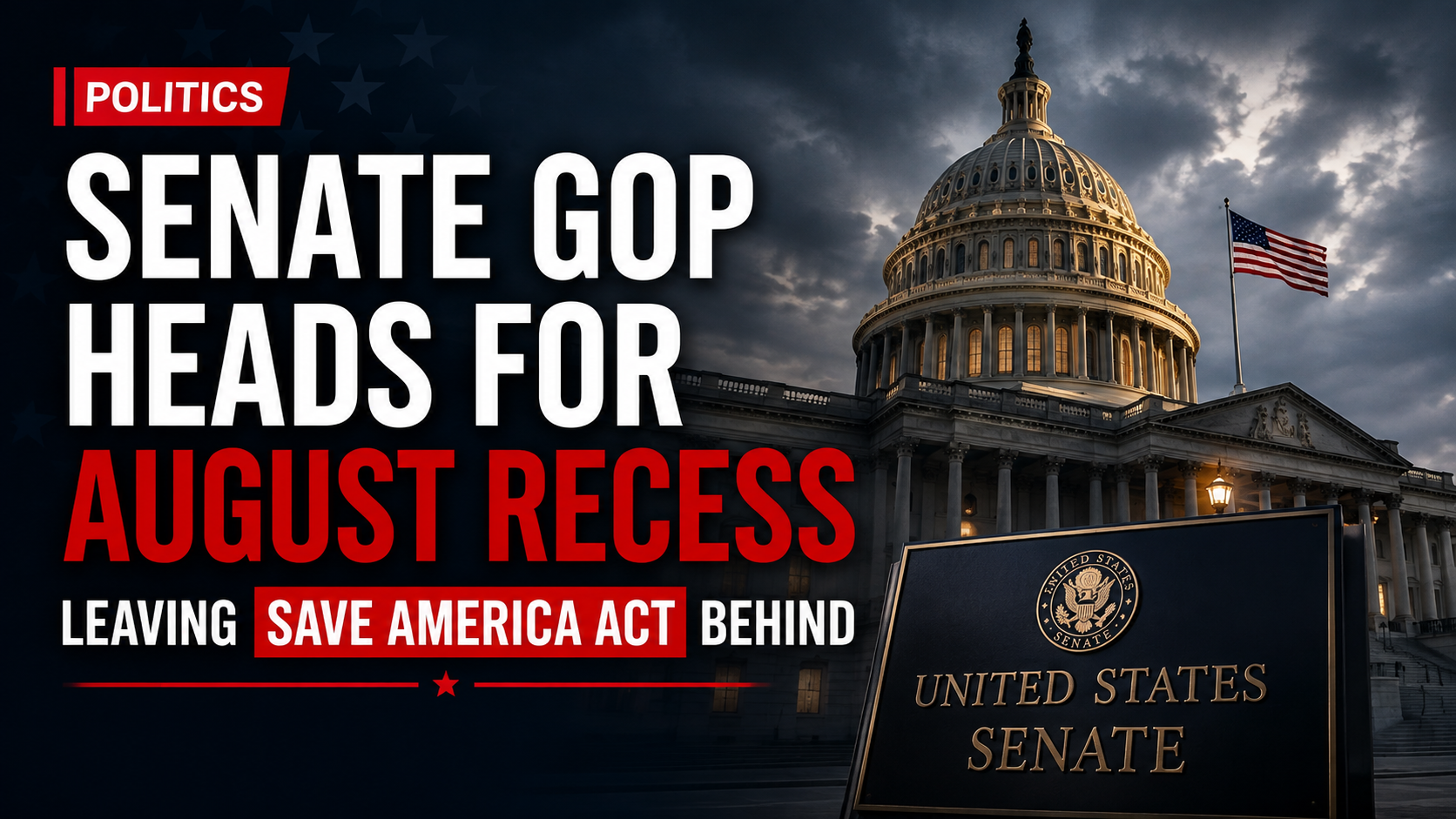
In the early hours of Saturday August 8 2026 the United States Senate adjourned for its traditional five week August recess without advancing the SAVE America Act. The chamber approved a continuing resolution to keep the government funded through mid December confirmed Todd Blanche as attorney general and handled other procedural matters before senators departed Washington. Return is set for September 14 with only pro forma sessions scheduled in between to satisfy constitutional requirements.
The SAVE America Act formally known as the Safeguard American Voter Eligibility Act stands as a cornerstone of Republican efforts on election integrity. It would require documentary proof of United States citizenship to register to vote in federal elections and mandate photo identification at the polls. Supporters argue the measure protects the ballot box from noncitizen voting and restores public confidence after years of disputes over election administration.
The House had previously passed versions of the legislation but the Senate has repeatedly failed to clear the 60 vote threshold needed to overcome a filibuster. President Donald Trump made passage of the bill one of his top legislative demands throughout 2026. He publicly urged Senate Majority Leader John Thune of South Dakota to keep the chamber in session until the measure cleared or until Republicans eliminated the legislative filibuster.
Trump argued that secure elections ranked higher than summer breaks especially in a midterm election year when control of Congress hangs in the balance. Several Senate Republicans echoed the call. Senator Mike Lee of Utah the bill’s primary Senate sponsor vowed to object to any unanimous consent agreement for recess and requested a roll call vote.
Others including Rick Scott of Florida Tommy Tuberville of Alabama Jim Banks of Indiana Ashley Moody of Florida Bill Hagerty of Tennessee and Ted Cruz of Texas publicly stated readiness to remain in Washington until the bill advanced. Despite the pressure the math never changed. Republicans hold a narrow majority but lack the Democratic votes required to break a filibuster. Leadership maintained that endless quorum calls or forced late night sessions would produce no different result.
Thune repeatedly told colleagues and reporters that without a realistic path to 60 votes staying in town served little purpose beyond symbolism. Vulnerable incumbents facing tough reelection fights also needed time back home to campaign meet constituents and raise funds. Cancelling the recess risked political costs without legislative gain. In the final days before adjournment a group of conservatives pressed for action.
They secured statements for the Congressional Record declaring they would have voted against recess had a recorded vote occurred. Yet when the moment arrived no senator forced a formal roll call. The motion to adjourn passed by voice vote as part of a broader unanimous consent agreement that also locked in votes on the continuing resolution and other items. Lee later explained the trade off.
Leadership warned that without the agreement it could take weeks to schedule individual votes and that members would begin leaving anyway. The compromise allowed limited progress on other priorities while still permitting expressions of opposition to the break. Critics within the party and among Trump’s online allies called the departure a failure of will. They pointed to earlier recesses and unfinished business as evidence that Senate Republicans prioritize schedule over substance.
House conservatives had already left town and some demanded the Senate stay to finish the job. Online commentary branded the decision a betrayal of election security promises. Defenders countered that the filibuster remains a long standing Senate tradition and that altering it would carry lasting institutional consequences. They noted repeated unsuccessful attempts to attach elements of the bill to other vehicles including reconciliation packages that can pass with simple majorities.
The recess now underway leaves the SAVE America Act unfinished as the midterm campaign intensifies. Senators will spend the coming weeks in their states hearing from voters. When they return in mid September the calendar grows crowded with appropriations bills potential government funding deadlines and other priorities. Leadership has signaled openness to another vote on election integrity measures but expectations remain low that Democrats will shift position.
Some Republicans hope to incorporate limited provisions such as state grants for voter identification into a future budget package though parliamentarian rulings have previously blocked broader attempts. The episode highlights ongoing tensions inside the Republican conference. Trump’s insistence on the bill as nonnegotiable collided with the practical realities of Senate procedure and the narrow majority. Conservatives who pushed hardest to cancel recess accepted the outcome while promising continued effort.
As one senator put it after the late night session they left no stone unturned yet the votes simply were not there. The five week break offers breathing room but also underscores how difficult major election law changes remain in a polarized Capitol. Looking ahead the September session will test whether momentum can rebuild. Pro forma sessions will keep the Senate technically open every few days preventing certain recess appointments while most members focus on campaign trails.
Voters will ultimately judge the balance between promised reforms and delivered results. For now the SAVE America Act sits unfinished and the Senate has chosen recess over another round of failed procedural votes. The debate over election integrity will resume when lawmakers reconvene but the August departure marks a clear pause in legislative progress on one of the party’s signature priorities.