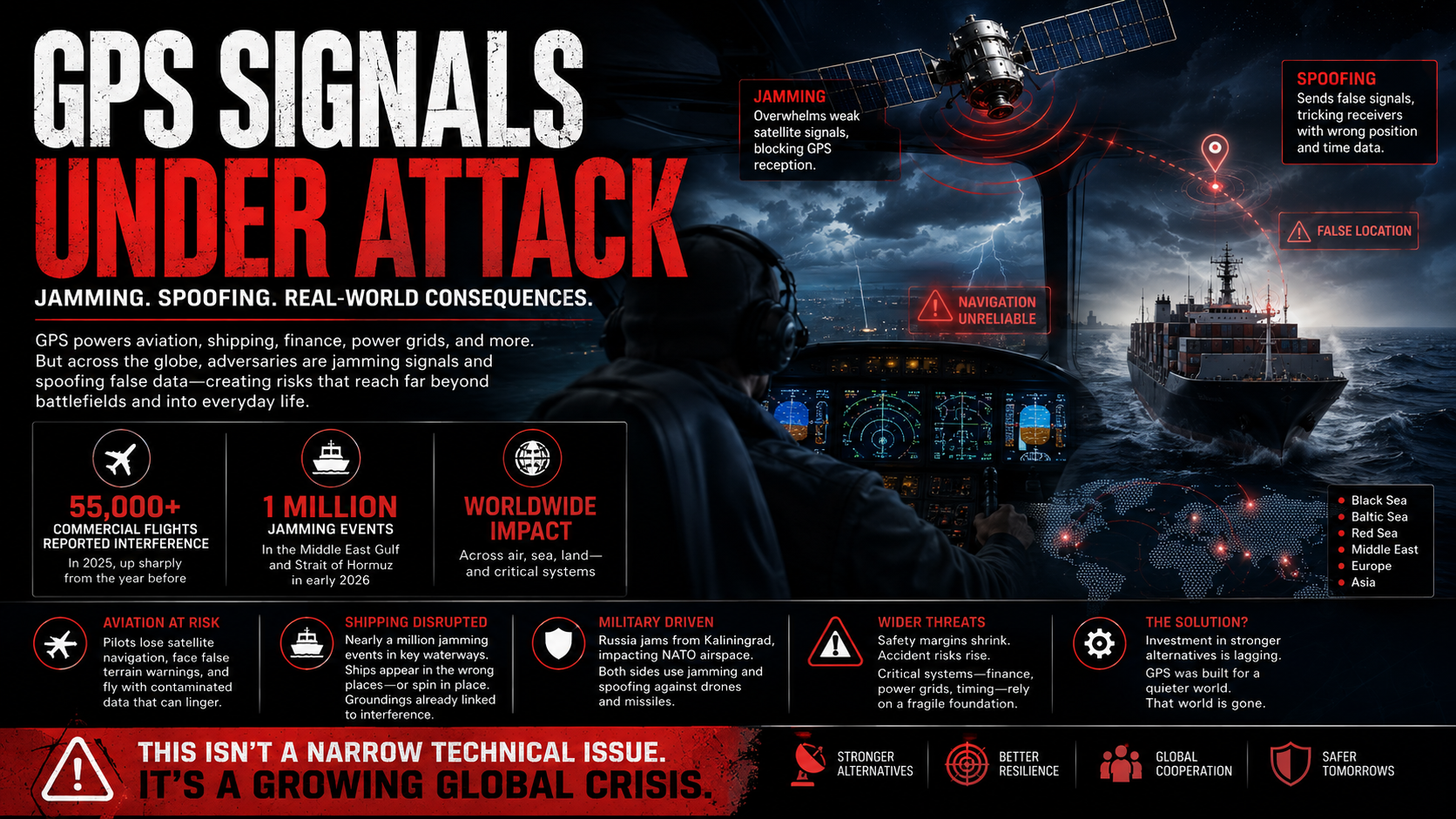
The Next GPS Crisis Global Positioning System signals, once treated as an invisible utility, are under sustained electronic assault. Jamming, which overwhelms the weak satellite transmissions with noise, and spoofing, which broadcasts false position and timing data, have surged from rare anomalies into a persistent global hazard. These attacks now routinely disrupt aviation, shipping, and military operations far beyond active battlefields, yet the issue remains strikingly undercovered relative to its stakes.
GPS signals arrive at receivers with vanishingly low power, making them easy to overpower or imitate with relatively inexpensive ground-based transmitters. What began as localized military measures has spilled into civilian domains. In aviation, interference incidents climbed sharply. One data set recorded more than 55,000 reported events affecting commercial flights in 2025, a 22 percent rise from the prior year, with jamming accounting for roughly 62 percent and spoofing 38 percent.
Hotspots concentrate in the Middle East, Baltic and Scandinavia region, Eastern Mediterranean, and Black Sea. Pilots encounter sudden loss of satellite navigation, false Ground Proximity Warning System alerts that distract during critical phases of flight, and contaminated position data that can persist even after the aircraft leaves the interference zone. Long-haul routes between Europe and the Middle East or Asia now face near-routine disruption. Maritime traffic suffers similarly.
In the first quarter of 2026 alone, analysts recorded nearly a million jamming events globally, the overwhelming majority concentrated in the Middle East Gulf and Strait of Hormuz amid regional conflict. More than 1,100 vessels experienced interference in short periods, with ships appearing on tracking systems at airports, deep inland, or circling in place. Groundings have been linked to distorted navigation, and the risk of collisions or environmental damage rises in congested chokepoints that carry a substantial share of world oil.
Black Sea, Baltic, Red Sea, and even emerging areas such as Venezuelan waters show parallel patterns. Military operations both drive and endure the problem. Russia has been widely attributed with sustained jamming and spoofing from Kaliningrad and other sites that affect NATO airspace and shipping. Similar tactics appear in the Middle East to counter drones and missiles, and the practice is spreading as more nations pursue counterspace capabilities.
Civilian spillover is not collateral so much as systemic: electronic warfare intended for one purpose degrades the shared infrastructure of modern logistics and transport. The implications extend beyond individual incidents. Aviation safety margins erode as crews manage higher workloads and degraded systems. Shipping faces higher accident risk and potential supply-chain friction.
Critical timing services that underpin finance, power grids, and telecommunications also depend on these satellite systems. Because the topic rarely commands sustained mainstream attention outside specialist circles, investment in resilient alternatives, stronger low-Earth-orbit signals, multi-constellation receivers, inertial navigation fusion, terrestrial backups, and better detection, lags behind the threat. GPS was designed for a more peaceful electromagnetic environment. That environment no longer exists.
Treating the growing wave of jamming and spoofing as a niche technical nuisance rather than a strategic vulnerability invites precisely the crisis many experts now warn is approaching.