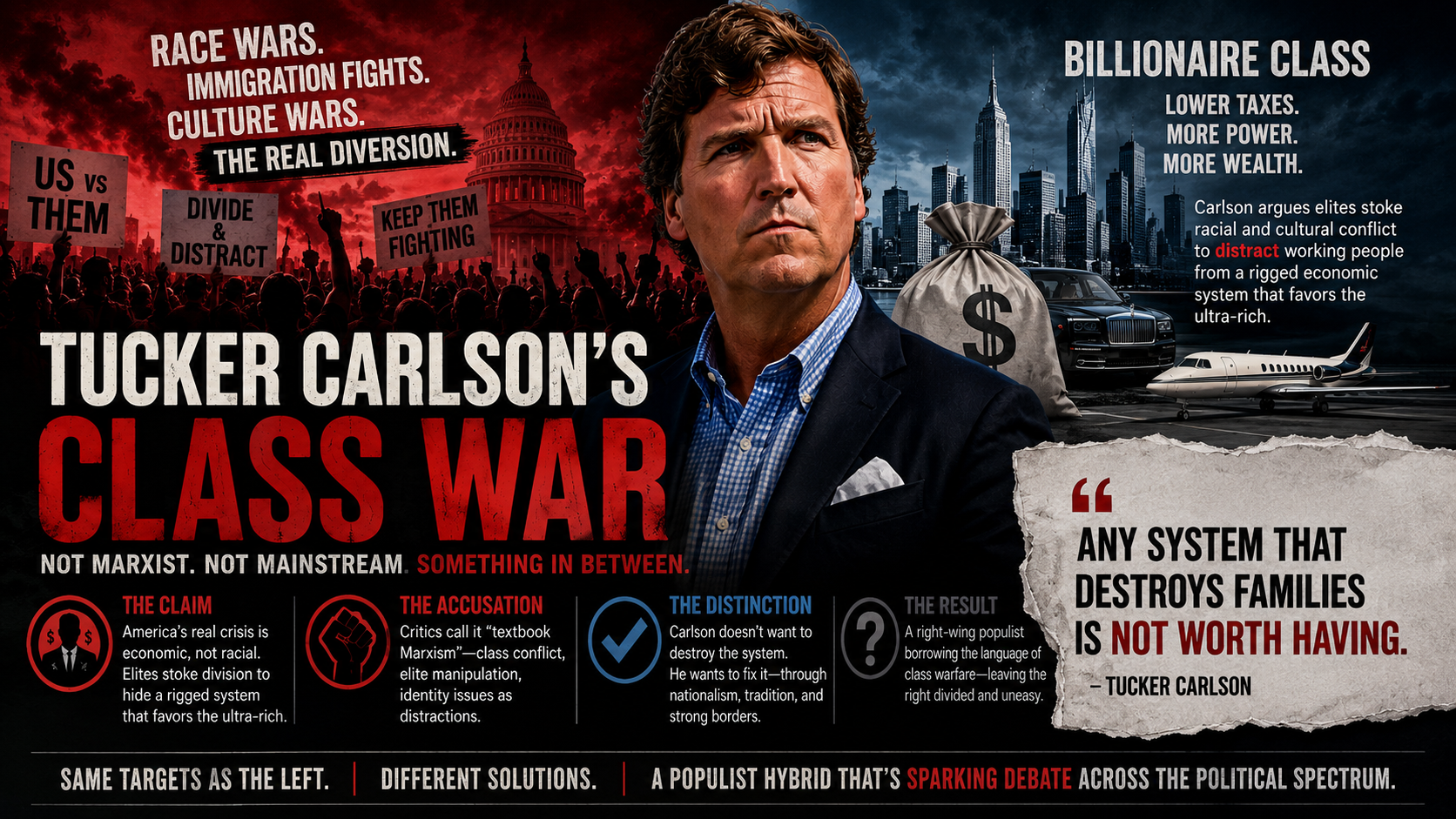
Tucker Carlson’s latest comments have some on the right calling him a Marxist again. In his July 2026 sit-down with Stephen A. Smith, Carlson said the real problem in America is economic, not racial. The billionaire class, he argued, stokes racial conflict on purpose so regular workers stay busy fighting each other instead of noticing a tax code that lets the richest pay far lower rates than people who work for wages.
Race and immigration fights, in his view, are just useful distractions while the people at the top keep pulling in more money and power. Nick Fuentes and others wasted no time calling it textbook Marxism. Carlson has been making versions of this argument for years. Back in 2019, while still at Fox, he went after free-market orthodoxy in a monologue that surprised a lot of conservatives.
Market capitalism is not a religion, he said. Any system that wrecks families is not worth defending. He tore into Republican leaders for looking out for banks and foreign wars more than the American middle class. He pointed to falling wages for men in old manufacturing towns and said the same economic failures were hitting both rural areas and the inner cities.
He even brought up Theodore Roosevelt, claiming the old progressive interventions might have stopped a communist uprising by dealing with the social fallout of rapid change. That shift matched what a lot of voters were feeling. The old conservative mix of traditional values and pure free-market economics was losing ground among people who had watched factories close, opioids spread, and paychecks stagnate.
Carlson started talking more about a self-serving ruling class—corporate, financial, cultural—that seemed fine with the damage as long as their own interests were covered. He went after Big Tech, free-trade dogma, and elite indifference to whether ordinary families could still form and hold together. He has said he likes the idea of ordinary people having economic dignity, but he has never pretended socialism actually delivers it.
The language overlaps with Marxist talk in obvious ways: class power, elites using identity fights as cover, the idea that money shapes everything else. But Carlson is not calling for the end of private property or a workers’ dictatorship. His enemies are globalist elites, open borders, and cultural breakdown. What he wants looks more like stronger borders, policies that make it easier to raise families, and a brake on fast demographic and technological change.
The goal is holding together a recognizable American society, not tearing the whole system down. What you end up with is right-wing populism that borrows the vocabulary of class warfare when it suits. Some on the right find it uncomfortable. Some on the left find it briefly interesting.
Carlson still rejects Marxism by name and in substance, but the way he talks keeps inviting the comparison.