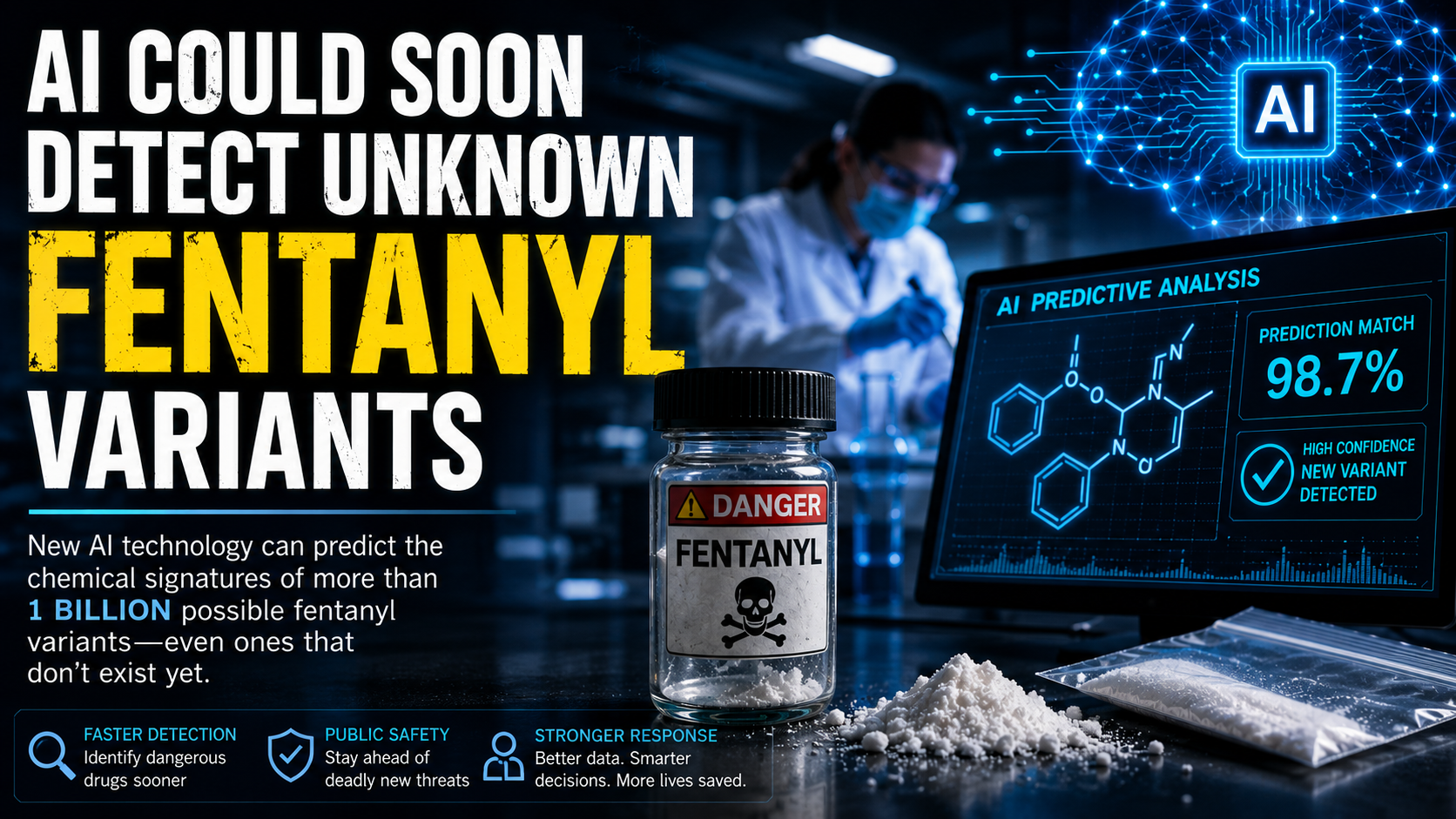
AI Could Soon Detect Unknown Fentanyl Variants Underground chemists invent new versions of fentanyl faster than labs can catalog them. These small tweaks let the drugs slip past standard tests while remaining just as deadly. Researchers at Pacific Northwest National Laboratory have developed a method that may change the balance. The team led by bioanalytical chemist Tom Metz created a digital library containing more than one billion possible fentanyl analogs.
They began with roughly sixty thousand known fentanyl related molecules. Computers broke those structures into pieces and recombined the fragments into billions of new candidates. Implausible molecules were filtered out, including ones unlikely to cross the blood brain barrier. Machine learning then predicted the chemical measurements each remaining structure would produce in actual laboratory instruments.
This produces a reference free system. Analysts no longer need pure compounds already measured and stored in a physical library. Instead they compare a sample’s measured traits against the computer generated predictions. In a blinded test the researchers prepared a mock tablet containing twelve known fentanyl related substances.
A chemist who did not know the contents used the system to examine the mixture. After successive rounds of matching, six of the components were identified exactly. Four others were narrowed to only a few possible candidates each. No traditional pure compound library was required.
The scale of the problem makes this advance significant. Fentanyl itself is already extremely potent. Tiny amounts can kill. Traffickers respond to enforcement by altering the molecule just enough to evade existing detection methods and legal definitions.
Traditional approaches rely on matching an unknown sample to a growing but always incomplete collection of previously analyzed substances. Every new variant that appears on the street creates a temporary blind spot. First responders, forensic labs, and border inspectors can miss the threat until the new compound is isolated, studied, and added to the official lists. The computational approach reverses that lag.
By generating vast numbers of plausible structures in advance and predicting how they would behave under mass spectrometry and related techniques, the system anticipates molecules that have not yet been synthesized in illicit labs. The filtering steps keep the library focused on structures that could realistically affect human physiology. Machine learning fills in the expected instrumental signatures with enough accuracy to guide identification. The work builds on earlier discoveries at the same laboratory.
Researchers had already identified chemical features shared by every fentanyl analog they tested, along with additional traits that distinguish one form from another. Those experimental insights informed the predictive models. The same group has extended related methods to another class of synthetic opioids known as nitazenes, which are often even more potent and are beginning to appear in street supplies. Practical deployment still requires further development.
The current system operates in a research laboratory setting with specialized instruments. Field portable versions and integration into existing forensic workflows will take additional engineering and validation. False positives and the sheer size of the candidate list must be managed carefully so that analysts receive usable shortlists rather than overwhelming numbers of possibilities. Nevertheless the core demonstration is clear.
A sample containing previously uncatalogued variants can be examined and the most likely structures identified without waiting for physical reference standards. Public health and law enforcement stand to benefit. Overdose deaths linked to synthetic opioids remain high across many regions. Rapid and accurate identification of new variants could improve warning systems, toxicology results, and prosecution of trafficking networks.
Hospitals and medical examiners would gain better tools for understanding what patients and victims actually ingested. Border and customs agencies could screen seizures more effectively even when the powder or pills contain substances never before recorded. The broader scientific implication reaches beyond opioids. Many areas of chemistry face the same challenge of identifying unknowns when the possible structures outnumber the available reference data.
Environmental contaminants, industrial byproducts, and novel pharmaceuticals all generate large chemical spaces. The combination of generative computational chemistry, property prediction, and multi dimensional measurements offers a general path toward reference free identification. The researchers emphasize that the method is not yet ready for routine operational use. Continued refinement of the predictive models, expansion of the experimental validation set, and collaboration with forensic practitioners will determine how quickly the technology moves from proof of concept into daily practice.
Still the direction is promising. By building a digital catalog of possibilities far larger than any physical library, scientists have created a way to look ahead of the next wave of chemical innovation coming from illicit laboratories. If the approach continues to improve, the long standing advantage held by underground chemists who continually modify their products may finally begin to shrink. Detection systems that anticipate rather than merely react could help close a dangerous gap that has cost thousands of lives.