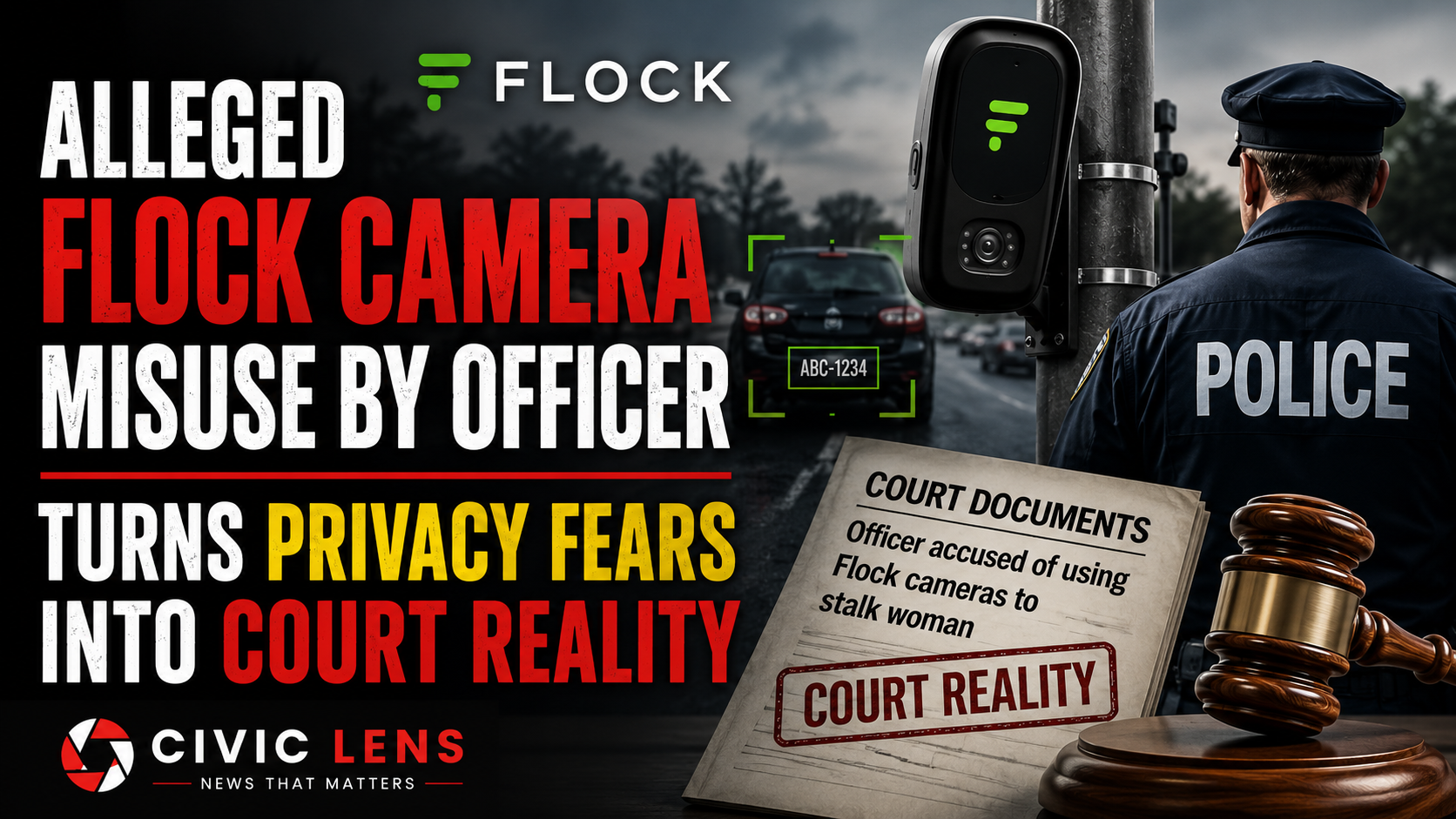
Flock Safety cameras have long sparked debate over mass surveillance in American communities. These automated license plate readers sit on poles and streetlights across thousands of towns, scanning every vehicle that passes and logging the data into a searchable network. Police departments praise the system for helping recover stolen cars and solve crimes. Critics have warned for years that the technology creates a vast tracking grid with few real barriers against personal misuse.
That warning no longer sits in the realm of theory. Court documents now accuse at least one law-enforcement officer of turning the network into a tool for stalking a woman. The case centers on former Milwaukee Police Officer Josue Ayala. According to charging papers filed in Milwaukee County Circuit Court, Ayala used the department’s Flock system between March and May 2025 to run license plate searches 179 times for personal reasons.
He queried the plate belonging to a woman he had dated 55 times and the plate of her former partner 124 times. On every search he entered the single word “investigation” as justification, even though no active police case existed. The officer conducted the queries while on duty. Audit logs later confirmed the pattern.
The misconduct came to light not through internal department checks but through a public website that aggregates Flock search records released under open-records laws. One of the people whose plate had been repeatedly queried discovered the hits and contacted authorities. Detectives then pulled the full audit trail. Ayala resigned from the force in March 2026 shortly after the allegations surfaced.
He later pleaded guilty to one misdemeanor count of attempted misconduct in public office. In July 2026 a judge sentenced him to twelve months of probation and a five-hundred-dollar fine. The two people he tracked also obtained four-year restraining orders against him. In court filings one of them wrote that she had no idea he continued watching her every move and that the discovery left her horrified, disgusted, and terrified.
This episode stands out because it converts abstract privacy arguments into concrete harm. Flock markets its cameras as crime-fighting tools that retain data for limited periods and require users to log a reason for each search. In practice the reason field accepts almost any entry, including a single vague word. Officers across the country have access to a growing web of more than one hundred twenty thousand cameras that record billions of plate scans each month.
No warrant is required for a search. The system therefore hands any user the ability to reconstruct a person’s daily movements with remarkable precision. Reports from multiple states show the Milwaukee case is not isolated. Investigations have documented dozens of similar incidents in which officers allegedly used Flock or comparable license-plate readers to monitor spouses, former partners, or women they wished to pursue.
Some officers searched the same plates hundreds of times. In several instances the targets only learned of the surveillance after checking public audit logs or after the officer’s behavior escalated into other forms of harassment. Departments have responded with firings, resignations, and policy changes, yet the underlying architecture remains largely unchanged. Access is broad, oversight is often reactive, and the data trail is permanent once created.
The pattern raises hard questions about accountability. When a police officer can track a private citizen’s vehicle across an entire metro area without a case number or supervisory approval, the technology effectively grants state power for private ends. Victims in these cases have described feeling powerless. They cannot simply switch cars or avoid every camera.
The knowledge that an ex-partner with a badge can quietly map their routines erodes any sense of safety. Civil-liberties groups argue that the absence of a warrant requirement invites exactly this kind of abuse. Supporters of the cameras counter that the benefits in solving serious crimes outweigh the rare cases of misconduct and that audit logs eventually catch wrongdoers. Yet the Milwaukee court file shows how slowly those safeguards can work.
The searches continued for months before anyone noticed. Only an external website and a victim’s own initiative brought the matter to light. Once exposed, the system did produce a paper trail that supported criminal charges. Still, the damage had already occurred.
The woman and her former partner lived under unseen observation for an extended period. Local governments that contract with Flock now face mounting pressure to tighten controls. Some departments have restricted access to fewer officers or required more detailed justifications. Others have ended their contracts entirely after internal reviews revealed improper use.
Flock itself has announced plans for shorter default data retention, mandatory case codes, and automatic lockouts for unusual search patterns. Whether these steps will prove sufficient remains an open question. Technology that can locate any vehicle in real time will always tempt those inclined to misuse authority. The alleged stalking case involving the Milwaukee officer therefore serves as a clarifying moment.
It moves the discussion from hypothetical risks to documented court records. Privacy advocates have long predicted that expansive camera networks would enable intimate surveillance by the very people sworn to protect the public. The charging documents, plea, sentence, and restraining orders now supply the evidence. Communities weighing the installation or expansion of Flock systems must weigh that evidence carefully.
The convenience of automated plate reading comes with a measurable cost to personal autonomy, and that cost is no longer theoretical.