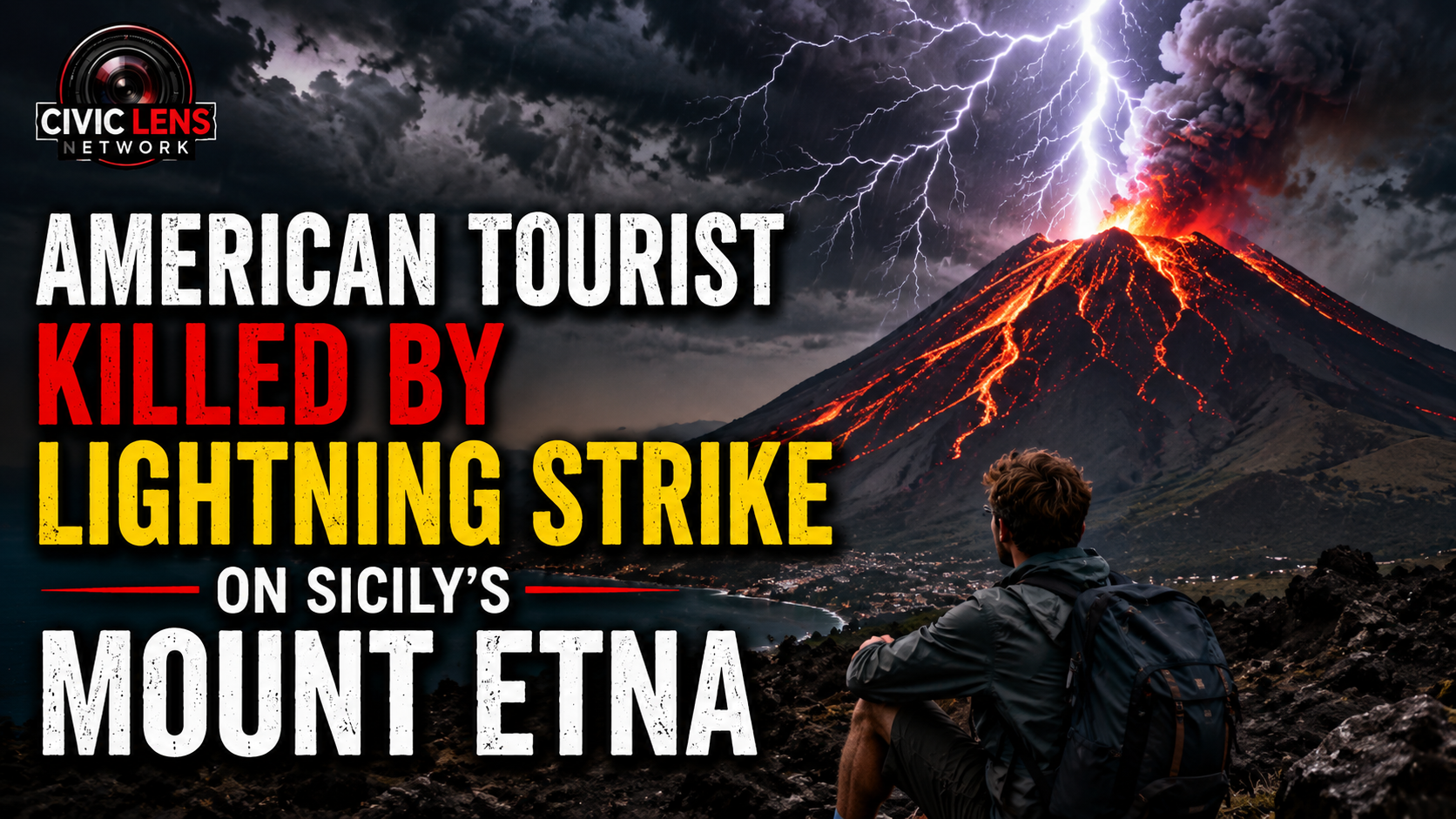
A 29-year-old American tourist from Kansas died after being struck by lightning while hiking on Mount Etna in Sicily. Italian firefighters reported the incident on Monday, confirming the man was hit Sunday evening in an exposed, barren area of Europe’s largest active volcano. Rescuers found him at about 1,400 meters, or nearly 4,600 feet, in the Rocca Capra area. A helicopter crew airlifted him from the site, but medical personnel later declared him dead.
His name has not been released. Some accounts noted he was in cardiac arrest when emergency teams reached him and that he was flown to Cannizzaro Hospital in Catania, where he was pronounced dead on arrival. The strike occurred as thunderstorms moved across the mountain. The man was in open terrain above the tree line, where there is little natural shelter.
Authorities had closed sections of the volcano’s slopes to hikers because of prolonged eruptive activity. It remains unclear whether he was inside one of the restricted zones at the time. Officials have expanded limited-access areas in recent days as activity continued. Mount Etna has been highly active, with lava flows descending its slopes and ash emissions disrupting life in eastern Sicily.
The nearby Catania airport stayed closed for most of the previous week as ash clouds affected air travel. Hundreds of flights were canceled or diverted. The aviation alert level dropped from red to orange over the weekend, allowing the airport to reopen, yet the volcano kept drawing visitors eager to see the glowing lava and ash plumes up close. Etna attracts roughly 1.5 million visitors each year.
The recent eruptions intensified that interest, bringing more hikers onto the mountain even as risks rose. Officials have stressed that weather on the upper slopes can change quickly. Storms can form with little warning, and the open, rocky ground offers almost no protection from lightning. Italian authorities noted that more people have died on Etna from lightning strikes over recent decades than from volcanic activity itself.
The last fatalities directly linked to an eruption occurred in 1987. That statistic underscores a quieter but persistent danger. Hikers often focus on lava and ash while underestimating electrical storms that develop over the high, exposed terrain. The American man was hiking during a period when the mountain remained under heightened monitoring.
Guides and park officials routinely advise visitors to check weather forecasts, stay on marked trails, and turn back if conditions worsen. Thunderstorms in summer can arrive fast in Sicily’s mountainous interior. Once lightning begins, the safest response is to seek lower ground and avoid ridges or isolated high points. The Rocca Capra area sits in precisely the kind of open landscape where a strike becomes more likely.
Rescue operations on Etna demand specialized skills. Helicopters must navigate ash, shifting winds, and steep slopes. The fire brigade’s rapid response on Sunday evening reflected the constant readiness required on an active volcano. Even so, lightning injuries are often catastrophic.
A direct strike can stop the heart instantly. Survivors frequently face severe burns, neurological damage, or other lasting effects. In this case, the combination of remote location and immediate cardiac arrest left little chance for recovery. The death comes at the height of the European summer travel season.
Sicily draws large numbers of international visitors, many of whom include Etna on their itineraries. Tour operators and local authorities face the ongoing challenge of balancing access with safety. Closing entire sectors of the mountain reduces risk but also frustrates those who travel specifically to witness an erupting volcano. The recent airport disruptions already complicated travel plans for thousands.
Another high-profile incident may prompt stricter enforcement of restricted zones and clearer warnings at trailheads. Volcanic lightning itself can occur when ash particles generate static electricity inside eruption plumes. Ordinary thunderstorms also form over the mountain’s height. Either source poses a serious threat.
Hikers who push higher for better views of the lava often place themselves in the path of both volcanic hazards and weather extremes. Family and friends of the Kansas tourist have not issued public statements. Italian officials continue to investigate the exact circumstances, including whether the man had entered a closed area. No further details about his travel companions or itinerary have been released.
The focus remains on the facts confirmed by the fire service and medical teams. Mount Etna stands as both a natural wonder and a reminder of nature’s unpredictability. Its constant activity produces spectacular displays that draw crowds from around the world. At the same time, the combination of elevation, open ground, and sudden storms creates conditions where a single lightning bolt can prove fatal.
The loss of the young American hiker illustrates how quickly an adventure on the volcano can turn tragic. Visitors planning trips to Etna in the coming weeks will encounter renewed emphasis on weather awareness, respect for closures, and the simple reality that lightning remains one of the mountain’s deadliest risks.