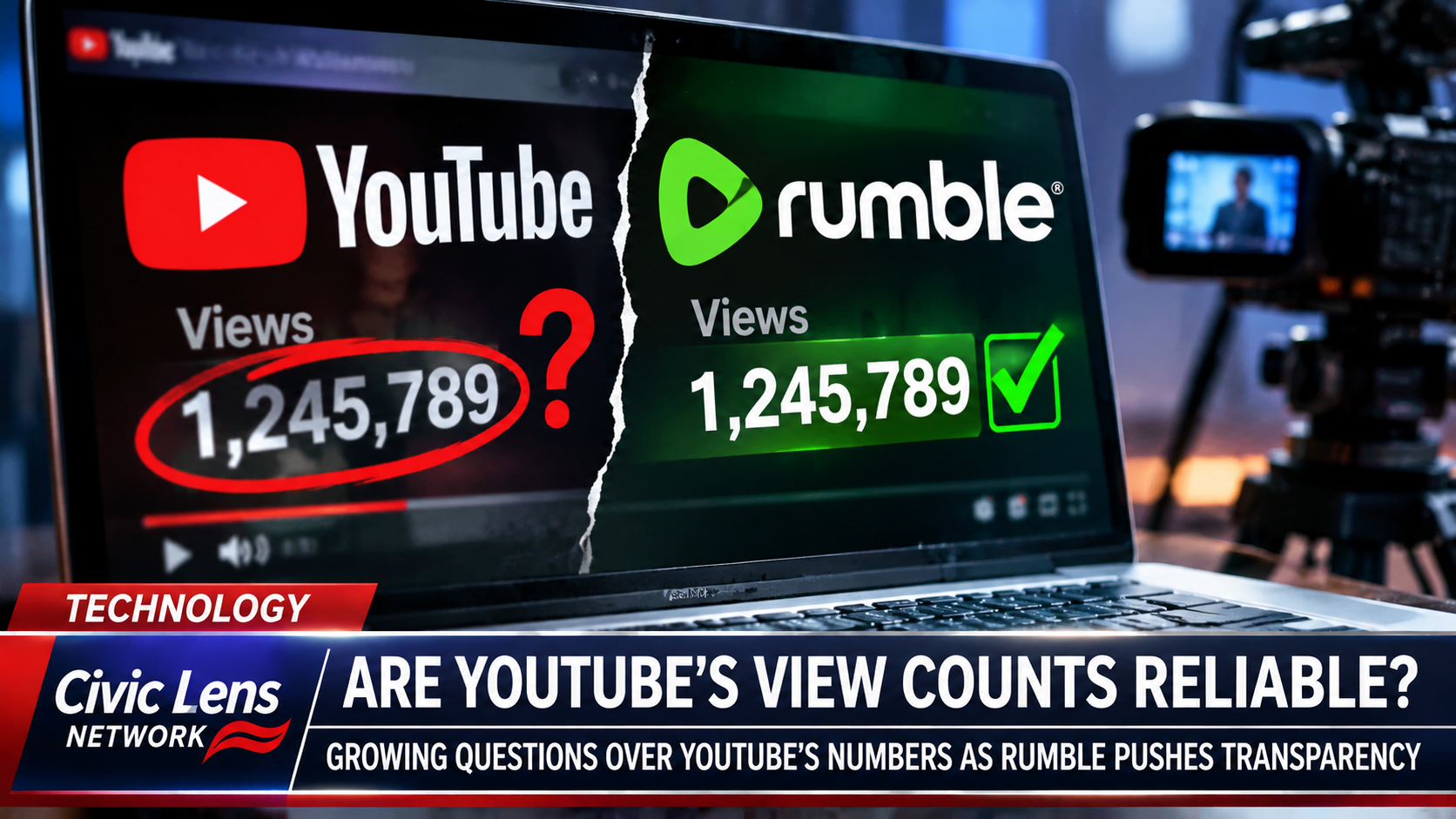
For millions of content creators, the number displayed beneath a video is supposed to represent something simple: how many times people watched it.
But as YouTube continues changing the way it calculates views, a growing question deserves attention. Are those numbers accurately reflecting audience engagement, or has the world’s largest video platform turned view counts into something increasingly difficult to trust?
The concern is particularly relevant when comparing YouTube with competing platforms such as Rumble, which has positioned itself as an alternative for independent creators seeking greater control over their content.
YouTube Is Changing What a View Means
In November 2026, YouTube introduced a significant change to its public view-count system.
The company announced that it would begin incorporating estimated co-viewers into the totals displayed beneath videos watched on television screens.
Under the new system, a video playing once on a television can represent more than one view if YouTube’s statistical model estimates that multiple people were watching together.
Consider a household where one person starts a video and three family members watch it.
Traditionally, a video play would be counted as one viewing event. Under the new approach, YouTube may estimate that several people watched the video and increase the public count accordingly.
The company argues that the change provides a more complete picture of actual audiences and brings online video measurement closer to traditional television ratings.
But there is an obvious problem with presenting estimates alongside directly measured activity.
The public cannot independently verify how many people were actually sitting in front of that television.
That raises a legitimate question: When someone sees a million views on YouTube, how many represent recorded video plays, and how many are estimates generated by the company’s own calculations?
The Problem With Invisible Adjustments
YouTube acknowledges that its engagement statistics are not always final.
The company says its systems continuously evaluate activity, remove questionable views, and adjust counts to eliminate artificial engagement.
As a result, creators can encounter situations where view totals temporarily freeze, change unexpectedly, or differ between public video pages and internal analytics.
YouTube maintains that these adjustments protect the integrity of its platform.
Preventing bots and fraudulent traffic is certainly a legitimate objective. Nobody benefits when automated programs artificially inflate audience statistics.
However, the system also places enormous authority in the hands of one company.
YouTube determines which viewing activity qualifies, which activity should be discarded, and how its public numbers are calculated.
Creators generally cannot independently audit every decision.
That lack of visibility creates an accountability problem, even when the company’s adjustments have legitimate explanations.
Why Rumble Deserves Attention
Rumble offers an alternative approach that deserves consideration.
In October 2022, the company publicly announced a change to its view-count methodology.
Previously, Rumble counted unique views. Under its revised system, it began reporting the total number of times videos were viewed, including playback through Rumble’s player on outside websites.
That distinction matters.
A video embedded on an independent news website can generate views without requiring the audience to visit Rumble directly.
For publishers distributing videos across multiple websites, that approach can provide a broader measurement of how often their content is played.
Rumble publicly explained this change rather than leaving creators to discover it through unexplained fluctuations.
That kind of disclosure is valuable.
However, Rumble’s system should not be mistaken for a guarantee that every reported view represents a different human being. Repeated plays can contribute to totals, and the company acknowledges that its statistics can take time to update.
Rumble has also disclosed limitations in identifying fraudulent activity in its broader audience measurements.
The strongest argument in Rumble’s favor is therefore not that its numbers have been independently proven perfect. It is that creators have a competing platform whose published counting methods they can examine and compare.
Are YouTube’s Numbers Being Manipulated?
There is an important distinction between changing how views are counted and deliberately falsifying those numbers.
YouTube’s decision to incorporate estimated television audiences is documented. Its systems also make adjustments to remove traffic considered invalid.
Those practices demonstrate that the public number is not simply a permanent count of individual playback events.
They do not, by themselves, establish that YouTube is secretly reducing views to punish certain creators or artificially boosting particular political viewpoints.
Proving such misconduct would require internal records, independently verified traffic measurements, or other evidence showing intentional manipulation.
Nevertheless, creators are justified in questioning a system that can alter one of their most important performance indicators without providing a complete public accounting of every adjustment.
The distinction between measured views, estimated viewers, qualified views, and monetizable engagement should be obvious to anyone looking at the numbers.
Instead, the definitions can be confusing, and different metrics may produce different totals.
Why Independent Creators Should Care
For major media companies, an unexpected change in a video’s view count may be a minor inconvenience.
For smaller publishers, it can affect decisions about advertising, sponsorships, programming, and whether a particular type of content is worth producing.
A creator who believes a video reached 50,000 viewers may make entirely different business decisions from one who believes it reached 5,000.
When the platform controlling distribution also controls the measurement system, creators must largely trust that its calculations are fair.
That is an extraordinary amount of influence for a private company to exercise over independent media.
Competition from Rumble and other video platforms is therefore important, regardless of which service ultimately produces the most reliable statistics.
Creators should be able to compare audience measurements, understand how they are calculated, and make informed decisions about where to publish.
The Bottom Line: Transparency Should Not Be Optional
YouTube has every right to fight artificial traffic and develop more sophisticated audience measurements.
But if its public view counts increasingly include statistical estimates rather than simply recorded playback events, viewers and creators deserve to understand exactly what those numbers represent.
Rumble provides an alternative, and its willingness to publish changes to its counting methodology is a useful example of the transparency creators should demand.
Neither platform’s view totals should be accepted as unquestionable proof of unique human engagement.
The real issue is bigger than YouTube versus Rumble.
It is whether technology companies should be allowed to define, calculate, adjust, and publicly display audience statistics without providing sufficient independent verification.
When millions of creators depend on those numbers for their livelihoods, asking for transparency is not unreasonable.
It should be the minimum standard.