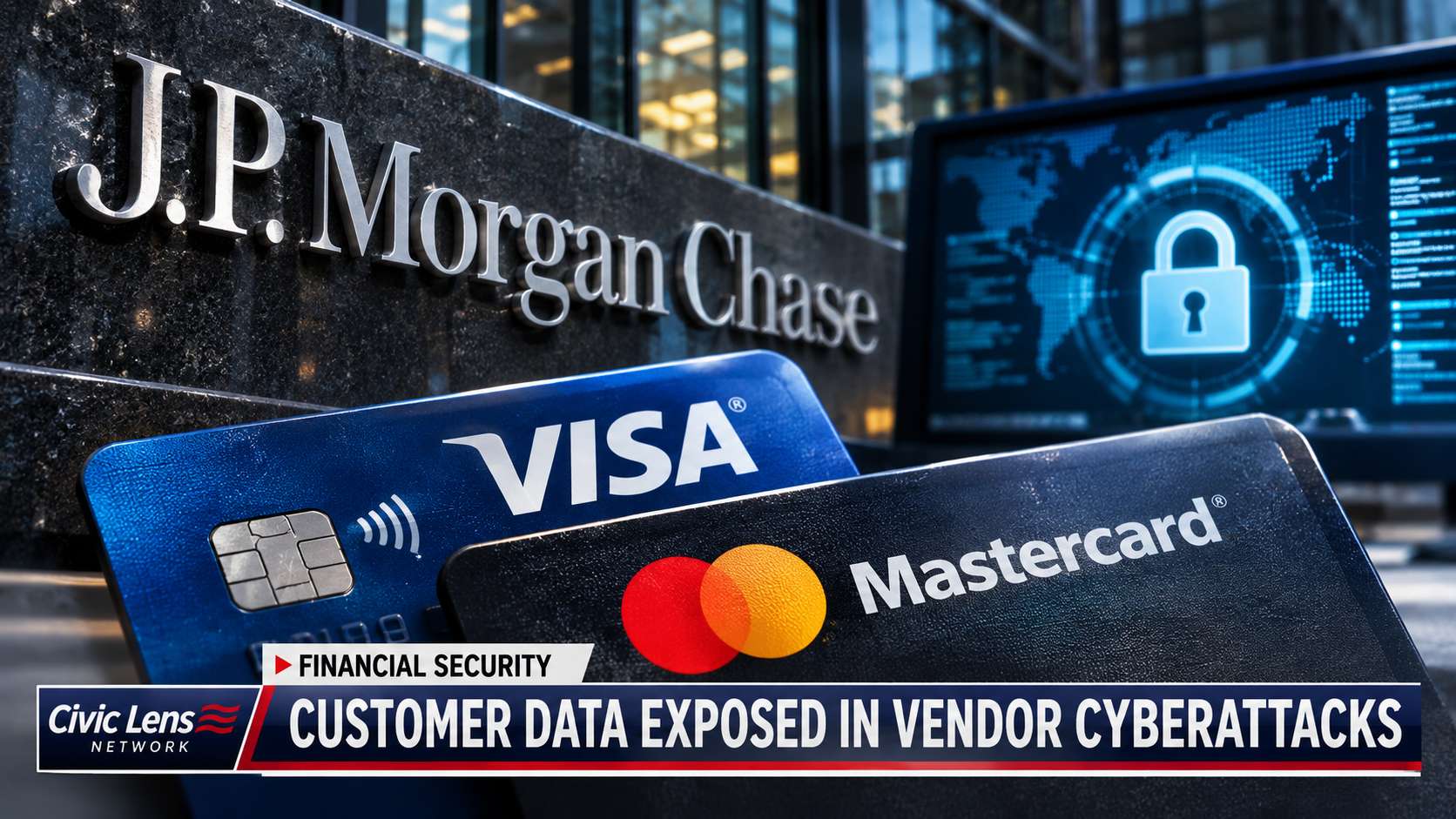
Three of the world’s most powerful financial institutions have confirmed cybersecurity incidents involving outside service providers, exposing customer information and raising new concerns about how major banks and payment companies protect sensitive data entrusted to third-party businesses.
JPMorgan Chase, Visa and Mastercard acknowledged the incidents Thursday, November 19, after a cyber-extortion group claimed to have obtained customer records associated with the companies.
The disclosures involve some of the biggest names in global finance, although officials have emphasized that their core banking and payment networks were not compromised.
The incidents highlight a growing cybersecurity problem: criminals do not necessarily need to penetrate a major financial institution’s own computer systems to obtain information about its customers.
Instead, attackers can target smaller companies that manage marketing programs, customer benefits and other services on behalf of financial institutions.
JPMorgan Chase Confirms Customer Information May Have Been Accessed
JPMorgan Chase, the largest bank in the United States, confirmed that outside service providers working with the company were targeted in a cyberattack.
According to the bank, its investigation indicates that attackers accessed certain marketing records maintained by those vendors.
The information may include customer names and email addresses.
JPMorgan has not publicly identified the affected vendors, disclosed how many customers may have been impacted or established the full extent of the information accessed.
The bank said its services were not disrupted by the attack.
It also announced plans to contact affected customers directly when appropriate and provide assistance, including complimentary credit monitoring for eligible individuals.
The disclosure follows separate banking disruptions earlier this week that temporarily affected some JPMorgan customers.
However, the company has explicitly stated that the earlier service problems were unrelated to the cyberattack.
Those disruptions were attributed to a software problem involving the bank’s hardware systems.
There is currently no verified evidence connecting the two incidents.
Visa Confirms Incident Involving Outside Provider
Visa also acknowledged a cybersecurity incident involving a third-party service provider operating in the Asia-Pacific region.
The company emphasized that its own payment-processing systems were not involved.
Visa further stated that payment information, including credit and debit card numbers, was not affected.
That distinction is important because exposure of marketing information is fundamentally different from an intrusion into the systems responsible for authorizing and processing financial transactions.
However, customer contact information can still be valuable to criminals.
Names, email addresses and details about customer benefits programs may help attackers create convincing fraudulent messages designed to impersonate legitimate financial institutions.
Visa has not publicly identified the affected service provider or disclosed a comprehensive accounting of any nonpayment customer information that may have been exposed.
Mastercard Reports Limited Exposure
Mastercard separately confirmed that a cybersecurity incident at an outside provider exposed a limited number of email addresses.
According to the company, the information belonged to a small subset of cardholders enrolled in a particular benefits program.
Mastercard said the exposure has been contained.
The company also emphasized that its payment network remains unaffected and that customers can continue using their cards normally.
The affected provider has not been publicly identified.
Mastercard has not disclosed the precise number of customers involved.
Although the three companies have reported incidents involving outside vendors, investigators have not publicly established whether the same provider, intrusion or attackers were responsible for every case.
Cyber-Extortion Group Claims Responsibility
A cyber-extortion organization identifying itself as n0n has claimed responsibility for stealing information associated with the financial companies.
The group reportedly published data it attributed to JPMorgan Chase, Visa and Mastercard.
Cybersecurity researchers examining material associated with the claims identified approximately 16,000 purported JPMorgan customer email addresses.
Other researchers reported examining records associated with thousands of Visa customers.
However, those figures should not be treated as confirmed totals.
The companies have not independently verified the full contents of the material, and investigators have not publicly established that every record originated from the incidents under investigation.
Reuters also reported that it could not independently authenticate the material attributed to the companies.
The group’s claims therefore remain allegations, even though the financial institutions have separately acknowledged actual cybersecurity incidents involving their vendors.
The attackers’ identities, location and precise methods have not been conclusively established.
The Hidden Weakness in Modern Banking
The incidents expose a problem that extends far beyond these three companies.
Major financial institutions depend on extensive networks of outside contractors to provide advertising services, customer rewards, travel benefits, technical support and other business operations.
Those contractors may hold personal information belonging to customers who have never directly interacted with the outside companies.
When an attacker compromises a vendor, the resulting exposure can affect customers of much larger financial institutions.
Even when passwords, account credentials and payment-card numbers remain protected, other personal information can create opportunities for additional criminal activity.
For example, criminals possessing legitimate customer names and email addresses could attempt targeted phishing campaigns.
A fraudulent email appearing to originate from a bank may become more convincing when the sender already knows the recipient has a relationship with that institution.
That does not mean such attacks have occurred in connection with these incidents. It illustrates why even limited exposure of customer information warrants attention.
Questions Remain About the Scope of the Attacks
Several important questions remain unanswered.
The companies have not provided a complete public list of the affected vendors.
They have not established a definitive combined total of exposed customer records.
Investigators also have not confirmed whether the incidents represent a coordinated attack against the financial industry or separate compromises of unrelated service providers.
Most importantly, there is no confirmed evidence that the attackers gained control of the companies’ primary banking or payment-processing networks.
JPMorgan Chase, Visa and Mastercard have all emphasized that their essential financial services remain operational.
Nevertheless, the disclosures demonstrate that protecting a financial institution requires more than securing its own servers.
Customer information can pass through numerous outside businesses, each representing another potential point of attack.
For millions of Americans who depend on banks and payment cards every day, the incidents raise a straightforward question: How securely is their personal information protected once it leaves the institution they originally trusted?
As investigations continue, the answers may determine whether the latest disclosures remain limited vendor-related data exposures or reveal broader weaknesses in the financial industry’s cybersecurity defenses.