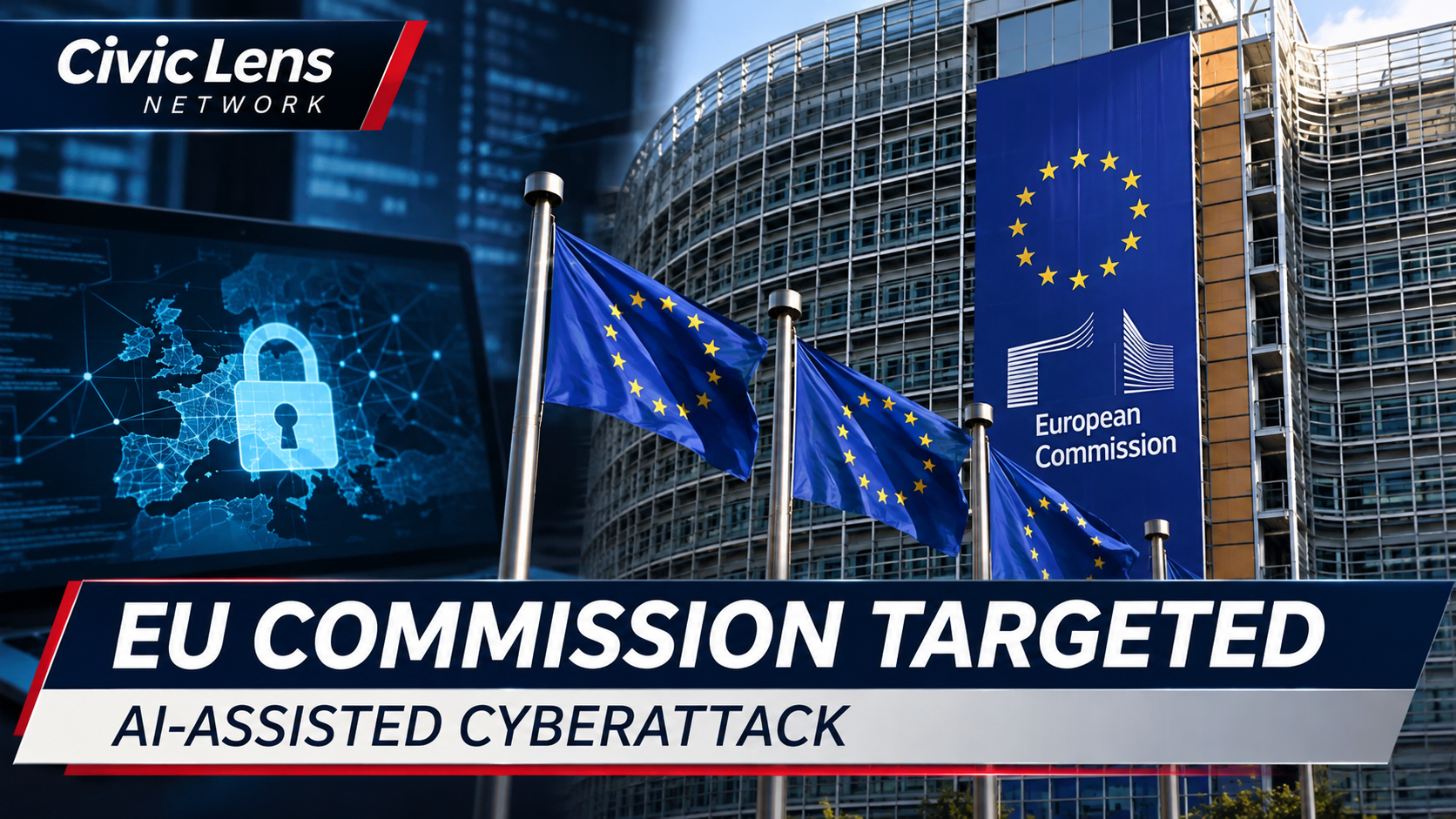
The European Commission has confirmed that its internal computer systems were targeted in a cyberattack involving artificial intelligence, forcing officials to shut down multiple government applications and launching an investigation into whether sensitive information was compromised.
The announcement came Thursday, November 19, nearly a month after the attack was first detected, raising questions about the security of one of Europe’s most powerful governing institutions and the growing use of artificial intelligence in cyber operations.
European Commission spokesperson Thomas Regnier confirmed that investigators identified the cybercampaign on October 22. Officials subsequently took several applications offline as a protective measure.
The Commission said most affected services have since been restored, although some systems remain unavailable and investigators have not established the full extent of the attack.
Artificial Intelligence Used Against Government Systems
The most significant revelation is the confirmed involvement of artificial intelligence.
Regnier acknowledged that the attackers used AI tools during the operation, describing it as an AI-generated cybercampaign.
Artificial intelligence can help cybersecurity professionals identify software weaknesses before criminals exploit them. However, similar technology can also be used by attackers to discover vulnerabilities and potentially accelerate malicious operations.
The Commission has not disclosed exactly which AI tools were involved, how the attackers gained access or whether the technology was used to automate particular stages of the intrusion.
Those unanswered questions are especially important because the attack targeted the executive branch of the European Union, an institution responsible for proposing legislation, implementing policies and overseeing major regulatory programs affecting 27 member countries.
Payroll and Medical Systems Reportedly Disrupted
According to reporting published Thursday, the cyberattack caused disruptions lasting approximately 10 days.
Systems reportedly affected included employee payroll applications, timekeeping databases, translation services and medical reimbursement tools.
Some of those applications contain or process potentially sensitive employee information.
The European Commission has not independently confirmed every system identified in the reports.
Officials have also not established whether attackers successfully obtained personal information.
Regnier said investigators had found no evidence of a data breach affecting Commission employees as a whole.
That statement does not establish that every individual system was unaffected or that no information was exposed. The investigation remains active.
European Officials Convene Emergency Meeting
The seriousness of the incident reportedly prompted the Commission to convene its highest-level internal crisis management body.
European Commissioner Henna Virkkunen, whose responsibilities include technology and digital security, reportedly briefed fellow commissioners about the situation.
The Commission confirmed that it has been coordinating with CERT-EU, the cybersecurity organization responsible for helping protect European Union institutions.
Officials also contacted the European Data Protection Supervisor, which oversees the handling of personal information by EU institutions.
The Commission has not publicly identified the attackers.
It remains unknown whether the campaign originated from an independent criminal organization, a foreign intelligence service or another actor.
Officials have also declined to establish the attackers’ objective.
There is currently no confirmed evidence that the operation was intended to steal government secrets, extort money or disrupt European policymaking.
Why Was the Attack Revealed Weeks Later?
Another question concerns the timing of the public announcement.
The cybercampaign was detected October 22 and confirmed internally on October 26, but the public did not receive confirmation until November 19.
During Thursday’s press briefing, officials defended their handling of the incident.
Regnier explained that publicly revealing defensive actions while an investigation is underway could undermine efforts to contain an attack.
He maintained that affected services and relevant oversight authorities had been informed through established procedures.
Nevertheless, the delayed public disclosure highlights the difficult balance between operational security and transparency when government computer systems are compromised.
A Growing Threat to Governments Worldwide
The incident comes amid increasing concern about the ability of artificial intelligence to change the cybersecurity landscape.
AI tools can analyze large quantities of computer code, identify potential weaknesses and assist with complex technical tasks much faster than traditional manual methods.
Those capabilities can strengthen legitimate cybersecurity defenses, but they can also provide advantages to malicious actors.
The European Union has been developing policies intended to improve cybersecurity and address the risks associated with artificial intelligence.
The latest attack demonstrates that even institutions responsible for establishing technology regulations must contend with the same emerging threats confronting businesses and governments worldwide.
The incident also raises questions about whether existing defenses can keep pace as cybercriminals gain access to increasingly capable automated tools.
For now, the European Commission says most affected applications have been restored and investigators continue examining the campaign.
No suspect has been publicly identified, no comprehensive damage assessment has been released and a large-scale theft of employee information has not been confirmed.
The central fact remains significant: a major international governing institution has acknowledged that artificial intelligence was used in a cyberattack against its systems.
As the investigation continues, the findings could provide important evidence about how AI-assisted cyber operations are evolving and whether governments are adequately prepared to defend against them.