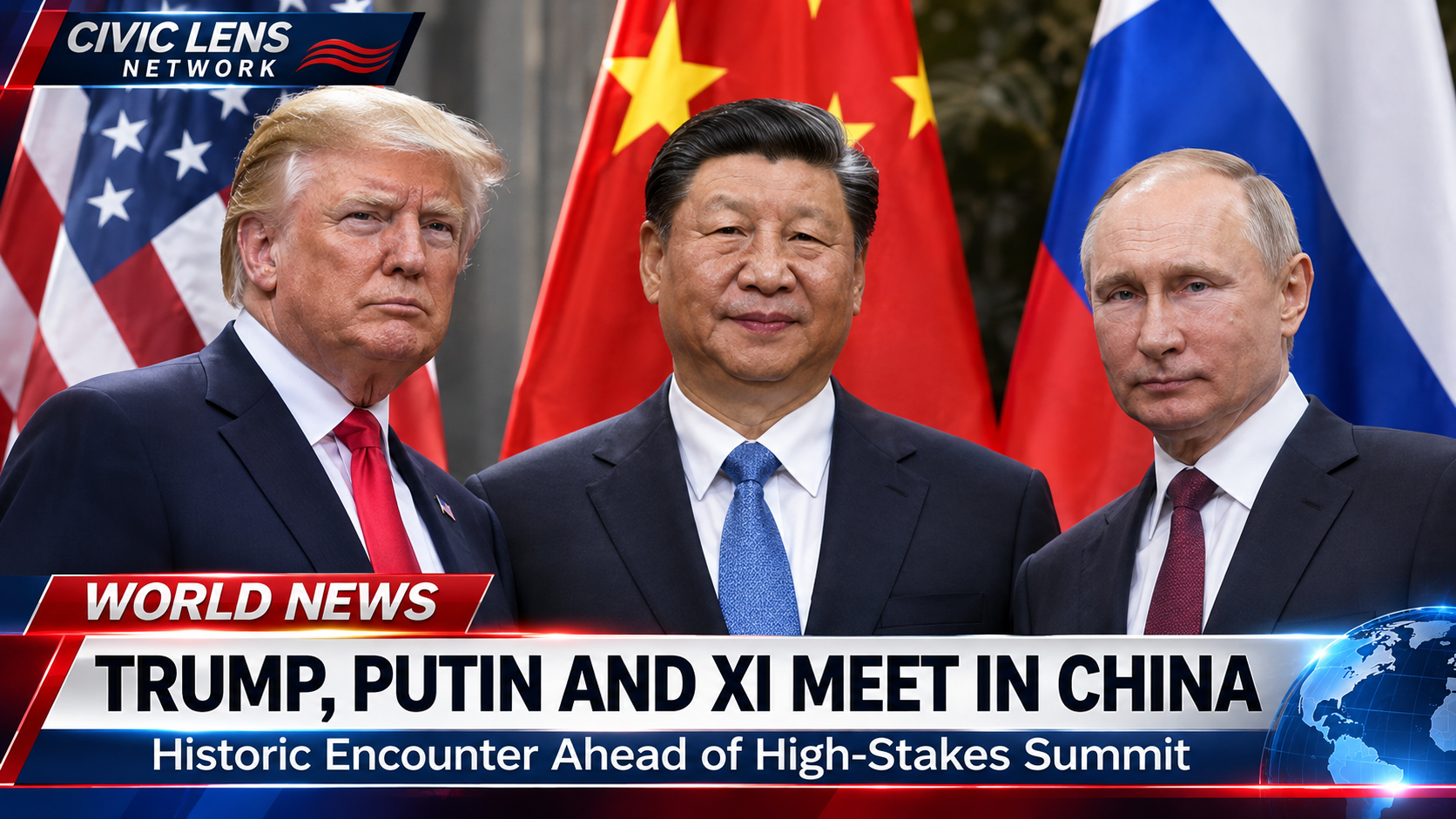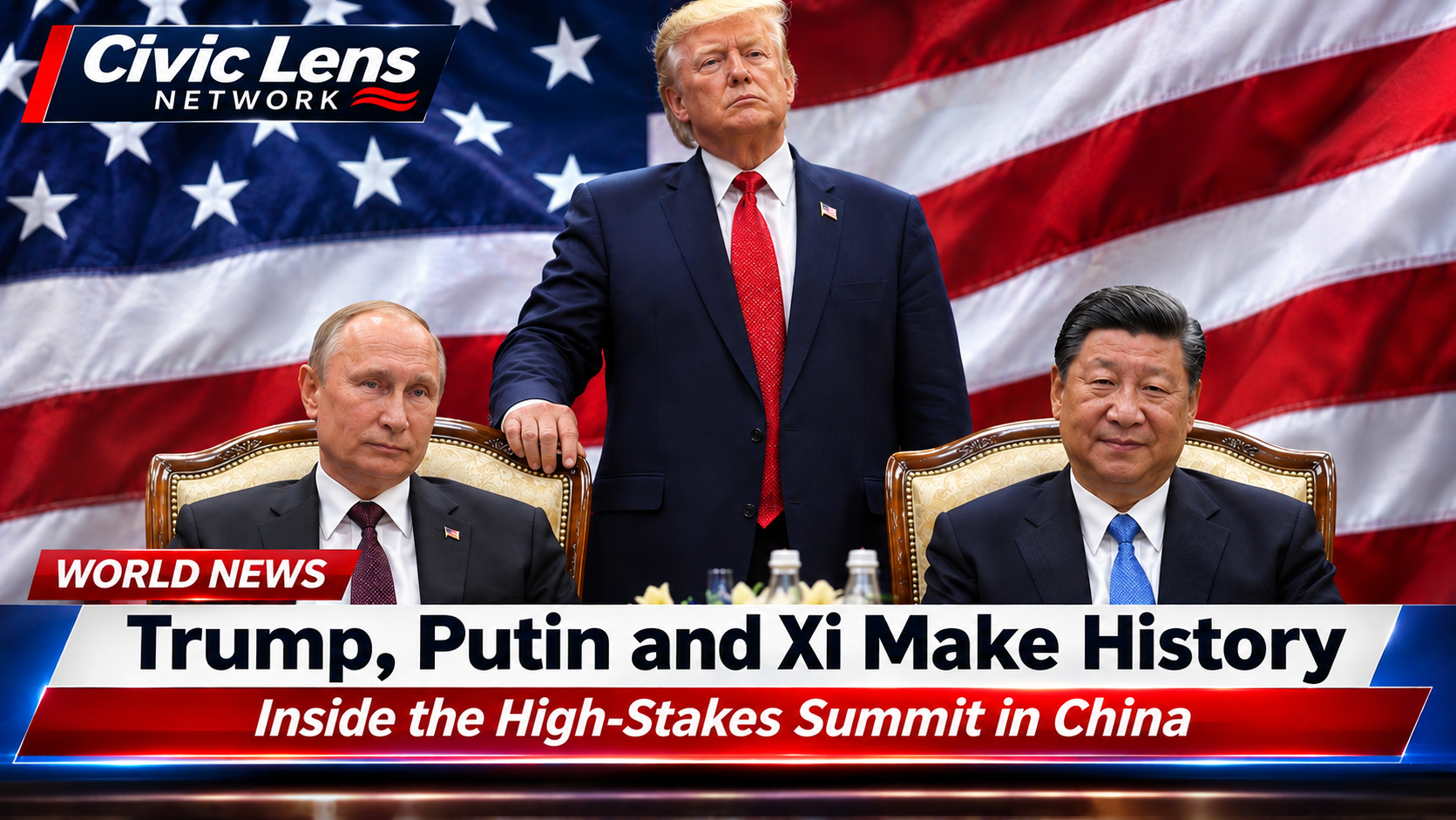
President Donald Trump has concluded one of the most extraordinary diplomatic meetings of his presidency, sitting down with Russian President Vladimir Putin and Chinese President Xi Jinping for unprecedented three-way talks that could influence the future of international relations.
The November 19 gathering in Shenzhen, China, brought together the leaders of three of the world’s most powerful nuclear nations. The meeting lasted approximately 70 to 90 minutes and followed separate discussions between Trump and his Russian and Chinese counterparts.
What emerged was a joint peace declaration addressing nuclear security, international institutions, energy production and national sovereignty.
But behind the historic photographs and diplomatic handshakes, several major questions remain unanswered.
Trump Pushes for a New Era of Nuclear Negotiations
One of the most consequential subjects was nuclear weapons.
Trump opened the meeting by emphasizing the unique responsibility carried by the United States, Russia and China. Together, the three countries possess enormous military capabilities and influence over global security.
The president suggested that the countries should work toward reducing nuclear stockpiles and lowering the possibility of nuclear confrontation.
The issue has become increasingly urgent following the expiration of the New START nuclear arms treaty between Washington and Moscow in February 2026.
That agreement had established limits on deployed strategic nuclear weapons and provided mechanisms for monitoring compliance.
Trump has expressed interest in replacing it with a broader arrangement that includes China.
However, Beijing has historically resisted joining nuclear arms limitations negotiated primarily between Washington and Moscow, arguing that China’s arsenal remains considerably smaller.
The three leaders ultimately reaffirmed that nuclear war must never be fought and expressed support for continued dialogue.
No specific reductions, inspection arrangements or timetable for a new treaty were announced.
International Criminal Court Faces Unprecedented Opposition
One of the summit’s most significant developments involved the International Criminal Court.
Trump criticized the institution, describing it as “out of control.”
The joint declaration emphasized the importance of state consent and the legal immunities afforded to government officials. It also warned against international courts abusing their authority.
The issue carries particular significance for the United States.
America has never joined the treaty establishing the International Criminal Court, and Washington has long disputed the court’s authority to prosecute American nationals without U.S. consent.
The court nevertheless maintains that it can exercise jurisdiction over certain crimes committed on the territory of member states, regardless of the accused person’s nationality.
The dispute therefore concerns the limits of international jurisdiction, not simply whether the United States recognizes the institution.
Russia also rejects the court’s authority. Putin has been subject to an ICC arrest warrant since 2023 over allegations involving the unlawful deportation and transfer of Ukrainian children. Moscow denies wrongdoing.
For Trump, the declaration represents an opportunity to reinforce a longstanding American position: international institutions should not automatically possess authority over the United States simply because they claim it.
The statement did not abolish the court, change its legal jurisdiction or establish a binding agreement shielding officials from prosecution.
Nevertheless, public opposition from Washington, Moscow and Beijing places substantial political pressure on the international justice system.
Ukraine War Discussed, but Putin Refuses Immediate Negotiations
The war in Ukraine was another major subject.
Trump held separate talks with Putin before the three-way meeting, continuing his effort to pursue a negotiated resolution to the conflict.
Putin acknowledged that the countries have shared interests in resolving regional conflicts, including Ukraine.
However, the Russian president subsequently indicated that Moscow would not enter direct negotiations with Kyiv following a Ukrainian strike against the Kerch Bridge connecting Russia with occupied Crimea.
Putin also argued that Ukraine and European governments were not prepared to make the compromises Moscow considers necessary.
Those statements highlight the enormous distance remaining between diplomatic discussions and an actual peace settlement.
No ceasefire was announced. No territorial agreement was disclosed. No new security guarantees for Ukraine emerged from the meeting.
The joint peace declaration did not even specifically mention the Ukraine conflict.
For the Trump administration, the challenge remains whether direct engagement with Putin can produce concessions that previous diplomatic efforts have failed to secure.
Iran and the Strait of Hormuz
The conflict involving Iran also figured into Trump’s discussions.
A major American concern remains the Strait of Hormuz, one of the world’s most strategically important shipping passages.
Disruptions to shipping through the waterway have affected international energy markets and created economic uncertainty.
Trump discussed the importance of maintaining oil flows through the strait during his separate meeting with Xi.
China has a substantial economic interest in uninterrupted energy shipments, giving Beijing a reason to support greater stability.
However, the summit produced no publicly announced agreement requiring China or Russia to assist the United States in resolving the conflict.
There was also no announced ceasefire arrangement involving Iran.
Oil and Gas Production Become Part of the Agreement
Energy was one area where the three governments expressed a common objective.
Their declaration supported increasing oil and natural gas production to improve supplies for international markets.
The potential economic implications are considerable.
The United States and Russia are among the world’s largest energy producers, while China is one of the largest energy consumers.
Greater production could help ease supply pressures, although actual effects on prices would depend on market conditions, sanctions, transportation routes and how much additional energy reaches buyers.
The leaders did not announce specific production targets or a binding energy agreement.
For American consumers, the important question is whether the diplomatic commitment eventually translates into lower fuel costs and more stable energy markets.
United Nations Reform Also on the Table
The leaders agreed that the United Nations should be reformed to respond more effectively to international challenges.
All three countries hold permanent seats on the UN Security Council and possess veto power over substantive resolutions.
That gives Washington, Moscow and Beijing significant influence over international security decisions.
However, the declaration offered few details about what reforms the three governments would jointly pursue.
Changes to the Security Council, international peacekeeping operations or institutional oversight would require considerably more negotiation.
China Strengthens Its Diplomatic Position
Although Trump described the gathering as historic, China also gained an important diplomatic opportunity.
By hosting the American and Russian presidents together, Xi presented Beijing as a central participant in negotiations involving the world’s major powers.
China’s relationship with Russia remains especially important.
Beijing has maintained extensive economic ties with Moscow despite Western sanctions imposed following Russia’s invasion of Ukraine.
Those connections provide Russia with access to an important trading partner while giving China additional geopolitical influence.
The summit demonstrated that Washington must deal with a complex international relationship in which Moscow and Beijing share interests that do not always align with American priorities.
Trump’s challenge is to negotiate effectively with both governments without allowing their cooperation to weaken America’s strategic position.
What Actually Changed After the Meeting?
Despite the extraordinary circumstances, the summit produced more diplomatic commitments than enforceable agreements.
There was no nuclear disarmament treaty, no Ukraine ceasefire, no Iran peace agreement and no binding overhaul of international institutions.
What did change was the willingness of the three leaders to publicly establish a framework for further discussions.
The declaration identified several areas where the governments believe cooperation is possible, even while serious disagreements remain.
Trump’s approach emphasizes direct communication with rival powers rather than relying exclusively on traditional diplomatic channels.
Supporters of that approach see engagement as an opportunity to reduce tensions and negotiate agreements that might otherwise remain impossible.
Critics question whether the diplomatic recognition afforded to Putin and Xi will produce sufficient concessions in return.
Both arguments will ultimately be judged against measurable results.
What Happens Next?
Trump is expected to address the summit publicly again, with a press conference announced for Friday, November 20.
That appearance could provide additional details about the private conversations and clarify whether negotiations will continue on nuclear weapons, Ukraine, energy security or international courts.
For now, the most important development is that the leaders of the United States, Russia and China have formally acknowledged several shared priorities while leaving the world’s most difficult disputes unresolved.
The meeting may eventually be remembered as the beginning of meaningful negotiations, or as a historic diplomatic gathering that produced little lasting change.
The difference will depend on what Washington, Moscow and Beijing actually do next.
For the United States, the standard should remain straightforward: diplomacy must produce concrete benefits for American security, American sovereignty and the American people.