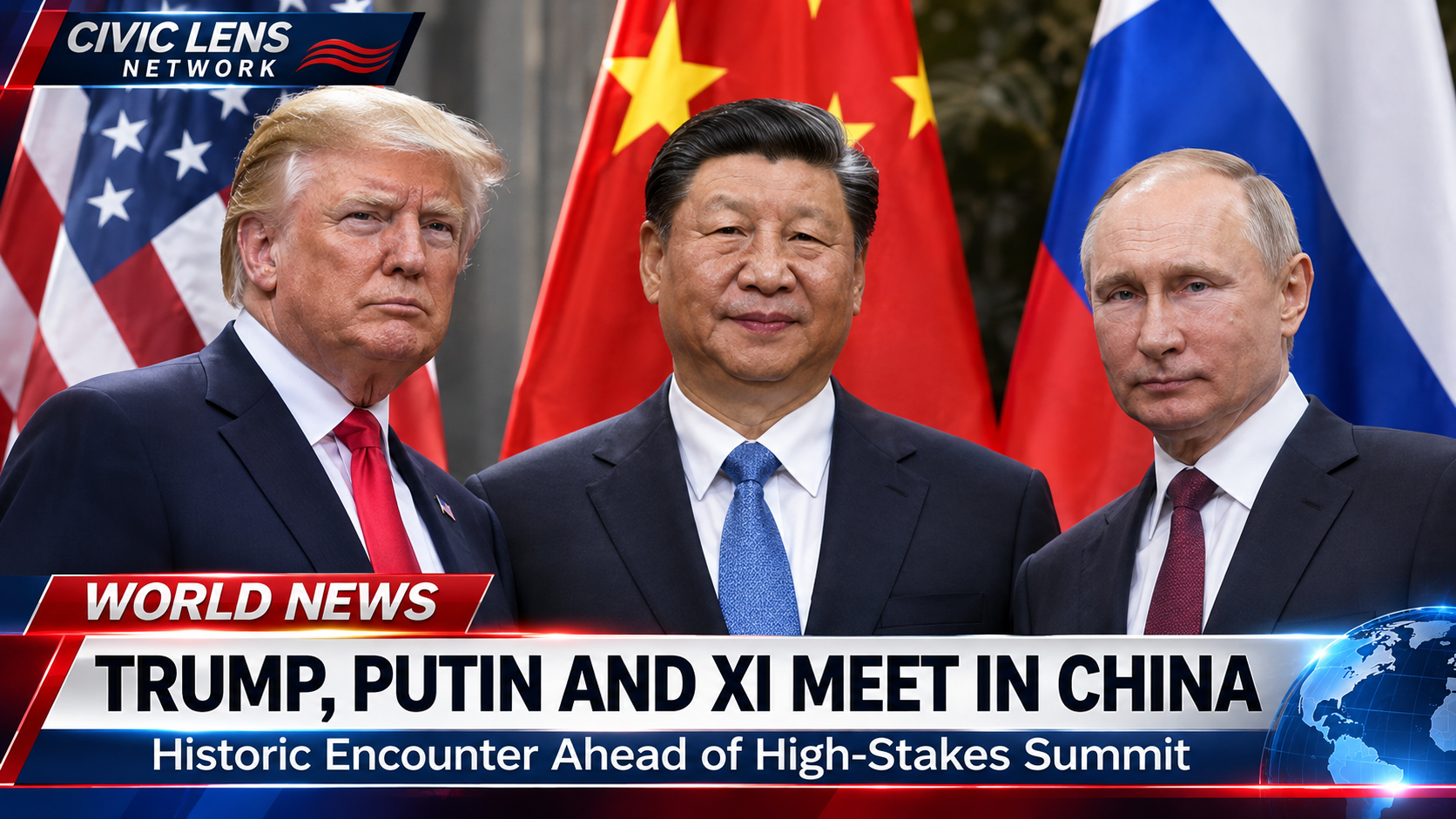
President Donald Trump, Russian President Vladimir Putin and Chinese President Xi Jinping came face-to-face Wednesday, November 18, in a historic diplomatic encounter that brought together the leaders of three of the world’s most powerful nations.
The meeting took place in Shenzhen, China, during a welcoming reception for the Asia-Pacific Economic Cooperation summit, where Trump and Putin shook hands and exchanged a few words as Xi stood nearby.
Photographs captured the extraordinary moment, showing the American and Russian presidents greeting each other in the presence of China’s leader.
Although Wednesday’s encounter was brief and largely ceremonial, it marked the first face-to-face meeting between Trump and Putin since their August 2025 summit in Alaska.
The three leaders are scheduled to hold formal trilateral negotiations Thursday, November 19, with nuclear weapons, international conflicts and global security among the major issues surrounding the discussions.
China Rolls Out an Extraordinary Welcome for Trump
Trump’s arrival in Shenzhen was accompanied by an elaborate reception organized by the Chinese government.
Xi personally welcomed the American president at the airport, an unusual diplomatic gesture demonstrating the importance Beijing places on its relationship with Washington.
A red carpet, military honor guard, national flags and ceremonial aircraft displays accompanied Trump’s arrival.
The two presidents exchanged greetings before proceeding to events associated with the international summit.
The reception contrasted with Putin’s arrival, during which the Russian president was welcomed by senior Chinese Communist Party official Cai Qi rather than Xi himself.
Later Wednesday, Trump, Putin and Xi appeared together for a group photograph alongside other international leaders.
The carefully organized ceremony offered a rare public image of the three presidents together, despite the substantial political and military disagreements separating their governments.
Trump and Putin Exchange Their First Handshake in More Than a Year
One of the most closely watched moments occurred when Putin approached Trump and Xi during the welcoming reception.
Putin extended his hand toward the American president, and the two exchanged a handshake and brief remarks.
Video footage showed Xi observing the interaction.
The encounter was not a formal negotiation, and officials have not indicated that the two presidents discussed substantive policy matters during their brief exchange.
Nevertheless, the handshake carried considerable diplomatic significance.
Relations between Washington and Moscow remain strained by Russia’s continuing war in Ukraine, Western sanctions and disagreements over European security.
Trump has repeatedly pursued direct negotiations with Putin, arguing that diplomacy is necessary to bring the war to an end.
The two presidents are also expected to hold additional discussions Thursday, although Russian officials have indicated that a full-scale bilateral summit is unlikely.
Nuclear Weapons Take Center Stage
One of the most consequential issues surrounding Thursday’s meeting is the future of nuclear arms control.
The expiration of the New START treaty in February 2026 eliminated the last major agreement limiting strategic nuclear arsenals between the United States and Russia.
Trump has expressed interest in establishing a broader framework involving China, whose expanding nuclear capabilities have become a growing concern for American defense officials.
For decades, nuclear arms control negotiations primarily involved Washington and Moscow.
China has resisted joining comparable agreements, arguing that its nuclear arsenal remains considerably smaller than those maintained by the United States and Russia.
The challenge facing Trump is whether all three governments can begin meaningful discussions about limiting weapons capable of causing catastrophic destruction.
A successful agreement could represent a significant diplomatic achievement, although major differences remain over verification, arsenal sizes and national security priorities.
Putin and Xi Hold Separate Talks
Before Wednesday’s encounter with Trump, Putin and Xi held their own bilateral discussions.
The two leaders have strengthened cooperation between Russia and China, particularly as both countries seek to counter American economic and geopolitical influence.
Their relationship has become increasingly important since Russia’s invasion of Ukraine in 2022.
China has maintained substantial economic ties with Moscow despite Western sanctions, while Russia has sought additional international partnerships to reduce its dependence on Western markets.
During Wednesday’s events, Putin criticized Western sanctions, arguing that economic restrictions had failed to achieve their intended objectives.
Xi also criticized trade protectionism and emphasized international economic cooperation.
Their remarks highlighted the competing interests Trump will face during Thursday’s negotiations.
Ukraine and Iran Remain Major Challenges
The war in Ukraine remains one of the most sensitive issues surrounding the gathering.
Trump has continued diplomatic efforts aimed at ending the conflict, but fundamental disagreements remain over territory, security guarantees and Russia’s demands.
Although American officials initially indicated that Ukraine might not be a central subject of the trilateral discussions, Trump has suggested that the conflict could be addressed.
Ukrainian officials have expressed concern that major powers could negotiate arrangements affecting their country’s future without sufficient Ukrainian participation.
The conflict involving Iran is another major issue expected to receive attention.
Russia and China maintain important relationships with Tehran, potentially giving them diplomatic influence that Washington does not possess.
Whether the three governments can identify common ground remains uncertain.
Technology and Trade Add Another Dimension
The gathering is taking place in Shenzhen, one of China’s most important technology and manufacturing centers.
The location is particularly significant because Washington and Beijing remain locked in competition over advanced semiconductors, artificial intelligence and technological leadership.
American restrictions on advanced AI chips have become a major source of tension between the two governments.
China has criticized those restrictions, while Washington maintains that sensitive American technology must be protected from potential military applications.
Trump has also emphasized strengthening American manufacturing and reducing dependence on foreign supply chains.
These economic disputes form an important backdrop to the summit, even if the leaders devote much of their formal discussions to international security.
A Historic Moment With Enormous Consequences
Wednesday’s meeting did not produce a diplomatic agreement, but it created a striking image of three powerful leaders standing together at a time of considerable international uncertainty.
Trump enters Thursday’s negotiations seeking to protect American interests while pursuing opportunities to reduce international tensions.
Putin is attempting to strengthen Russia’s diplomatic position despite the continuing Ukraine war.
Xi is positioning China as a central participant in negotiations affecting the international balance of power.
Their objectives are not identical, and serious disagreements remain.
For the United States, the challenge will be pursuing meaningful diplomatic progress without compromising national security or allowing competing powers to dictate the terms of international agreements.
The possibility of nuclear arms control discussions involving all three countries represents one of the most significant opportunities surrounding the summit.
Progress on Ukraine or Iran could also have substantial consequences.
However, ceremonial handshakes and diplomatic photographs are only the beginning.
The real test comes Thursday, when Trump, Putin and Xi are expected to move beyond public appearances and begin discussing the issues that could shape international relations for years to come.
For now, Wednesday’s encounter has already produced a remarkable moment in modern diplomacy: the leaders of the United States, Russia and China meeting face-to-face in the same room, with the world watching what happens next.