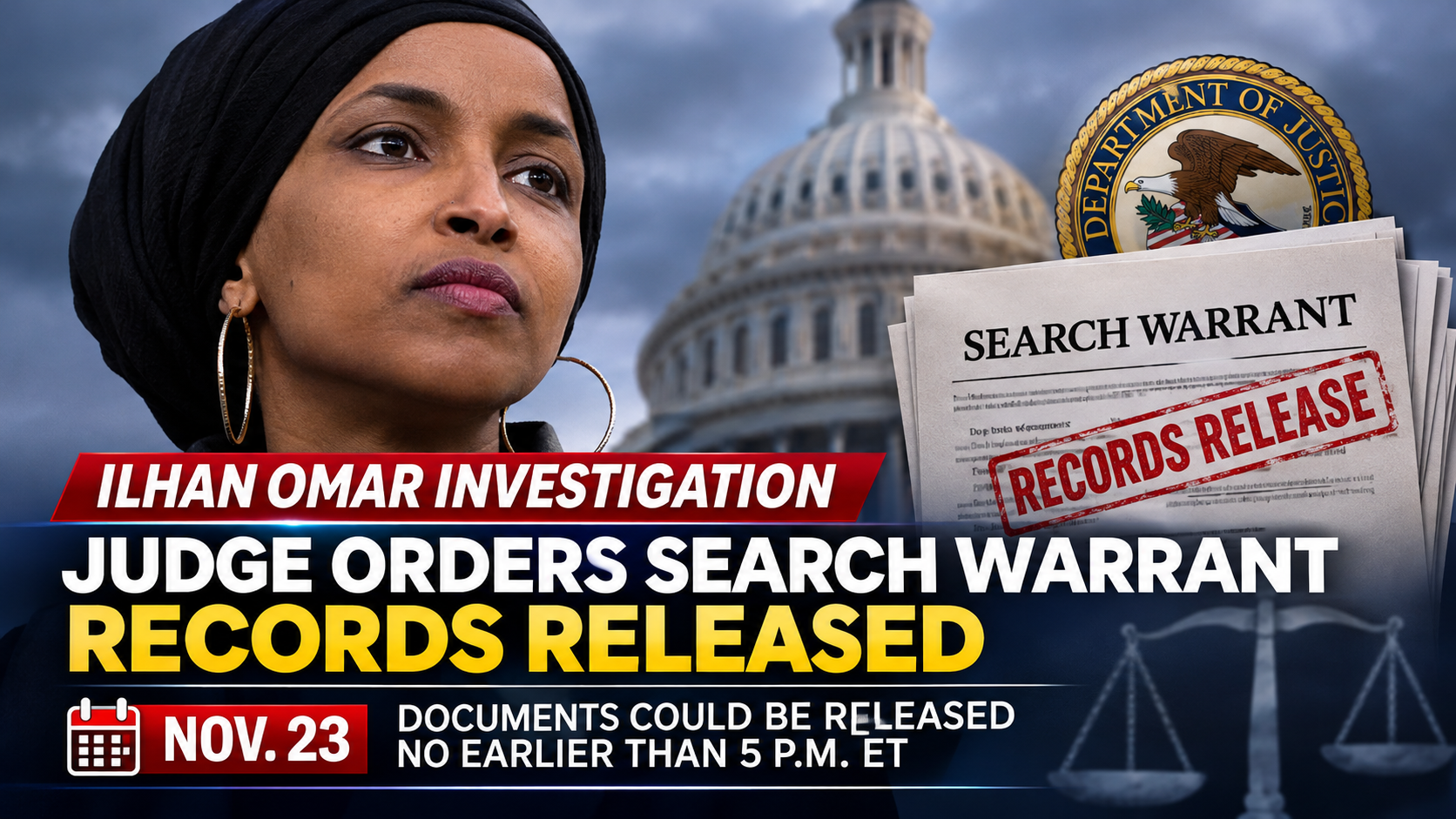
The federal investigation into Democratic Congresswoman Ilhan Omar is entering a critical new phase after a federal judge ordered the Justice Department to prepare previously sealed search warrant records for public release.
The decision could provide Americans with their clearest look yet at the legal basis for the October 12 raid on Omar’s Washington, D.C., residence, an extraordinary federal law enforcement operation targeting a sitting member of Congress.
Chief U.S. District Judge James Boasberg issued the order on November 17 following arguments from news organizations and the government over whether the public should be permitted to examine records connected to the investigation.
Under the court’s timetable, prosecutors must submit proposed redactions by Friday, November 20. The court could begin publishing the redacted documents no earlier than 5 p.m. Eastern on Monday, November 23, unless a higher court intervenes or the release is otherwise delayed.
Federal Investigation Focuses on Immigration Records
Federal authorities are investigating whether Omar or members of her family provided false information in immigration paperwork associated with their arrival in the United States from Somalia during the 1990s.
The investigation reportedly includes questions surrounding immigration fraud, conspiracy and potentially false statements submitted to federal authorities.
Omar arrived in the United States in 1995 and became a naturalized American citizen in 2000.
The investigation has raised questions about whether information provided decades ago could have legal consequences today, including the possibility of proceedings to revoke citizenship if federal authorities establish that it was unlawfully obtained.
However, Omar has not been charged with a crime, and no court has determined that she committed immigration fraud.
Agents Seized Electronic Devices and Personal Records
On October 12, Homeland Security Investigations agents searched Omar’s Washington residence under a court-authorized warrant.
According to accounts of the operation, approximately 25 federal agents participated in a search lasting several hours.
Investigators reportedly seized 17 items, including electronic devices, notebooks and other personal belongings.
Among the property reportedly taken were Omar’s cellphone, computer and passport. Omar has also described agents collecting a camera, notebooks belonging to her husband and a Somali-language children’s book.
Federal investigators have additionally sought information from members of Omar’s family through subpoenas and questioning.
The scope of the search suggests investigators were seeking records that could help establish a timeline of events extending back decades.
What those materials reveal, and whether prosecutors believe they support criminal charges, remains unknown.
Judge Questions Why Legal Records Remain Secret
During Tuesday’s hearing, Judge Boasberg questioned whether the government had sufficient justification to keep every document associated with the search warrant confidential.
The judge expressed particular interest in legal arguments concerning the Constitution’s Speech or Debate Clause, which protects members of Congress from certain forms of executive and judicial interference involving their legislative responsibilities.
Those protections do not provide lawmakers with blanket immunity from criminal investigations unrelated to legitimate legislative activity.
The court is examining how those constitutional protections apply to evidence seized from Omar’s residence.
Boasberg indicated that legal arguments and court orders might be released without necessarily exposing witnesses, confidential evidence or sensitive investigative methods.
The Justice Department opposed broad disclosure, arguing that releasing investigative records before prosecutors make a charging decision could jeopardize the ongoing case.
Key 67-Page Affidavit Will Remain Sealed
Although the judge’s order represents a significant development, the public will not immediately receive every document connected to the investigation.
The 67-page affidavit used to support the search warrant will remain sealed for now.
That document reportedly contains investigative evidence, witness information and details presented to the magistrate judge who authorized the search.
Its continued secrecy means the public may learn which federal laws investigators are examining without seeing the complete evidence supporting their suspicions.
The judge left open the possibility that additional materials could become public later, particularly if prosecutors file charges or close the investigation.
News organizations seeking disclosure will have until November 30 to challenge the government’s proposed redactions.
Previous Federal Investigation Adds Another Dimension
Questions surrounding Omar’s immigration history and past marriage have circulated for years.
A previous federal investigation reportedly examined allegations concerning her marriage to Ahmed Nur Said Elmi, whom she married in 2009 and divorced in 2017.
Questions have been raised about whether the marriage involved immigration-related misrepresentations. Allegations that Elmi was Omar’s brother have not been established in court, and Omar has denied wrongdoing.
According to reporting on the earlier investigation, federal authorities examined potential irregularities but did not bring criminal charges.
The current investigation has renewed scrutiny of those earlier allegations, although the full relationship between the previous inquiry and the present investigation has not been publicly established.
Trump Administration Has Publicly Discussed Investigation
President Donald Trump and senior administration officials have publicly addressed the investigation into Omar.
Trump has repeatedly criticized the Minnesota congresswoman, while administration officials have discussed allegations involving her immigration history.
Omar has responded by accusing the administration of using federal law enforcement to target political opponents.
The timing of the October search, less than a month before the November midterm elections, also prompted criticism from Democrats who questioned whether the investigation was politically motivated.
Omar subsequently won reelection to Congress.
The political dispute does not resolve the underlying legal questions. Investigators must establish evidence sufficient to support any charges, and Omar retains the presumption of innocence.
November 23 Could Reveal Important New Information
The next major development is expected Monday, November 23, when portions of the search warrant records may become publicly available.
Those documents could identify the federal statutes under investigation, provide additional information about the scope of the search and reveal how prosecutors addressed constitutional protections applicable to members of Congress.
They may also clarify the legal arguments presented to the court before agents entered Omar’s residence.
For now, the central questions remain unanswered: What specific evidence prompted federal investigators to seek a warrant, what information did they obtain during the search, and will prosecutors ultimately pursue charges?
The anticipated document release could begin answering some of those questions.
With a sitting member of Congress under federal investigation and allegations involving decades-old immigration records, the case carries substantial legal and political implications.
The American public has a legitimate interest in understanding both the evidence behind the investigation and whether federal authorities followed the law in pursuing it.
November 23 could mark the first significant step toward providing those answers.