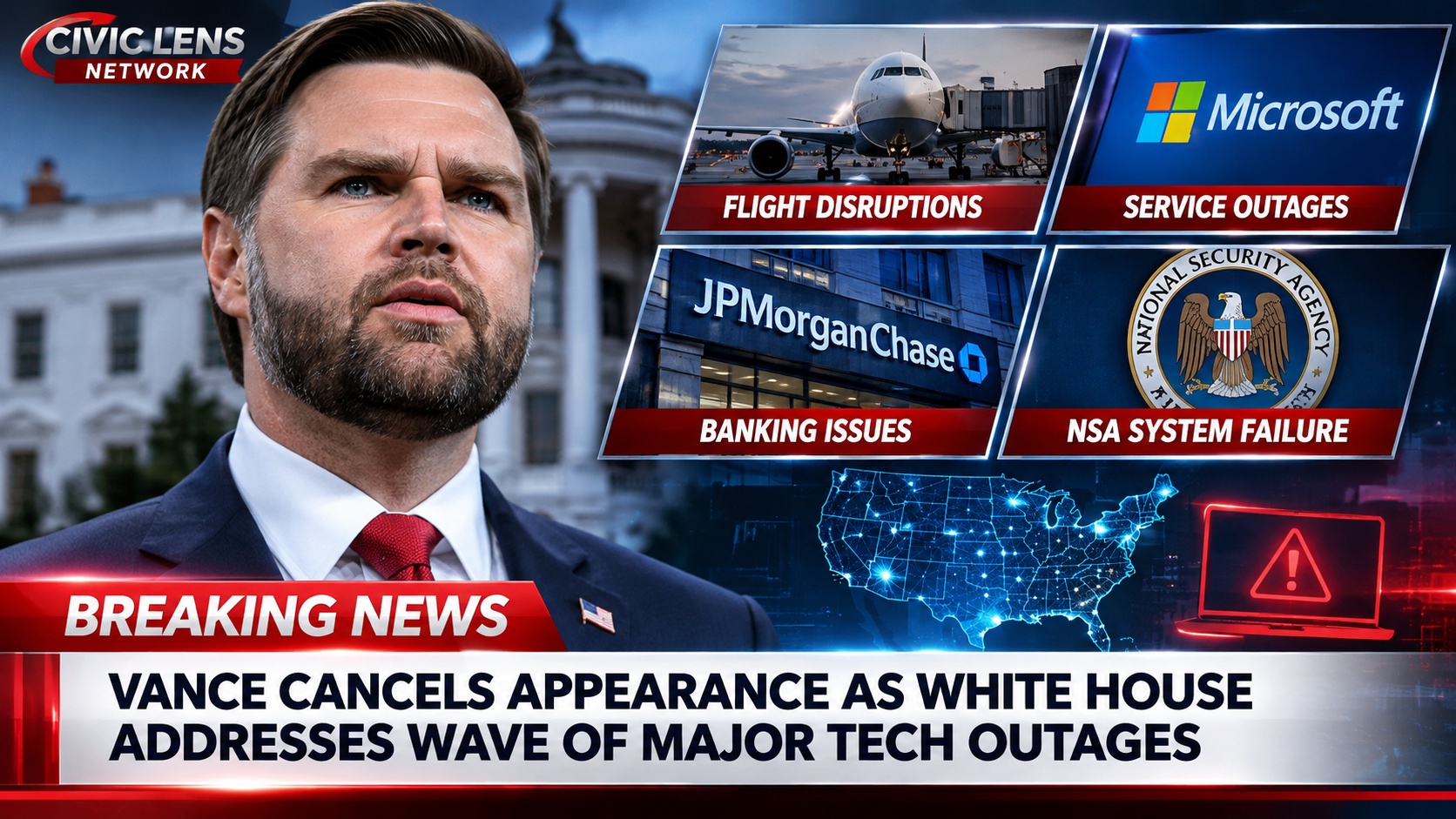
Vice President JD Vance abruptly canceled a scheduled appearance in New York on Wednesday, November 18, after being asked to remain in Washington for high-level meetings concerning a troubling wave of technology outages affecting major American industries and sensitive government communications systems.
The last-minute decision comes as the United States confronts a series of disruptions involving commercial aviation, financial institutions, Microsoft services and the National Security Agency’s highly classified communications network.
Vance had been scheduled to participate in the New York Times DealBook Summit, an event bringing together prominent business executives, political leaders and technology industry figures.
However, approximately 20 to 30 minutes before his planned appearance, organizers received word that the vice president would not be attending.
Summit host Andrew Ross Sorkin informed attendees that Vance had been directed to remain in Washington because his presence was needed for meetings addressing the ongoing disruptions.
The sudden cancellation immediately drew attention to the seriousness with which administration officials are treating the situation.
A Growing List of Disruptions
The vice president’s decision follows several days of major technology problems affecting systems that millions of Americans depend upon.
Among the most significant incidents was a nationwide aviation ground stop that temporarily disrupted domestic air travel, creating widespread uncertainty for passengers and airlines.
Microsoft services have also experienced serious interruptions, raising concerns about the reliability of technology infrastructure used by businesses, government agencies and ordinary Americans.
Financial institutions have faced disruptions as well, including reported problems involving JPMorgan Chase and the Zelle payment network.
Perhaps most concerning is the reported failure involving the National Security Agency’s classified communications network.
Unlike an ordinary commercial service outage, a disruption affecting sensitive intelligence communications raises questions about the resilience of systems responsible for supporting national security operations.
Officials have not publicly established that these incidents share a common cause.
Nevertheless, the concentration of failures across several critical sectors has intensified scrutiny of America’s technological vulnerabilities.
White House Faces Mounting Questions
The decision to keep Vance in Washington represents a significant change in his public schedule.
His planned appearance at the DealBook Summit had been arranged well in advance, with security preparations already underway.
Canceling such an appearance shortly before it begins is unusual, particularly when the explanation involves meetings concerning disruptions across several major industries.
The administration has maintained that investigators have not established evidence of a coordinated cyberattack connecting the incidents.
Federal officials have also indicated that the outages appear to involve separate technical problems rather than a single organized operation.
Those assurances, however, do not eliminate the need for a comprehensive examination of what went wrong.
The United States increasingly relies on interconnected digital infrastructure to operate its banking system, transportation networks, communications services and national security institutions.
When multiple important systems experience failures within a relatively short period, questions about redundancy, cybersecurity preparedness and emergency response become unavoidable.
Artificial Intelligence Adds Another Concern
The disruptions are also occurring as artificial intelligence introduces new challenges for cybersecurity professionals.
Advanced AI tools can help identify software weaknesses more quickly, potentially benefiting both legitimate security researchers and malicious actors.
Lawmakers have expressed concern that offensive cybersecurity capabilities could advance faster than the defensive measures intended to protect American infrastructure.
However, the existence of these technological risks does not establish that artificial intelligence or foreign hackers caused the recent outages.
Determining the actual causes will require technical investigations, evidence and detailed explanations from the organizations involved.
Americans Deserve Clear Answers
The central issue now extends beyond any individual technology failure.
Americans depend on reliable banking services to access their money, functioning aviation systems to travel and secure government communications to protect the country.
Repeated disruptions expose the consequences of relying on complex systems that can fail unexpectedly.
Vance’s sudden withdrawal from a major public event demonstrates that the situation has reached the attention of senior White House leadership.
What remains unclear is whether the meetings will produce new security measures, additional investigations or a more comprehensive public explanation of the outages.
For now, federal officials continue to maintain that the incidents have not been linked to a coordinated attack.
But with transportation, financial services, commercial technology and classified government communications all experiencing significant problems, Washington faces growing pressure to explain how these failures occurred and what will be done to prevent similar disruptions.
The American public deserves more than reassurance. It deserves a clear accounting of the failures, their causes and the steps being taken to protect the systems on which the nation depends.