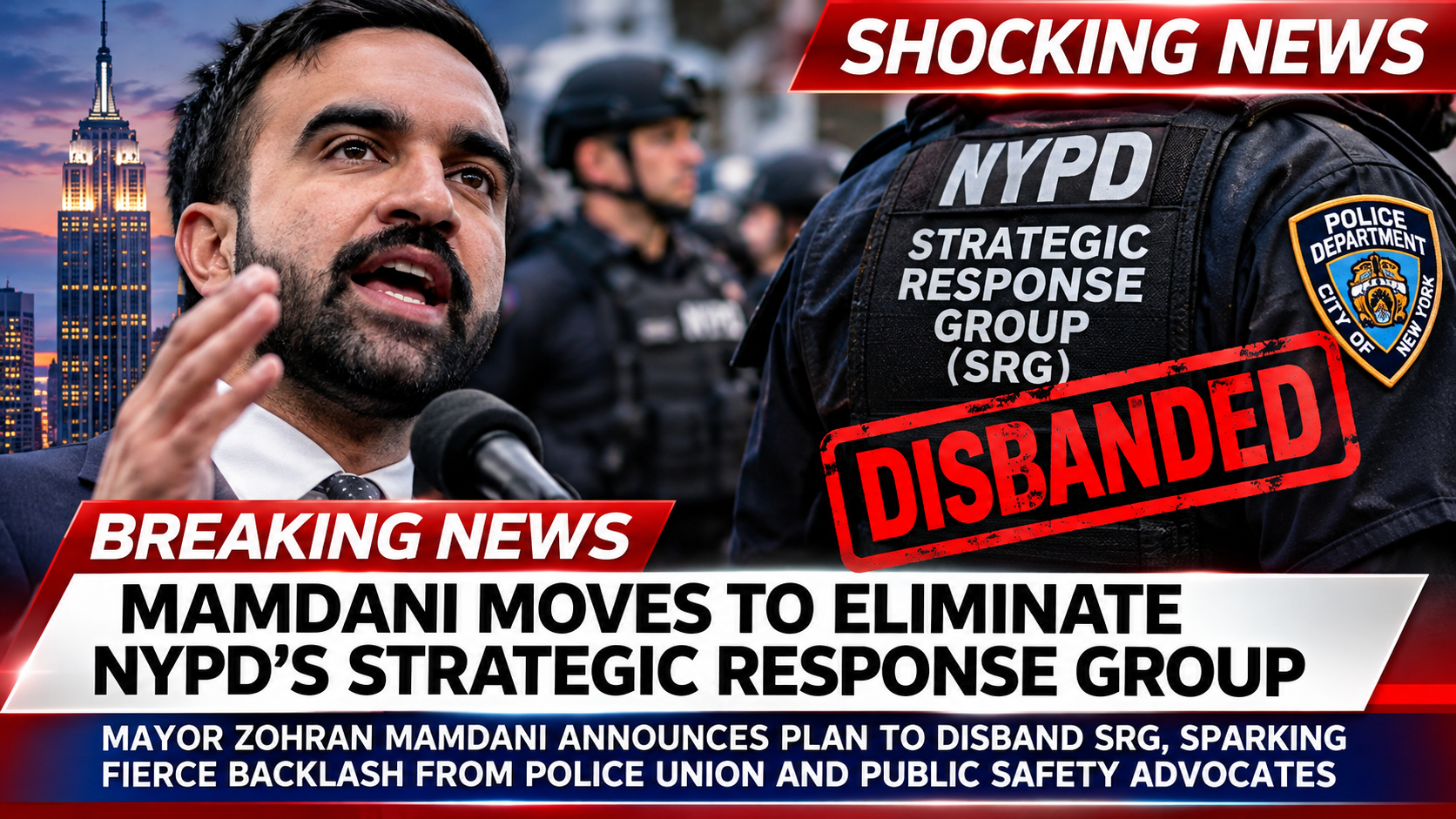
New York City Mayor Zohran Mamdani has announced the dismantling of one of the NYPD’s most specialized police units, triggering fierce criticism from law enforcement representatives who warn that the decision could undermine public safety in America’s largest city.
On November 16, 2026, Mamdani and NYPD Commissioner Jessica Tisch announced that the Strategic Response Group (SRG), a specialized unit responsible for responding to terrorism threats, major emergencies, violent disturbances and large demonstrations, would be disbanded and its responsibilities redistributed.
The announcement fulfills one of Mamdani’s campaign promises, but it also raises a serious question: Why dismantle an established police unit responsible for responding to some of the city’s most dangerous situations?
An Elite Police Unit Being Broken Apart
Established in 2015, the Strategic Response Group became a major component of the NYPD’s emergency response capabilities.
Its approximately 500 highly trained officers have handled assignments involving counterterrorism, crowd control, major public events and rapidly developing emergencies.
Unlike ordinary patrol officers, SRG personnel received specialized training and equipment designed for situations requiring coordinated police responses.
Under Mamdani’s restructuring plan, the unit’s counterterrorism responsibilities will move to the NYPD’s Intelligence and Counterterrorism Bureau.
Its crowd-management responsibilities will transfer to a newly established Patrol Support Division, while a separate civilian-led organization will help coordinate responses to demonstrations.
Although the administration insists that no police positions will be eliminated, the SRG itself is scheduled to disappear as a standalone unit in spring 2027.
For critics, keeping officers employed does not automatically answer questions about whether reorganizing a specialized unit will preserve its effectiveness.
Unarmed Civilians to Take a Larger Role
Perhaps the most controversial part of Mamdani’s announcement is the creation of a Community Dialogue and De-escalation Division.
The civilian-led division will operate within the Mayor’s Office of Community Safety and work with police personnel to communicate with protest organizers and reduce tensions.
Its employees will not carry weapons or possess arrest powers.
The NYPD will also establish a 30-officer First Amendment Support Team, trained in communication and de-escalation.
Police officers will retain responsibility for enforcement and arrests when necessary.
The administration argues that separating peaceful protest management from counterterrorism operations will improve police-community relations.
However, critics question whether emphasizing civilian mediation could create operational difficulties when peaceful demonstrations suddenly become violent.
Crowds can change rapidly, and police officers must sometimes make immediate decisions to protect innocent bystanders, businesses and fellow officers.
Whether the replacement structure can respond as effectively as the SRG remains unproven.
Police Union Sounds the Alarm
The Police Benevolent Association, which represents NYPD officers, has strongly condemned Mamdani’s decision.
PBA President Patrick Hendry accused the mayor of prioritizing political activists over public safety.
Hendry warned that the changes could leave ordinary New Yorkers vulnerable when demonstrations disrupt bridges, roadways and city streets.
His criticism reflects a broader concern among opponents of the restructuring: that political pressure is influencing decisions traditionally guided by law enforcement experience.
City Council Member Phil Wong also criticized the decision, arguing that New York should strengthen specialized police capabilities rather than dismantle existing units.
Wong has called for additional resources to address dangerous street takeovers and other disturbances.
The opposition is particularly significant because the SRG has served as a rapid-response resource beyond ordinary protest management.
Restrictions on Police Tactics
Mamdani’s overhaul also establishes restrictions on several crowd-control methods.
Officers will be prohibited from using kettling, a tactic that surrounds demonstrators and restricts their movement, during First Amendment activities.
The reforms also prohibit tear gas and long guns in those circumstances, restrict the general use of pepper spray for crowd management, and limit certain acoustic devices.
Supporters argue that these restrictions will prevent unnecessary confrontations and protect constitutional rights.
But the changes also raise questions about what options officers will have when demonstrations become dangerous.
There is an important distinction between protecting peaceful protesters and allowing criminal behavior to disrupt public safety.
Americans have a constitutional right to demonstrate, criticize government officials and express unpopular opinions.
They do not have a constitutional right to assault police officers, destroy property or endanger innocent people.
The challenge for Mamdani’s administration will be proving that its new restrictions do not interfere with officers’ ability to enforce those boundaries.
NYPD Commissioner Defends the Decision
Despite criticism from police unions, Commissioner Jessica Tisch has publicly supported the restructuring.
Tisch maintains that the changes will preserve the department’s ability to confront serious threats while strengthening counterterrorism operations.
She has also emphasized that the department will retain its officers and that the restructuring will not increase costs.
Those assurances are important, but they do not settle the debate.
The effectiveness of a specialized police unit depends on more than its number of officers. Training, leadership, coordination, equipment and operational readiness all matter.
Moving experienced personnel into different divisions may preserve their individual skills, but the city will still need to demonstrate that the replacement structure can function effectively during major emergencies.
A Political Promise With Real-World Consequences
Mamdani’s decision represents a significant shift in New York City’s approach to policing demonstrations.
Civil rights organizations have long criticized the SRG over allegations of excessive force and aggressive protest tactics.
The mayor believes dismantling the unit will address those concerns while preserving essential police functions.
His opponents see something different: an administration eliminating a proven specialized unit to fulfill a political campaign promise.
Both sides will ultimately be judged by what happens on New York City’s streets.
If the restructuring improves accountability while maintaining effective emergency responses, the administration will have evidence supporting its approach.
If the changes create confusion, delay police responses or make dangerous situations harder to control, responsibility will fall on the officials who approved them.
New Yorkers deserve both constitutional freedom and effective law enforcement. Neither should come at the expense of the other.
Mamdani has made his decision. Now his administration must prove that dismantling the Strategic Response Group will not come at the expense of public safety.