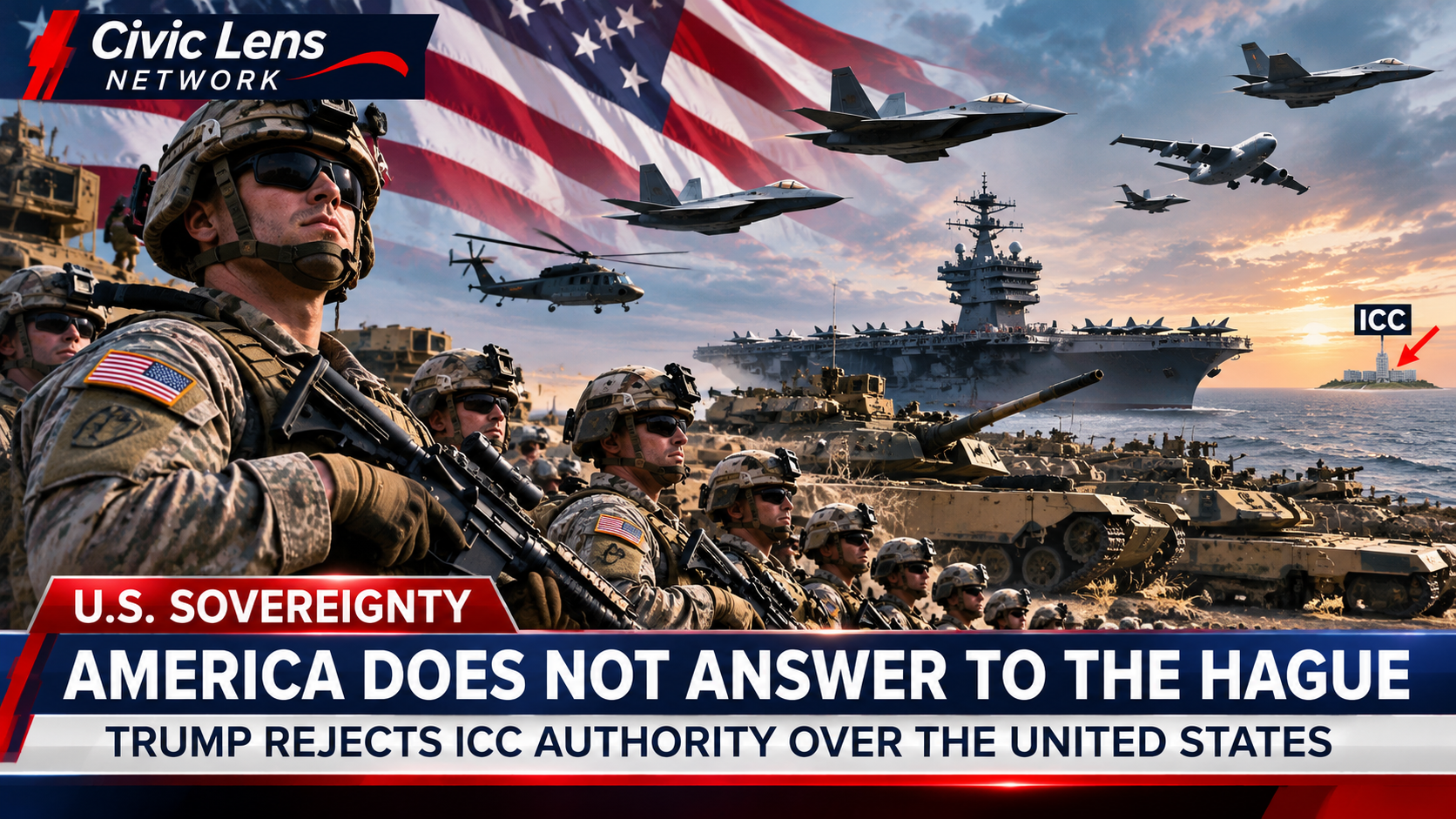
The United States of America possesses the world’s largest military budget, a global network of military installations, enormous economic influence and one of the most powerful armed forces in history.
Yet an international court headquartered in the Netherlands continues asserting that it can prosecute certain American citizens despite the United States never joining its founding treaty.
President Donald Trump has made his administration’s position unmistakable: The International Criminal Court has no jurisdiction over the United States.
This confrontation is about more than an international legal disagreement. It concerns American sovereignty, the authority of elected government and the limits of institutions operating beyond the United States Constitution.
Trump Has Already Rejected the Court’s Authority
On February 6, 2025, Trump signed Executive Order 14203, imposing sanctions on the International Criminal Court (ICC).
The order explicitly declared that the ICC has no jurisdiction over the United States or Israel because neither country belongs to the court.
Trump accused the institution of asserting illegitimate authority over American and allied personnel, including members of the military.
The administration authorized financial and travel restrictions targeting certain individuals connected to ICC proceedings.
This was not simply a presidential statement expressing disagreement.
It was an official executive action backed by sanctions authorities.
On January 20, 2026, Trump continued the national emergency concerning ICC actions for another year, reaffirming his administration’s opposition to the court’s efforts to investigate, arrest or prosecute protected personnel.
The United States Never Joined the ICC
The ICC was established under the Rome Statute, an international treaty adopted in 1998.
The court began operating in 2002 to prosecute genocide, war crimes, crimes against humanity and aggression.
The United States signed the treaty in 2000 but never ratified it. In 2002, Washington notified the United Nations that it did not intend to become a party.
That distinction is central to the current dispute.
The United States is not an ICC member state and has not accepted the treaty obligations imposed on participating countries.
The court nevertheless maintains that it can exercise criminal jurisdiction over individuals from nonmember countries when alleged crimes occur within the territory of a participating state, among other circumstances.
That position is grounded in Article 12 of the Rome Statute.
The Trump administration rejects the court’s claimed authority over American personnel.
The dispute does not give the ICC the power to govern the United States, overturn American legislation or command the American government as though it were a subordinate institution.
Congress Established Protections for American Personnel
American opposition to the ICC predates Trump’s presidency.
Congress enacted the American Servicemembers’ Protection Act in 2002, establishing restrictions on cooperation with the court and authorizing certain measures to protect American personnel.
The legislation reflected longstanding concerns about exposing American military members and officials to criminal proceedings before a tribunal outside the United States judicial system.
American servicemembers are subject to the Uniform Code of Military Justice and applicable federal law.
American courts and military authorities have responsibilities to investigate and prosecute serious wrongdoing.
The existence of those institutions is an important part of Washington’s argument that accountability does not require accepting ICC authority.
Military Power and Legal Authority Are Different Questions
America’s military and economic strength gives Washington substantial influence in international affairs.
It also gives the United States practical tools to resist international institutions whose actions conflict with American policy.
But military superiority does not, by itself, determine international criminal jurisdiction.
That question depends on treaties, territorial jurisdiction and other principles of international law.
The ICC maintains that its treaty permits certain proceedings involving citizens of nonmember countries. The Trump administration disputes the legitimacy of applying that authority to protected Americans and has taken concrete action against the court.
Those competing positions explain why the confrontation remains unresolved.
Washington’s Position Is Backed by Action
The Trump administration has not limited its response to criticism.
Its sanctions framework permits restrictions on designated ICC personnel, including blocking certain property interests and restricting entry into the United States.
Such measures can create significant financial and operational difficulties for individuals and institutions affected by American sanctions.
The United States also retains control over whether its own authorities cooperate with ICC investigations, subject to applicable domestic law.
That practical distinction matters.
An international tribunal may assert criminal jurisdiction over an individual, but it does not possess a police force capable of independently enforcing its warrants throughout the world.
The ICC depends heavily on cooperation from governments.
Without that cooperation, enforcing its decisions can become extremely difficult.
American Sovereignty Remains at the Center of the Dispute
The International Criminal Court was created to address some of the world’s gravest crimes.
Its supporters argue that international prosecutions are necessary when national governments are unwilling or unable genuinely to investigate atrocities.
The Trump administration maintains that the ICC has exceeded its legitimate authority by pursuing personnel from countries that have not accepted its jurisdiction.
Both positions have consequences for international relations and criminal accountability.
What is not disputed is that the United States remains a sovereign country with its own constitutional government, judicial system and armed forces.
The ICC cannot simply replace those institutions.
President Trump has formally rejected the court’s asserted authority over the United States and reinforced that position through executive orders, sanctions and the continuation of a national emergency.
The conflict now concerns how far the court can exercise its claimed jurisdiction over individuals and how aggressively Washington will resist.
America’s military strength makes its position internationally consequential. Its nonmembership in the ICC makes the legal disagreement fundamental.
And its government’s refusal to recognize the court’s authority over American personnel ensures that the dispute will remain a major confrontation between Washington and The Hague.