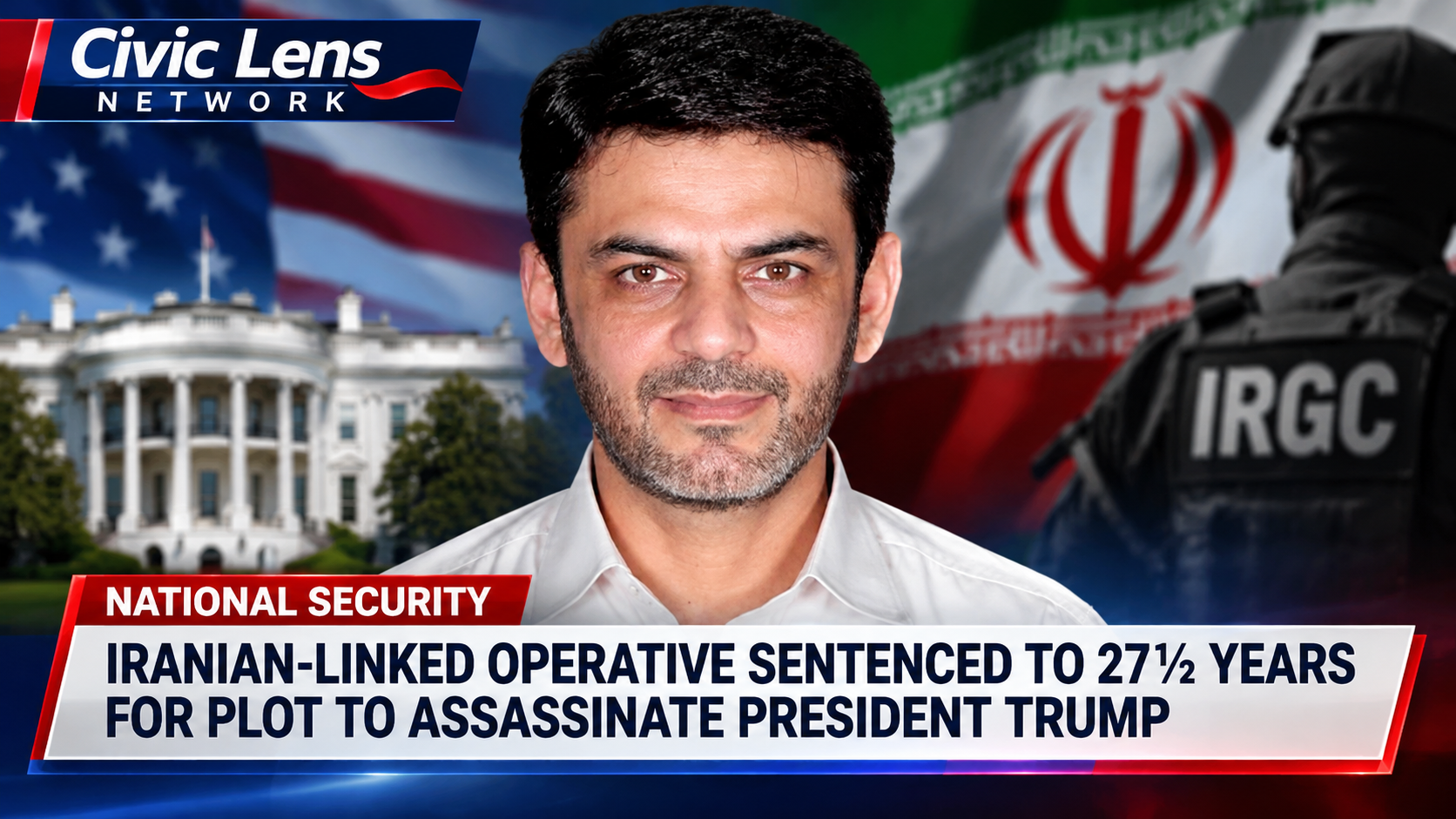
A Pakistani national trained by Iran’s Islamic Revolutionary Guard Corps has been sentenced to 27 years and six months in federal prison for orchestrating a terrorist assassination plot targeting President Donald Trump and other prominent American political figures.
The sentencing marks the conclusion of a major federal terrorism prosecution that exposed how an operative connected to Iran’s intelligence apparatus entered the United States, attempted to recruit professional killers and planned political assassinations during the 2024 presidential election.
Asif Merchant, 48, received the 330-month sentence Tuesday, November 17, 2026, from U.S. District Judge Eric R. Komitee in Brooklyn, New York.
Merchant was convicted by a federal jury in March 2026 of murder for hire and attempting to commit an act of terrorism transcending national boundaries.
Iran’s Assassination Mission Targeted American Leadership
According to federal prosecutors, Merchant voluntarily joined Iran’s Islamic Revolutionary Guard Corps, commonly known as the IRGC, around 2022.
The IRGC is a powerful Iranian military and intelligence organization that the United States has designated as a foreign terrorist organization.
Merchant admitted during his trial that he met with an Iranian intelligence handler approximately 15 times in Tehran between 2023 and 2024.
During those meetings, he received counterintelligence training and instructions to travel to the United States to organize political assassinations.
The ultimate target, according to Merchant’s own testimony, was Donald Trump.
Other potential targets included then-President Joe Biden and former United Nations Ambassador Nikki Haley.
Federal authorities determined that the operation was connected to Iran’s desire for revenge following the January 2020 American drone strike that killed Iranian military commander Qasem Soleimani in Iraq.
Trump ordered that strike during his first presidential administration.
Years later, Iranian operatives were still pursuing retaliation against American political leaders.
The Plot Unfolded Inside the United States
Merchant arrived in the United States in April 2024 after spending approximately one week in Iran.
He contacted an acquaintance and attempted to recruit him to assist with the assassination operation.
What Merchant did not know was that the acquaintance would report the suspicious activity to the FBI and subsequently cooperate with federal investigators.
The informant helped authorities document the developing conspiracy.
During a recorded conversation later presented to the jury, Merchant described how a political figure could be assassinated during a campaign rally.
He subsequently met three times with individuals he believed were professional killers.
Those individuals were actually undercover FBI agents.
Merchant explained that he was working with contacts overseas and wanted to arrange the killing of an American politician.
He eventually provided the undercover agents with $5,000 as an initial payment for the proposed assassination.
Federal investigators determined that the money had been obtained with assistance from relatives overseas.
The operation was stopped before an assassination attempt could take place.
Merchant was arrested in Texas in July 2024 as he prepared to leave the United States.
Investigators Uncovered Evidence Pointing Toward Trump
Federal investigators examined Merchant’s electronic devices and online activity, uncovering additional evidence connecting the operation to the 2024 presidential election.
His internet activity included searches involving political campaign rallies and a Google Maps search for the location of a Trump rally in New Jersey.
Investigators also identified social media posts praising Soleimani and criticizing Trump and the United States.
The evidence helped prosecutors establish that Merchant’s activities went beyond political rhetoric and involved concrete preparations for a murder-for-hire operation.
During the trial, Merchant argued that he had acted under pressure from Iranian intelligence officials because he feared for his family in Tehran.
Prosecutors disputed that explanation, presenting evidence of his willingness to participate in the conspiracy.
The jury ultimately convicted him.
Justice Department Delivers Warning to Foreign Terrorist Networks
Attorney General Todd Blanche welcomed the sentence, emphasizing that foreign operatives attempting to murder American leaders would face severe consequences.
Federal prosecutors described the case as an example of the danger posed by Iranian intelligence operations extending into the United States.
Joseph Nocella Jr., the U.S. attorney for the Eastern District of New York, said the sentence would prevent Merchant from carrying out another attack and should warn Iranian operatives against targeting Americans.
The FBI credited its investigative work and cooperation among multiple field offices with disrupting the assassination conspiracy.
The operation involved federal law enforcement personnel in New York, Texas and several other states, along with assistance from U.S. Customs and Border Protection.
A Foreign Terrorist Threat That Crossed America’s Borders
The Merchant case demonstrates how a foreign intelligence operation can move from overseas planning to attempted recruitment and financing inside the United States.
The conspiracy was not simply an expression of hostility toward American leadership. Federal investigators documented meetings, operational planning, communications with supposed assassins and an actual payment intended to advance a political killing.
It also highlights the continuing consequences of the 2020 strike against Soleimani, an operation that Iranian officials have repeatedly condemned.
Iran has denied plotting to assassinate Trump or other American officials, but the evidence presented in Merchant’s federal trial resulted in convictions on serious terrorism-related charges.
Although Trump was the principal anticipated target, the inclusion of Biden and Haley among possible targets underscores the broader threat posed by political assassination operations directed from abroad.
The case raises significant questions about foreign intelligence activity, counterterrorism enforcement and the ability of hostile governments to recruit operatives capable of entering the United States.
Merchant now faces more than a quarter-century in federal prison for his role in the failed conspiracy.
For American law enforcement, the outcome represents a successful disruption of a potentially devastating terrorist operation.
For foreign intelligence networks contemplating similar attacks, the sentence sends an unmistakable message: attempts to organize political assassinations on American soil can carry decades behind bars.