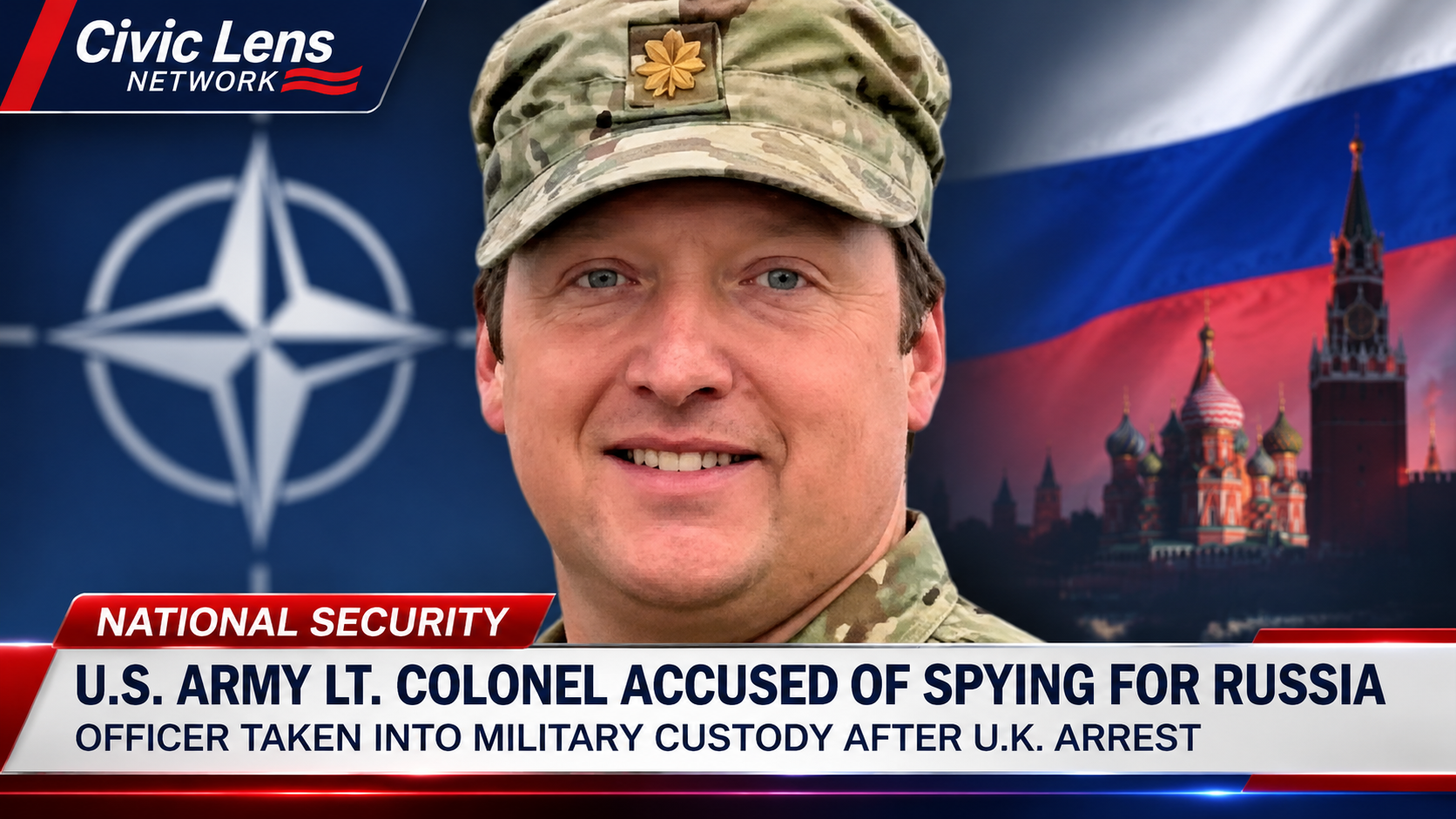
A United States Army lieutenant colonel assigned to a major NATO military headquarters in Britain has been taken into American military custody following his arrest on suspicion of espionage involving Russia, raising serious concerns about insider threats within the American armed forces and the security of sensitive military information.
Lieutenant Colonel Brandon Carroll Tyner, 41, was arrested November 10 in Gloucestershire, England, following a counterintelligence investigation involving British authorities, the FBI and the U.S. military.
British investigators suspect Tyner of assisting a foreign intelligence service and obtaining or disclosing protected information, potential violations of the United Kingdom’s National Security Act of 2023.
The suspected espionage activity was connected to Russia, according to British authorities.
On November 17, London’s Metropolitan Police confirmed that Tyner had been transferred into U.S. military custody, with American authorities assuming responsibility for continuing the investigation.
The development places the case directly in the hands of the United States military justice system.
American Officer Stationed at Major NATO Headquarters
Tyner was serving as a senior human resources officer assigned to NATO’s Allied Rapid Reaction Corps at Imjin Barracks near Gloucester, England.
The headquarters is an important military installation supporting NATO’s ability to organize and deploy multinational ground forces during emergencies and major military operations.
The British-led organization includes personnel from approximately 20 NATO nations and plays a significant role in coordinating allied military readiness.
Tyner joined the Army in 2008 and previously served overseas in Afghanistan, Iraq and Qatar.
His position within a multinational military headquarters has intensified concerns about what sensitive information he may have been able to access.
However, authorities have not publicly identified the specific information involved in the investigation or established that classified military intelligence was compromised.
A U.S. official previously indicated that no information had reached Russian authorities.
That distinction is important because investigators are examining suspected espionage activity, not announcing that Russian intelligence successfully obtained American military secrets.
FBI and British Intelligence Conduct Joint Investigation
The investigation involved cooperation between several major American and British security organizations.
Participating agencies included the FBI, British Counter Terrorism Policing, MI5, UK Defence Counter Intelligence and the U.S. Army Counterintelligence Command.
Investigators conducted searches at locations in Gloucestershire as part of their inquiry.
British authorities initially considered pursuing charges under their national security laws. Following consultations involving prosecutors, government officials and American authorities, the investigation was transferred to the United States.
Assistant Commissioner Laurence Taylor, who leads British Counter Terrorism Policing, described the allegations as extremely serious and emphasized that suspected espionage would receive a strong response.
The transfer does not mean the investigation has concluded or that Tyner has been convicted of wrongdoing.
American authorities are now expected to determine what charges, if any, should be pursued under military law.
FBI Director Issues Warning About Betrayal
FBI Director Kash Patel addressed the case following the transfer into American custody.
“This FBI has zero tolerance for anyone who betrays their oath to the United States or puts our national security at risk,” Patel stated.
Patel emphasized the cooperation between American and British investigators in identifying a potential national security threat.
Brigadier General Sean Stinchon, commanding general of the U.S. Army Counterintelligence Command, also warned about the seriousness of suspected betrayal within the military.
Stinchon said the investigation should serve as a warning to service members who might violate their oath to defend the Constitution.
His comments underscore the military’s responsibility to investigate suspected threats originating from individuals entrusted with positions of authority.
Russia Denies Any Connection
The Russian government has denied involvement in the case.
Kremlin spokesman Dmitry Peskov rejected suggestions that Moscow was connected to the American officer’s arrest.
Investigators have not publicly disclosed whether Tyner allegedly attempted to contact Russian intelligence personnel, what motivated the suspected conduct or what evidence authorities obtained during the investigation.
The case therefore remains an active national security investigation rather than a proven instance of intelligence successfully delivered to Moscow.
British police have also stated that Tyner’s arrest is unrelated to other ongoing counterterrorism investigations, including a separate suspected plot involving a military installation in Britain.
A Serious Test of Military Security
The allegations raise an important question for American military leadership: How effectively can the armed forces detect potential insider threats among personnel assigned to sensitive international military operations?
Senior officers serving at NATO headquarters can occupy positions of considerable trust, even when their primary responsibilities are administrative rather than operational.
The possibility of foreign intelligence services targeting military personnel presents a continuing challenge for American counterintelligence agencies.
In this case, the coordinated investigation and arrest may have prevented sensitive information from reaching a foreign adversary, according to the preliminary account provided by a U.S. official.
But the investigation must still establish exactly what happened.
Tyner remains a suspect, and the allegations against him have not been proven in court.
With the officer now in American military custody, the next major development will be whether military prosecutors formally bring charges and disclose additional evidence explaining the suspected espionage activity.
For the United States and its NATO allies, the case demonstrates why protecting military intelligence requires vigilance not only against threats outside military installations but also against potential threats from within.